What Is a Self-Directed IRA and What Can You Invest In?

Imagine unlocking a retirement account that lets you invest in rental properties, precious metals, or even cryptocurrency—all while enjoying the same tax advantages as a traditional IRA. That's the po...
The Lifetimes America editorial team curates, fact-checks, and updates guides on personal finance, property, health, immigration, legal, business, and lifestyle topics relevant to Lifetimes America readers. Articles are produced with AI assistance and reviewed by the editorial team before publication.
Imagine unlocking a retirement account that lets you invest in rental properties, precious metals, or even cryptocurrency—all while enjoying the same tax advantages as a traditional IRA. That's the power of a self-directed IRA (SDIRA), giving savvy Americans greater control over their wealth-building journey.
For those tired of being limited to stocks and bonds, an SDIRA opens doors to alternative assets that can diversify your portfolio and potentially boost returns. But with great flexibility comes greater responsibility. In this guide, we'll break down exactly what a self-directed IRA is and what you can invest in, tailored for U.S. investors navigating 2026 rules.
What Is a Self-Directed IRA?
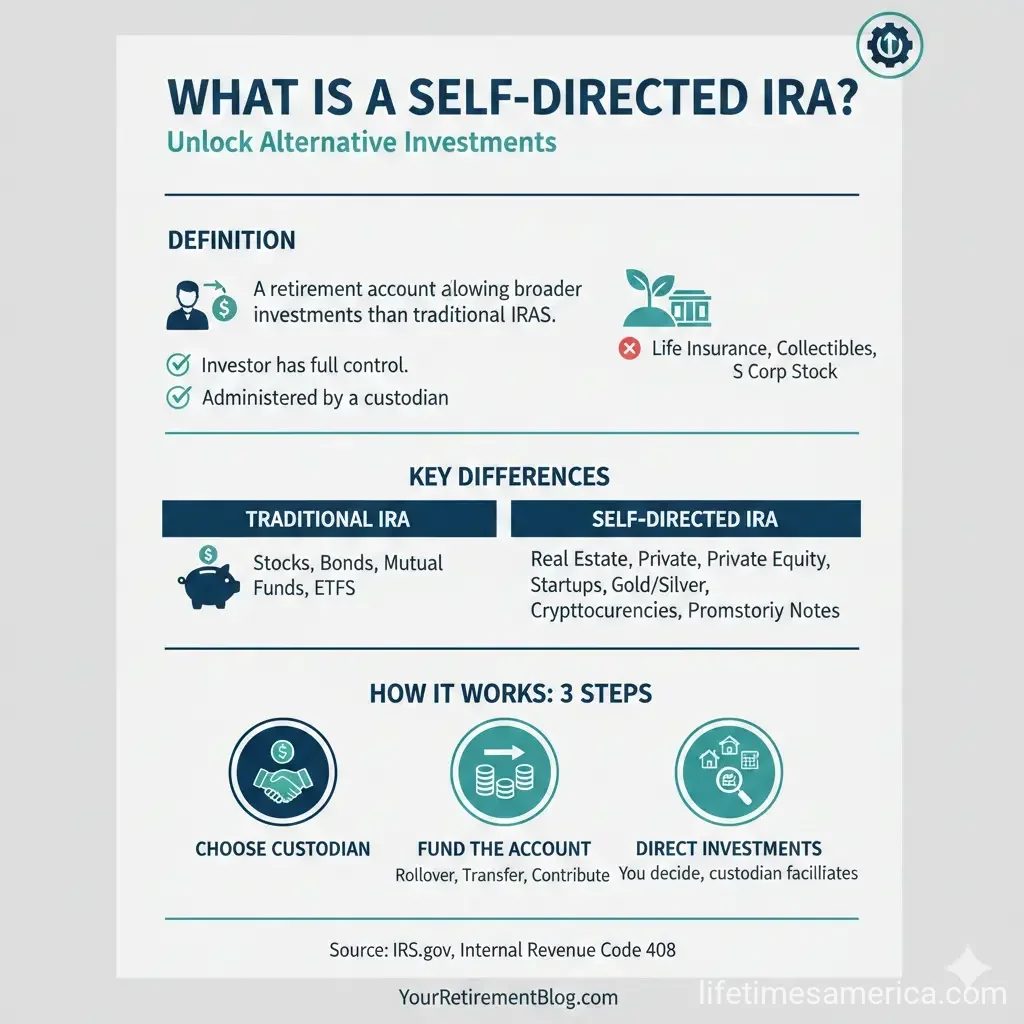
A self-directed IRA is a type of individual retirement account (IRA) that allows you to invest in a broader range of assets beyond the stocks, bonds, and mutual funds offered by conventional IRAs. It's not a unique account type—it's a standard IRA (traditional or Roth) held by a specialized custodian who permits alternative investments.
Like regular IRAs, SDIRAs follow IRS rules on contributions, distributions, and taxes. For 2026, the annual contribution limit remains $7,000 for those under 50, plus $1,000 catch-up for those 50 and older, subject to income phase-outs. Traditional SDIRAs offer tax-deductible contributions with taxed withdrawals, while Roth versions provide tax-free growth and distributions if rules are met.
Key Differences from Traditional IRAs
- Investment Control: You call the shots on alternatives like real estate or private equity, not a broker.
- Custodian Role: They handle compliance and paperwork but offer no investment advice—due diligence is on you.
- Tax Perks: Identical to standard IRAs, including rollover options from 401(k)s without penalties.
This setup suits hands-on investors who want to leverage expertise in niche markets for retirement growth.
How Does a Self-Directed IRA Work?
SDIRAs operate through a custodian—a bank, trust company, or IRS-approved entity—that holds your assets and ensures IRS compliance. You direct investments, but all transactions must go through them to avoid prohibited rules.
Step-by-Step Setup Process
- Choose a Custodian: Select one experienced in alternatives, like those specializing in real estate SDIRAs. Compare fees, as they can range from $50 to $500 annually plus transaction costs.
- Open the Account: Submit an application with ID, choose traditional or Roth, and name beneficiaries. Approval takes days.
- Fund It: Contribute cash, rollover from a 401(k) or IRA, or transfer assets. Rollovers are tax-free if direct.
- Invest: Direct the custodian to buy your chosen assets. For example, use funds to purchase rental property titled in the IRA's name.
Two main structures exist: full-service (custodian handles everything, slower with fees) or checkbook control (via an LLC for faster deals).
What Can You Invest In with a Self-Directed IRA?
SDIRAs expand beyond Wall Street staples. You can hold virtually any IRS-permitted asset, fueling diversification.
Allowed Investments
- Real Estate: Rental properties, land, flips (no personal use). Example: Buy $150,000 land in your Roth SDIRA; if it appreciates to $400,000 with $200,000 rent over 20 years, withdraw $650,000 tax-free.
- Precious Metals: Gold, silver (not collectibles).
- Cryptocurrency: Bitcoin, Ethereum via compliant exchanges.
- Private Equity & Notes: Venture capital, promissory notes, tax liens.
- Commodities & More: Timber, oil, private businesses (non-S-corp).
Prohibited Investments
IRS rules ban "disqualified" assets to prevent self-dealing:
- Life insurance contracts.
- Collectibles (art, antiques, rugs, stamps, most metals/coins).
- S corporation stock.
- Personal-use property (your vacation home).
Prohibited transactions—like lending IRA money to family—trigger taxes and penalties up to 15% plus account disqualification.
Advantages and Risks of Self-Directed IRAs
Top Benefits
- Diversification: Hedge against stock market volatility with real assets.
- Higher Return Potential: Leverage your real estate savvy tax-deferred.
- Tax Advantages: Same as IRAs—deduct contributions or tax-free Roth growth.
Key Risks
SDIRAs demand expertise. FINRA warns of fraud, illiquidity, and no custodian oversight on investment quality. You're solely responsible for due diligence—verify deals, project cash flows, and watch for scams promising outsized returns.
"Investments in these kinds of assets have unique risks... including a lack of information and liquidity—and the risk of fraud."
Fees add up: setup ($50+), annual ($200+), transactions ($100+ per deal).
IRS Rules and Regulations for 2026
All SDIRAs must follow IRS guidelines. Contributions phase out at higher incomes (e.g., Roth: $146,000-$161,000 single filers). Required minimum distributions (RMDs) start at age 73 for traditional SDIRAs.
Report via Form 1099-R for distributions; custodians handle 5498 for contributions. Use IRS.gov for updates.
Practical Tips for Getting Started
- Consult a tax pro or financial advisor familiar with SDIRAs before rolling over funds.
- Start small: Test with precious metals before jumping into real estate.
- Choose custodians via FINRA/Better Business Bureau checks.
- Track expenses: All costs (repairs, taxes) must come from the IRA, not your pocket.
- Document everything to prove arm's-length transactions.
Next Steps to Launch Your Self-Directed IRA
Ready to take control? Research custodians today, crunch numbers on your dream investments, and speak with a tax advisor to align with your 2026 goals. With discipline, an SDIRA can supercharge your retirement—diversify wisely and stay IRS-compliant for tax-free wealth.
Frequently Asked Questions
Sources & References
-
1
Self-Directed IRA (SDIRA): How It Works and Where to Open One — NerdWallet — www.nerdwallet.com
-
2
Self Directed Ira Land 2026: Complete Guide — The Land Geek — www.thelandgeek.com
-
3
What Is a Self-Directed IRA and How Does It Work? — SmartAsset — smartasset.com
-
4
Why Every American Should Have a Self-Directed IRA — IRA Financial — www.irafinancial.com
-
5
What Is a Self-Directed IRA? — STRATA Trust Company — www.stratatrust.com
- 6
- 7
Related Articles

How to Protect Your Assets Before You Need Nursing Home Care
Imagine working a lifetime to build your nest egg, only to watch it vanish paying for nursing home care. In the United States, the average cost of a private room in a nursing home exceeds $100,000 per...

What Is a Gold IRA and Is It a Good Investment?
If you're looking to diversify your retirement portfolio beyond traditional stocks and bonds, a gold IRA might be worth considering. This self-directed retirement account allows you to hold physical p...

Best Online Brokers for Beginner Investors in the USA
Starting your investing journey doesn't have to be overwhelming. With the right online broker, you can build wealth through stocks, ETFs, and more—without hidden fees or complex tools holding you back...

Investment Property Loans: How to Finance a Rental Property
Imagine turning a spare $50,000 into a steady stream of rental income that builds your wealth over time. That's the power of investment property loans—they let you leverage borrowed money to buy renta...