Investment Property Loans: How to Finance a Rental Property

Imagine turning a spare $50,000 into a steady stream of rental income that builds your wealth over time. That's the power of investment property loans—they let you leverage borrowed money to buy renta...
The Lifetimes America editorial team curates, fact-checks, and updates guides on personal finance, property, health, immigration, legal, business, and lifestyle topics relevant to Lifetimes America readers. Articles are produced with AI assistance and reviewed by the editorial team before publication.
Imagine turning a spare $50,000 into a steady stream of rental income that builds your wealth over time. That's the power of investment property loans—they let you leverage borrowed money to buy rental properties that generate cash flow and appreciate in value. Whether you're eyeing a single-family home in Texas or a duplex in Florida, financing a rental property in 2026 requires understanding the right loan types, qualification hurdles, and strategies to secure the best terms.
In this guide, we'll break down everything you need to know about investment property loans, from conventional mortgages to alternative options, tailored for American investors. With conforming loan limits rising to $832,750 for one-unit properties in most areas—and up to $1,249,125 in high-cost markets—this could be an ideal time to expand your portfolio.
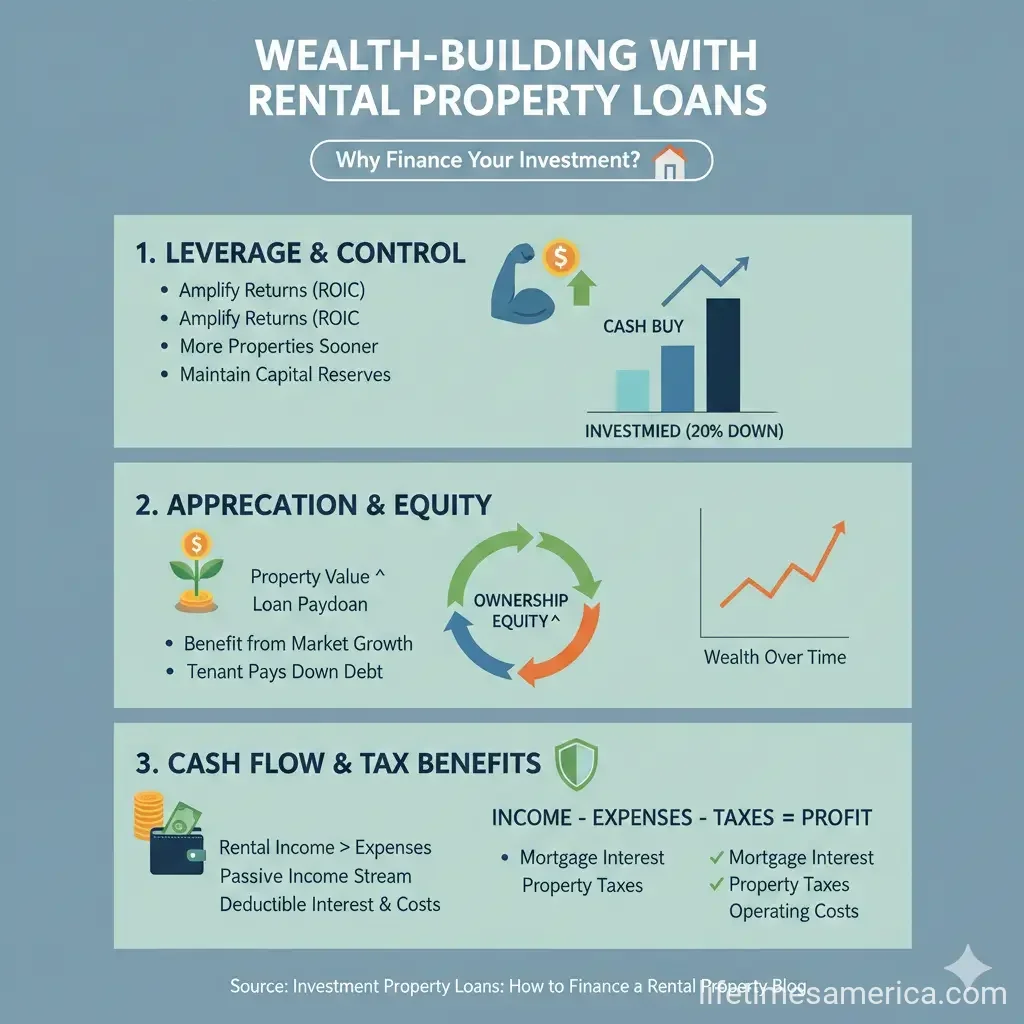
Why Finance a Rental Property? The Wealth-Building Case
Rental properties offer dual income: monthly rent covers your mortgage and expenses, while appreciation grows your equity. In 2026, with home values stabilizing in many markets, savvy investors use leverage to amplify returns. For instance, a $300,000 property with 20% down ($60,000) could yield $1,500 monthly net cash flow at 75% occupancy, paying off your loan while building equity.
Key benefits include tax deductions on mortgage interest, property taxes, and depreciation via IRS Schedule E. Always consult a tax pro or visit irs.gov for the latest rules.
Types of Investment Property Loans Available in 2026
Not all mortgages suit rentals. Primary residence loans have laxer rules, but investment loans demand stronger finances. Here's a breakdown of top options:
Conventional Loans: The Go-To Choice
Backed by Fannie Mae and Freddie Mac, these finance 1-4 unit properties up to the 2026 conforming limits ($832,750 baseline). Expect:
- Minimum 15-25% down payment (15% for 1-unit, 25% for 2-4 units)
- Credit score of 620+ (higher for better rates)
- DTI ratio up to 45-50%
- 6-12 months cash reserves
Rental income from an appraisal can offset your DTI, making qualification easier if market rents are strong.
Government-Backed Loans: Limited but Useful
FHA loans allow 1-4 units with 3.5% down if your credit is 580+, but they're rare for pure investments—lenders often require owner-occupancy history for refinances. VA loans follow similar rules for veterans.
DSCR Loans: Investor-Friendly Alternative
Debt Service Coverage Ratio (DSCR) loans qualify based on property income, not yours. Ideal if self-employed. Requirements: 1.0-1.25x DSCR, 20-30% down, 660+ credit.
Portfolio and Private Loans: For Non-Traditional Deals
Banks hold these in-house, offering flexibility for 5+ units or fix-and-flips. Private lenders prioritize experience: 20-30% down, 3-6 months reserves, faster closings.
| Feature | Primary Residence Loan | Investment Property Loan |
|---|---|---|
| Minimum Down Payment | As low as 3% | Typically 15–25% |
| Credit Score Requirement | 580–620+ | 620–680+ |
| Cash Reserve Requirement | Low or none | 6–12 months of mortgage reserves |
Qualification Requirements for Investment Property Loans
Lenders view rentals as riskier, so standards are tougher. Here's what you'll need in 2026:
- Credit Score: 620 minimum; 680+ unlocks better rates and lower down payments.
- Down Payment: 15-25% to avoid PMI; higher for multi-unit.
- DTI Ratio: 43-50% max, factoring rental offsets.
- Cash Reserves: 6+ months PITI (principal, interest, taxes, insurance).
- Income Proof: W-2s, tax returns, pay stubs; leases for existing rentals.
- Appraisal: Includes market rent analysis.
Pro tip: Boost approval odds by paying down debt or adding a co-signer with strong credit.
Step-by-Step: How to Get an Investment Property Loan
- Check Your Finances: Pull your credit report at AnnualCreditReport.com. Aim for 700+ FICO.
- Calculate Affordability: Use DTI formula: (monthly debts + PITI) / gross income ≤ 45%.
- Gather Documents: 2 years tax returns, bank statements, asset proofs.
- Get Preapproved: Shop lenders like Rocket Mortgage or PennyMac for quotes.
- Find the Property: Focus on cash-flow positive areas via Zillow or Realtor.com.
- Appraisal & Underwriting: Expect rental comps; close in 30-45 days.
Preapproval strengthens offers and locks rates amid 2026's competitive market.
Costs and Considerations for Rental Financing
Beyond down payments, budget 2-5% closing costs, plus landlord insurance. No PMI with 20%+ down. Factor vacancy (5-10%) and maintenance (1% of value/year). Use tools like the BiggerPockets calculator for projections.
In high-cost areas (e.g., California), leverage higher limits up to $1,249,125.
"Rental income can help you qualify, based upon the current rental market value."
Common Mistakes to Avoid
- Underestimating reserves—stock 6-12 months.
- Ignoring DSCR—ensure rents cover 1.25x PITI.
- Skipping inspections—hidden repairs kill cash flow.
- Over-leveraging—limit to 4 financed properties per lender guidelines.
Ready to Finance Your Rental Empire?
Investment property loans make wealth building accessible if you're prepared. Start by pulling your credit, crunching numbers, and getting preapproved today. Connect with a local lender or use resources like consumerfinance.gov to compare options. Your first rental could be the foundation of financial freedom—act now in this favorable 2026 market.
Frequently Asked Questions
Sources & References
-
1
Minimum Mortgage Requirements for 2025 — lendingtree.com — www.lendingtree.com
-
2
What are investment property loans? Exploring your options — rocketmortgage.com — www.rocketmortgage.com
- 3
-
4
Investment Property Loans - Eligibility, Benefits & Apply — pennymac.com — www.pennymac.com
-
5
How to Find the Best Loan for Your Rental Property in 2026 — parkplacefinance.com — parkplacefinance.com
- 6
-
7
Mortgages for Investment & Rental Properties — freedommortgage.com — www.freedommortgage.com
Useful Tools
Related Articles

What Is a Self-Directed IRA and What Can You Invest In?
Imagine unlocking a retirement account that lets you invest in rental properties, precious metals, or even cryptocurrency—all while enjoying the same tax advantages as a traditional IRA. That's the po...

How to Protect Your Assets Before You Need Nursing Home Care
Imagine working a lifetime to build your nest egg, only to watch it vanish paying for nursing home care. In the United States, the average cost of a private room in a nursing home exceeds $100,000 per...

What Is a Gold IRA and Is It a Good Investment?
If you're looking to diversify your retirement portfolio beyond traditional stocks and bonds, a gold IRA might be worth considering. This self-directed retirement account allows you to hold physical p...

Best Online Brokers for Beginner Investors in the USA
Starting your investing journey doesn't have to be overwhelming. With the right online broker, you can build wealth through stocks, ETFs, and more—without hidden fees or complex tools holding you back...