Best Online Brokers for Beginner Investors in the USA

Starting your investing journey doesn't have to be overwhelming. With the right online broker, you can build wealth through stocks, ETFs, and more—without hidden fees or complex tools holding you back...
The Lifetimes America editorial team curates, fact-checks, and updates guides on personal finance, property, health, immigration, legal, business, and lifestyle topics relevant to Lifetimes America readers. Articles are produced with AI assistance and reviewed by the editorial team before publication.
Starting your investing journey doesn't have to be overwhelming. With the right online broker, you can build wealth through stocks, ETFs, and more—without hidden fees or complex tools holding you back. In 2026, these platforms make it easier than ever for beginners in the USA to dive in confidently.
Why Choose an Online Broker as a Beginner Investor?
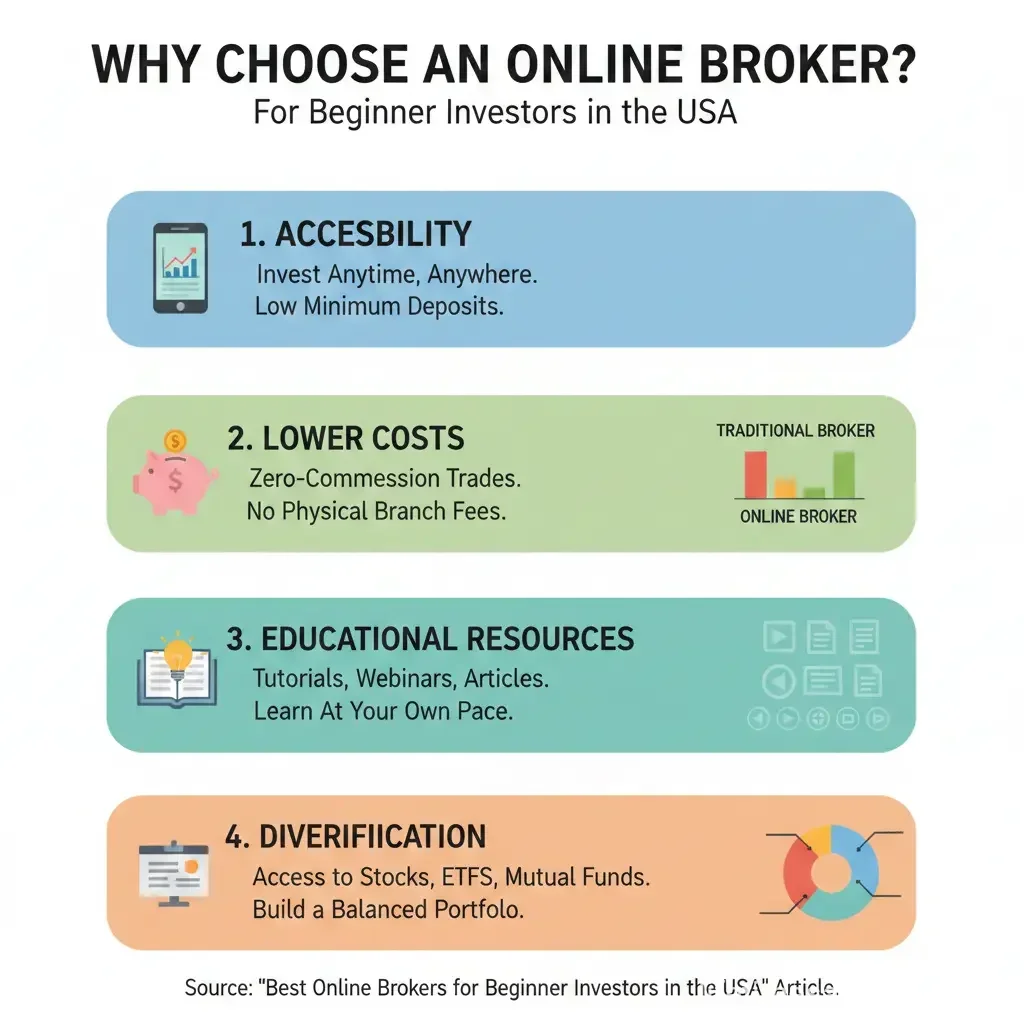
Online brokers have revolutionized investing by offering commission-free trades, user-friendly apps, and educational resources tailored for newcomers. Unlike traditional brokers, they let you open an account with $0 minimums and trade U.S. stocks and ETFs at no cost. This accessibility helps Americans grow their 401(k) alternatives or taxable accounts while learning the ropes.
Key benefits include:
- Low or no fees: Most charge $0 per stock and ETF trade in 2026.
- Educational tools: Tutorials, webinars, and paper trading simulate real markets risk-free.
- Mobile-first apps: Trade from your phone, perfect for busy lifestyles.
- Fractional shares: Buy portions of pricey stocks like Apple or Tesla with small amounts.
Regulated by the SEC and FINRA, these brokers protect your funds through SIPC insurance up to $500,000 per account. Always verify a broker's status on sec.gov or finra.org before funding.
Top Criteria for Selecting the Best Online Brokers for Beginners
We evaluated platforms based on ease of use, fees, education, promotions, and customer support—drawing from 2026 reviews. Prioritize brokers with intuitive interfaces, robust learning centers, and no account minimums to match beginner needs.
Fees and Commissions
Expect $0 commissions on U.S. stocks, ETFs, and often options. Watch for options contract fees ($0.50–$0.65) or inactivity charges—rare for top picks.
Educational Resources
Look for video libraries, articles, and demo accounts. Platforms like Fidelity offer thousands of free courses on everything from Roth IRAs to dividend investing.
Mobile App and Platform Usability
A seamless app is crucial. Robinhood and Webull shine here with clean designs for quick trades.
Promotions and Bonuses
Many offer free stocks or cash bonuses for funding new accounts—up to $1,500 in 2026.
Our Top Picks: Best Online Brokers for Beginner Investors in the USA (2026)
Here are the standout brokers for 2026, ranked for beginners. Each excels in key areas while keeping things simple and cost-effective.
1. Fidelity: Best Overall for Beginners
Fidelity tops lists with a 5.0/5 rating for its all-in-one platform. Trade stocks, ETFs, and fractional shares commission-free. No account minimum or promotion right now, but its education center includes planning tools for IRAs and 529 plans.
- Pros: Extensive research, 24/7 support, robo-advisor option.
- Cons: No current signup bonus.
- Best for: Long-term learners building diversified portfolios.
2. Charles Schwab: Best for Practice Investing
Charles Schwab earns high marks for its thinkorswim paper trading—practice without real money. $0 trades, no minimums, and integration with banking services.
- Pros: ETF focus, strong mobile app, advisor access.
- Cons: Complex mutual fund fees.
- Best for: Hands-on practice before live trading.
3. E*TRADE: Best for Investor Education
Score 4.5/5 for education with interactive courses and a $1,500 bonus for new funded accounts. $0 stocks/ETFs, advanced screening tools simplify stock picks.
- Pros: Mobile app excellence, options trading intro.
- Cons: $500 minimum for robo-advisor.
- Best for: Education-focused starters eyeing options.
4. Robinhood: Best for Seamless Platform
Robinhood's app offers 4.5/5 simplicity with free stock (worth $5–$200) on signup. Ideal for quick trades in stocks and crypto.
- Pros: No fees, fractional shares, 24/7 trading.
- Cons: Limited research tools.
- Best for: Mobile-first millennials.
5. SoFi Active Investing: Best for Advisor Access
4.6/5 rating with up to $1,000 bonus and free advisor consultations. Combines investing with loans and banking.
- Pros: Holistic financial dashboard, no fees.
- Cons: Fewer advanced tools.
- Best for: Beginners wanting guidance.
6. Vanguard: Best for Passive Investing
Perfect for low-cost index funds with $0 trades. Pairs well with IRAs for tax advantages.
- Pros: Ultra-low expense ratios, advisor matching.
- Cons: $100 robo minimum, basic platforms.
- Best for: Buy-and-hold strategies.
Other Strong Contenders
- M1 Finance: Automated pie investing for custom portfolios.
- Wealthfront: Robo-advisor with tax-loss harvesting.
- Webull: Mobile trading with extended hours.
- Betterment: Hands-off with no stock picking.
Comparison Table: Best Online Brokers for Beginners
| Broker | Best For | Stock/ETF Trades | Minimum | Promotion | Rating |
|---|---|---|---|---|---|
| Fidelity | Overall | $0 | $0 | None | 5.0/5 |
| Charles Schwab | Practice | $0 | $0 | Varies | Top-rated |
| E*TRADE | Education | $0 | $0 | Up to $1,500 | |
| Robinhood | Seamless App | $0 | $0 | Free Stock | 4.5/5 |
| SoFi | Advisors | $0 | $0 | Up to $1,000 | 4.6/5 |
| Vanguard | Passive | $0 | $0 | Varies | Top for Funds |
Practical Tips for Getting Started with Online Brokers
Follow these steps to launch your portfolio:
- Open an account: Provide SSN, ID, and link a bank—takes 10 minutes.
- Fund it: Start with $100–$500 via ACH transfer (free, 1–3 days).
- Practice first: Use demo modes on Schwab or Fidelity.
- Diversify: Buy ETFs like VTI (total market) or SPY (S&P 500).
- Set up IRAs: Contribute up to $7,000 in 2026 for tax perks (check irs.gov).
- Monitor taxes: Track 1099 forms for capital gains.
Avoid day trading as a beginner—focus on long-term holds to minimize risks and taxes.
Next Steps to Build Your Wealth
Pick one broker from our list, like Fidelity for its balance of tools and ease. Open an account today, fund it, and invest in a broad ETF. Track progress monthly, and consider a financial advisor via SoFi once you're comfortable. Consistent investing through market ups and downs is your path to financial freedom—start small and scale up.
Frequently Asked Questions
Sources & References
-
1
Best Brokers for Beginner Investors: Top Picks for 2026 - NerdWallet — www.nerdwallet.com
-
2
6 Best Online Trading Platforms of 2026 - Money — money.com
-
3
7 Best Stock Brokers for 2026 - StockBrokers.com — www.stockbrokers.com
-
4
Ranking The Best Stock Brokers in 2026! - (Tier List) - YouTube — www.youtube.com
Useful Tools
Related Articles

What Is a Self-Directed IRA and What Can You Invest In?
Imagine unlocking a retirement account that lets you invest in rental properties, precious metals, or even cryptocurrency—all while enjoying the same tax advantages as a traditional IRA. That's the po...

How to Protect Your Assets Before You Need Nursing Home Care
Imagine working a lifetime to build your nest egg, only to watch it vanish paying for nursing home care. In the United States, the average cost of a private room in a nursing home exceeds $100,000 per...

What Is a Gold IRA and Is It a Good Investment?
If you're looking to diversify your retirement portfolio beyond traditional stocks and bonds, a gold IRA might be worth considering. This self-directed retirement account allows you to hold physical p...

Investment Property Loans: How to Finance a Rental Property
Imagine turning a spare $50,000 into a steady stream of rental income that builds your wealth over time. That's the power of investment property loans—they let you leverage borrowed money to buy renta...