Health Savings Accounts (HSA): The Triple-Tax Advantage Secret

Imagine slashing your tax bill today, watching your savings grow tax-free, and pulling money out tax-free for healthcare in retirement—that's the power of a Health Savings Account (HSA). With healthca...
The Lifetimes America editorial team curates, fact-checks, and updates guides on personal finance, property, health, immigration, legal, business, and lifestyle topics relevant to Lifetimes America readers. Articles are produced with AI assistance and reviewed by the editorial team before publication.
Imagine slashing your tax bill today, watching your savings grow tax-free, and pulling money out tax-free for healthcare in retirement—that's the power of a Health Savings Account (HSA). With healthcare costs projected to eat up a bigger chunk of your retirement budget, HSAs stand out as the triple-tax advantage secret every American should know about in 2026.
Whether you're dealing with high-deductibles, planning for Medicare gaps, or building a tax-smart nest egg, an HSA offers unmatched flexibility. Let's break down how it works, who qualifies, and why it's a game-changer for tackling medical debt and securing your financial future.
What is a Health Savings Account (HSA)?
A Health Savings Account (HSA) is a tax-advantaged savings account designed for people with high-deductible health plans (HDHPs). It lets you set aside pre-tax dollars for qualified medical expenses, and the money rolls over year after year—it's yours to keep, even if you change jobs or retire.
Unlike flexible spending accounts (FSAs) that expire unused funds annually, HSAs grow like an investment account. You can use the funds anytime for eligible costs, from doctor visits to prescriptions, and invest the balance for long-term growth.
Key Eligibility Rules for 2026
To open and contribute to an HSA, you must meet these IRS requirements:
- Be enrolled in an HDHP with a minimum deductible of $1,650 for self-only or $3,300 for family coverage in 2026 (exact minimums updated annually by IRS).
- Have no other health coverage that isn't an HDHP, like a spouse's low-deductible plan.
- Not be enrolled in Medicare or claimed as a dependent on someone else's tax return.
Exciting news for 2026: Thanks to expansions under the One Big Beautiful Bill (OBBB), more plans qualify, including all Bronze and Catastrophic plans on Healthcare.gov. This opens HSAs to millions more Americans, even if you qualify for premium tax credits.
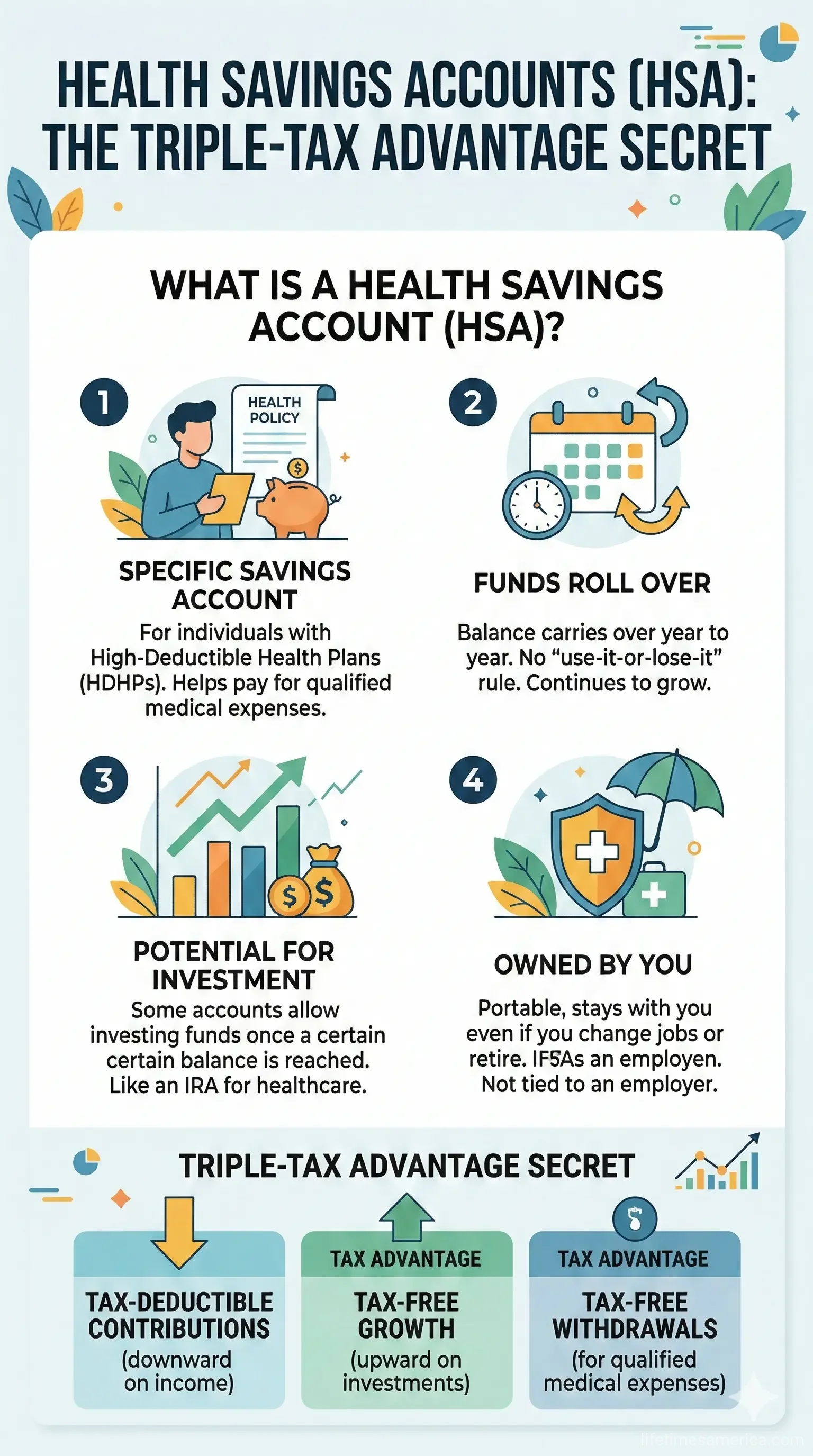
The Triple-Tax Advantage: Why HSAs Beat Other Accounts
HSAs deliver a rare triple-tax advantage that outshines 401(k)s, IRAs, and even Roth accounts: contributions go in tax-free, growth is tax-free, and qualified withdrawals are tax-free.
1. Tax-Deductible Contributions
Every dollar you contribute reduces your taxable income. For 2026, limits are $4,400 for individual coverage and $8,750 for family (2+ people). If you're 55 or older, add a $1,000 catch-up contribution.
Contributions via payroll dodge federal income tax and FICA taxes (Social Security and Medicare)—a double savings worth 7.65% extra for most workers. Someone in the 37% bracket maxing a family HSA could save over $3,200 in taxes alone.
Employers often chip in too: For example, Dartmouth contributes $500 (individual) or $1,000 (family), prorated for new hires, counting toward your limit.
2. Tax-Free Growth
Park your HSA cash in low-risk options or invest in stocks, bonds, or mutual funds through providers like Fidelity. Earnings compound tax-free, with no capital gains hits.
Unlike taxable brokerage accounts, you pay nothing on dividends, interest, or appreciation as long as funds stay in the HSA.
3. Tax-Free Withdrawals for Qualified Expenses
Use funds penalty-free for a broad range of costs: deductibles, copays, dental, vision, prescriptions, and even Medicare premiums (Parts B, D, and Medicare Advantage) in retirement. Long-term care insurance and COBRA premiums also qualify.
Non-qualified withdrawals before age 65 incur income tax plus a 20% penalty; after 65, just income tax—like a traditional IRA.
2026 Contribution Limits and Strategies
The IRS bumped limits for 2026 to keep pace with rising costs, giving you more room to save.
| Coverage Type | 2026 Limit | Catch-Up (55+) |
|---|---|---|
| Individual | $4,400 | $1,000 |
| Family | $8,750 | $1,000 |
Actionable Tip: Front-load contributions early in the year via payroll for maximum tax savings all 12 months. You can contribute through December 31, 2026, or until your tax filing deadline for 2026.
- Max out if possible—pair with 401(k) contributions for layered tax breaks.
- Save receipts: Reimburse past qualified expenses tax-free anytime, letting funds grow meanwhile.
- Shop providers: Banks like HSA Bank or investment firms like Fidelity offer low-fee investing options.
HSAs in Retirement: Your Secret Weapon Against Medical Debt
Healthcare eats 15% of average retiree budgets, but HSAs shine here—no required minimum distributions (RMDs) like 401(k)s, so funds grow indefinitely.
Post-65, use tax-free for Medicare gaps (not Medigap premiums) or pay income tax on non-medical uses. Fidelity estimates maxing an HSA plus 401(k)/IRA over 20 years could yield massive tax savings.
"HSAs offer flexibility to cover qualified medical expenses without dipping into your retirement accounts."
Treat it as a "health IRA": Invest aggressively now, reimburse later. It's portable, so it follows you from job to job or into retirement.
Practical Tips to Maximize Your HSA
- Choose the right HDHP: Compare on Healthcare.gov—Bronze/Catastrophic now HSA-eligible with premium tax credits.
- Invest wisely: Allocate beyond cash once you hit your deductible; aim for diversified, low-cost index funds.
- Track expenses: Apps like HSA Bank's help log receipts for future reimbursements.
- Employer match: If offered, it's free money—always contribute enough to get it.
- Avoid pitfalls: No Medicare? Lose eligibility. Plan switches? Confirm HDHP status.
Start Unlocking Your Triple-Tax Advantage Today
Don't let medical debt derail your retirement—open an HSA if eligible, max contributions, and invest for the long haul. Check Healthcare.gov or IRS.gov for your HDHP options, and consult a tax pro to personalize. With 2026's higher limits and broader eligibility, now's the time to claim this Health Savings Accounts (HSA): The Triple-Tax Advantage Secret.
Next Steps:
- Verify HDHP eligibility on your plan docs or employer portal.
- Compare HSA providers at Fidelity.com or HSAstore.com.
- Run numbers: Use online calculators to project your tax savings.
- File Form 8889 with your 2026 taxes—easy with tax software.
Frequently Asked Questions
Sources & References
-
1
HSAs: Your Triple-Tax-Advantaged Secret Weapon for Retirement — www.northstarplanners.com
-
2
Maximizing tax-advantaged savings - Fidelity Investments — www.fidelity.com
-
3
2026 Health Savings Account - Dartmouth — www.dartmouth.edu
-
4
NEW HSA for 2026: How To 3X Your Tax Savings - YouTube — www.youtube.com
- 5
-
6
New in 2026: More plans now work with Health Savings Accounts — www.healthcare.gov
-
7
HSAs: An Overlooked Retirement Savings Vehicle - Morgan Stanley — www.morganstanley.com
- 8
Related Articles

How to Negotiate Your Medical Bills and Reduce Hospital Debt
A surprise medical bill can hit like a truck, turning a routine hospital visit into a financial nightmare. With medical costs soaring—insurance premiums more than doubled for millions from 2025 to 202...

How to Use Your HSA to Build Wealth for Retirement
Imagine turning your everyday health savings into a powerhouse retirement fund—one that grows tax-free and lets you withdraw money penalty-free for medical bills even after age 65. That's the hidden p...