Roth IRA vs Traditional IRA: Which Is Right for You?
Choosing between a Roth IRA and a Traditional IRA can shape your retirement future, especially with tax rules evolving in 2026. These accounts offer powerful ways to build wealth, but the key is match...
The Lifetimes America editorial team curates, fact-checks, and updates guides on personal finance, property, health, immigration, legal, business, and lifestyle topics relevant to Lifetimes America readers. Articles are produced with AI assistance and reviewed by the editorial team before publication.
Choosing between a Roth IRA and a Traditional IRA can shape your retirement future, especially with tax rules evolving in 2026. These accounts offer powerful ways to build wealth, but the key is matching the right one to your current income, expected future taxes, and retirement timeline.
Understanding the Core Differences
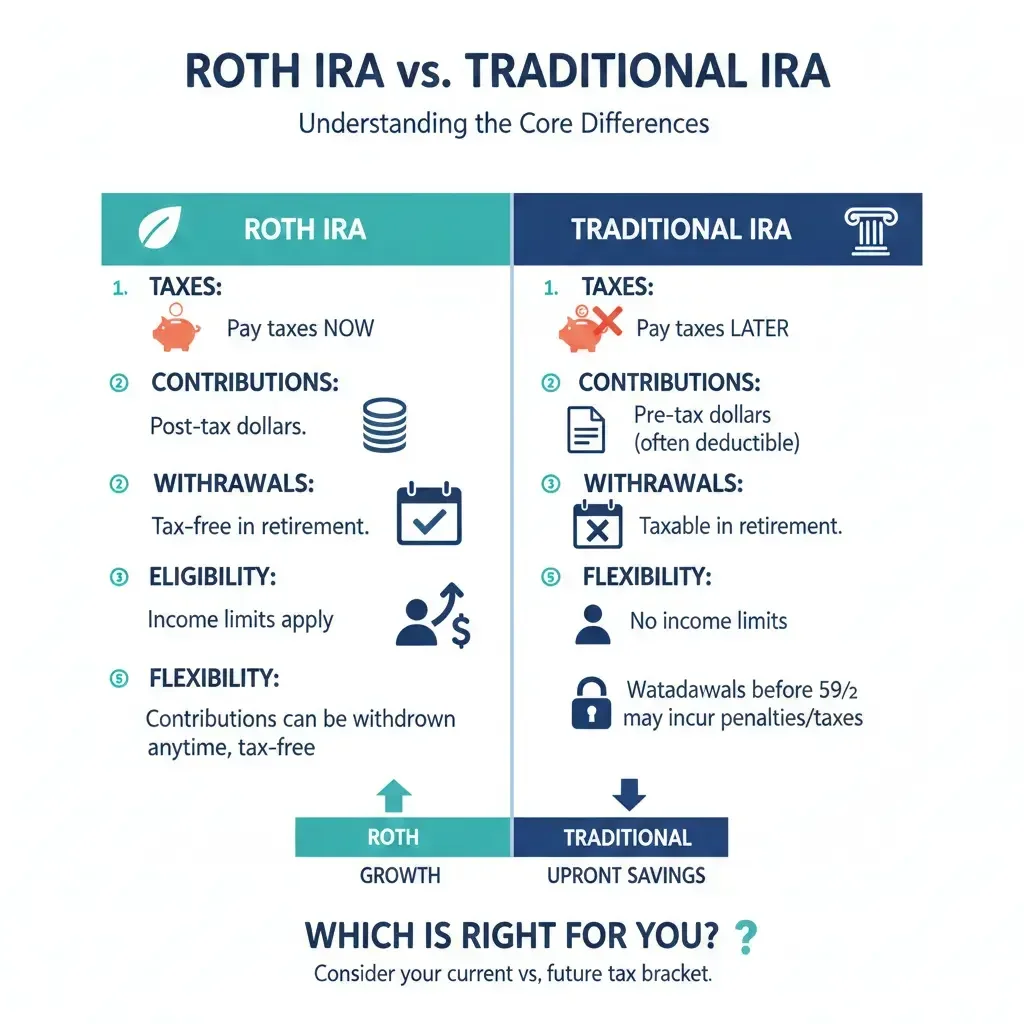
The fundamental distinction boils down to when you pay taxes. With a Traditional IRA, contributions are typically tax-deductible now, lowering your taxable income today, but withdrawals in retirement count as ordinary income and face taxes. A Roth IRA flips this: you contribute after-tax dollars, but qualified withdrawals—including earnings—are completely tax-free.
This timing matters because U.S. tax brackets can shift over decades. If you're in a lower bracket now but expect higher taxes later—due to career growth, policy changes, or rising brackets—a Roth often wins out. Conversely, if you're in a high bracket today and anticipate lower taxes in retirement, the Traditional IRA's upfront deduction provides immediate relief.
2026 Contribution Limits
Both accounts share the same annual limits: $7,500 for those under 50, and $8,600 including catch-up contributions if you're 50 or older. This is a combined limit across all your IRAs, so contributing $4,000 to a Roth leaves $3,500 (or $4,600 with catch-up) for a Traditional. You can't exceed your earned income, but non-working spouses can contribute using joint filing income.
Eligibility Rules for 2026
Traditional IRAs have no income limits for contributions, though deductibility phases out if you or your spouse have a workplace plan and income exceeds certain thresholds (check IRS Publication 590-A for details). Roth IRAs, however, cap eligibility based on modified adjusted gross income (MAGI):
| Filing Status | MAGI Under (Full Contribution) | Phase-Out Range | MAGI Over (Ineligible) |
|---|---|---|---|
| Single | $153,000 | $153,000 - $168,000 | $168,000 |
| Married Filing Jointly | $242,000 | $242,000 - $252,000 | $252,000 |
| Married Filing Separately | Not eligible | $0 - $10,000 | $10,000 |
If you're over income limits, consider a backdoor Roth: contribute to a Traditional non-deductible IRA and convert to Roth (watch for pro-rata rules).
Tax Treatment: A Side-by-Side Comparison
| Feature | Roth IRA | Traditional IRA |
|---|---|---|
| Contributions | After-tax (not deductible) | Pre-tax (often deductible) |
| Growth | Tax-free | Tax-deferred |
| Qualified Withdrawals | Tax-free (after 59½ and 5-year rule) | Taxed as ordinary income |
| Early Withdrawals | Contributions penalty-free; earnings penalized | 10% penalty + taxes (exceptions apply) |
For Roths, your contributions (not earnings) come out anytime tax- and penalty-free. Traditional early withdrawals hit you with income taxes plus a 10% penalty before 59½, unless exceptions like first-time homebuying apply.
Required Minimum Distributions (RMDs)
Traditional IRAs force RMDs starting at age 73 (rising to 75 in 2033), taxing you even if you don't need the money. Roth IRAs skip RMDs during your lifetime, letting funds grow tax-free indefinitely—ideal for legacy planning or extended longevity.
Note: Inherited Roths may have RMDs for beneficiaries, but yours stays flexible.
Which IRA Fits Your Situation?
Run the numbers based on your profile. Expect higher retirement taxes? Go Roth. Need deductions now? Traditional.
Ideal for Roth IRA
- Younger savers in lower brackets (time for tax-free compounding).
- High earners phased out of deductions but eligible for Roth.
- Those wanting no RMDs or estate planning perks.
- Believers in future tax hikes (e.g., post-2025 TCJA expiration).
Ideal for Traditional IRA
- High earners maximizing current deductions.
- Those expecting lower brackets in retirement (e.g., downsizing).
- Self-employed without a solo 401(k).
- Immediate tax relief amid high costs like healthcare or college.
You can have both, splitting contributions strategically. Tools like Schwab's Roth vs. Traditional calculator help model scenarios.
Practical Tips for Americans Getting Started
- Maximize contributions early: Even $7,500 in 2026 grows massively over 30+ years.
- Use employer matches first: 401(k)s often match before IRAs.
- Check deductibility: Use IRS worksheets if covered by a work plan.
- Diversify tax strategies: Many hold both for flexibility (tax-free and taxable buckets).
- Reassess yearly: Life changes—promotions, kids, moves—affect eligibility.
- Open via brokers: Vanguard, Fidelity, or Schwab offer low-fee options; compare expense ratios under 0.1%.
For official guidance, visit IRS.gov/retirement-plans/iras or use their withholding estimator.
Take Control of Your Retirement Today
Whether Roth or Traditional, start contributing before the April 2026 deadline for 2025 (or anytime for 2026). Model your scenario with free IRS tools or a fiduciary advisor. Diversifying both hedges against tax uncertainty—many Americans thrive with this "tax diversification" approach. Open an account at a low-cost provider, automate deposits, and watch compound growth build your secure future.
Frequently Asked Questions
Sources & References
-
1
Roth vs. Traditional IRA: Which Is Right For You? - NerdWallet — www.nerdwallet.com
-
2
Traditional IRA vs. Roth IRA | Guideline — www.guideline.com
-
3
Roth IRA vs. Traditional IRA: Rules & Tax Benefits - Vanguard — investor.vanguard.com
-
4
Retirement Plans – Roth vs. Traditional: Which is better? - SavingsPlusNow — www.savingsplusnow.com
-
5
Roth IRA vs traditional IRA | Comparing IRAs - Fidelity Investments — www.fidelity.com
-
6
Traditional and Roth IRAs | Internal Revenue Service — www.irs.gov
-
7
Roth vs. Traditional IRA Calculator | Charles Schwab — www.schwab.com
Related Articles

The Best "No-Fee" Brokerages for Fractional Shares in 2026
Imagine owning a slice of Amazon or Tesla without needing thousands of dollars upfront. That's the power of fractional shares, letting everyday Americans build diversified portfolios on any budget in...

The Best "Micro-Investing" Apps for Spare Change in 2026
Imagine turning your daily coffee run's spare change into a growing investment portfolio without lifting a finger. In 2026, micro-investing apps make it easier than ever for Americans to build wealth...
How to Hedge Against 2.8% Inflation: The Best Assets for 2026
Inflation at 2.8% might not grab headlines like the 9% peaks of a few years back, but it's still quietly eroding your purchasing power—think higher grocery bills, pricier gas, and rent that just keeps...

How to Use "Series I Bonds" as a 2026 Inflation Hedge
If you're worried about inflation eating away at your savings, Series I bonds offer a straightforward way to protect your purchasing power while earning a competitive return backed by the U.S. governm...