How to File Your Taxes for Free: Best IRS Free File Options

Filing your taxes doesn't have to drain your wallet. The IRS Free File program lets you prepare and e-file your federal income tax return at absolutely no cost if you qualify—and you might be surprise...
The Lifetimes America editorial team curates, fact-checks, and updates guides on personal finance, property, health, immigration, legal, business, and lifestyle topics relevant to Lifetimes America readers. Articles are produced with AI assistance and reviewed by the editorial team before publication.
Filing your taxes doesn't have to drain your wallet. The IRS Free File program lets you prepare and e-file your federal income tax return at absolutely no cost if you qualify—and you might be surprised by how many taxpayers actually do. Whether you're a simple filer or someone with rental properties and side gigs, there's likely a free option that works for your situation.
Who Qualifies for IRS Free File in 2026?
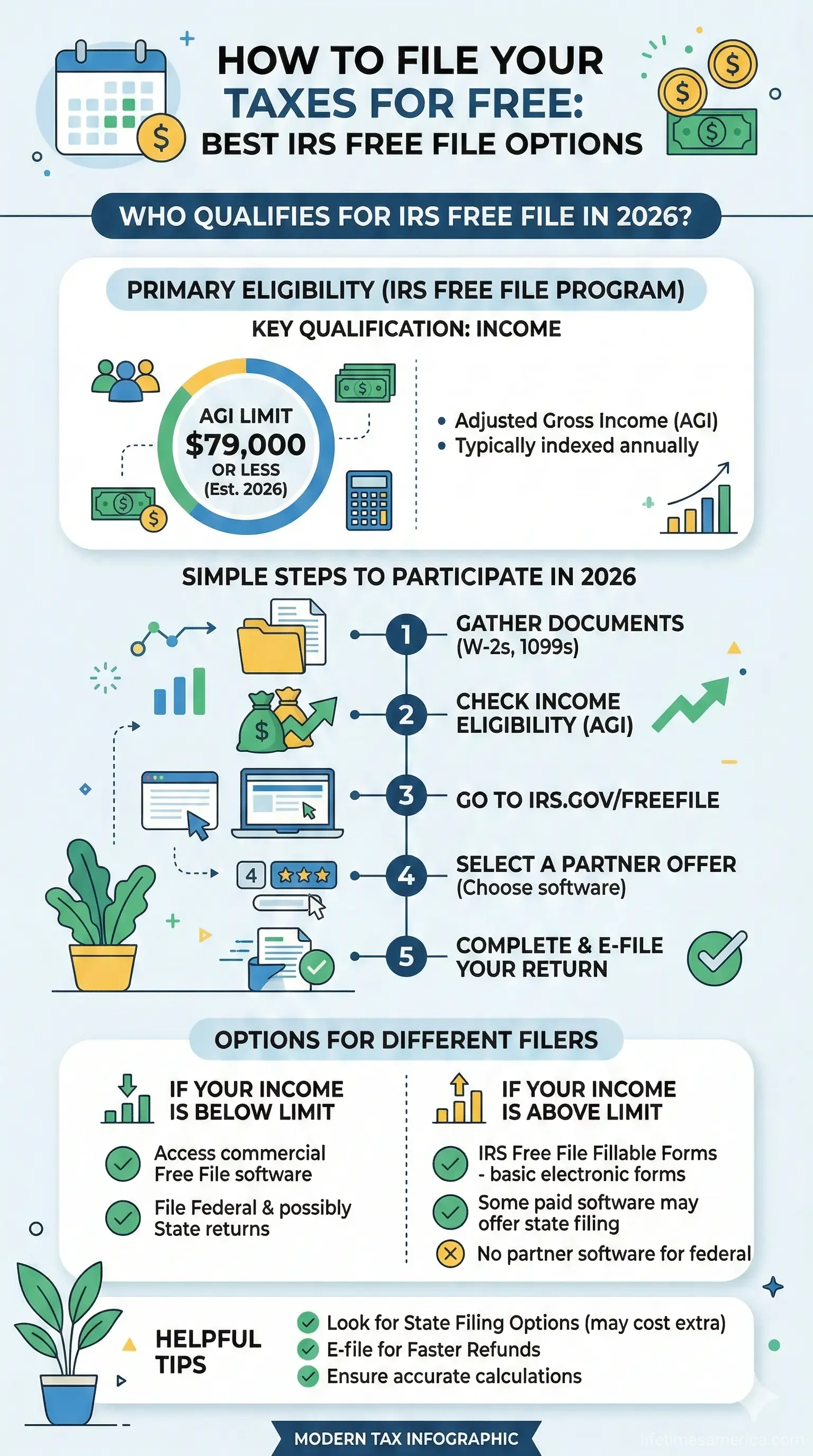
The eligibility rules for IRS Free File are straightforward. If your adjusted gross income (AGI) is $89,000 or less for the 2025 tax year, you're eligible to use the IRS Free File Guided Tax Software at no cost. This income threshold applies to all filing statuses—whether you're single, married filing jointly, head of household, or anything else.
The key thing to understand is that this limit refers to your adjusted gross income, not your gross income. Your AGI is your total income minus certain deductions, so it's typically lower than your gross income.
Some additional eligibility requirements vary by provider, but if you meet the $89,000 AGI cap, you'll have at least one free filing option available to you. The program also welcomes active-duty military members regardless of income level.
What Types of Returns Can You File for Free?
There's a common misconception that Free File only works for simple, straightforward returns. That's not true. You can file for free even if your tax situation is more complex. For example, small business owners, gig workers, and landlords with multiple rental properties all qualify as long as they stay under the $89,000 AGI limit.
The IRS Free File program supports all major tax situations and allows you to claim valuable tax benefits including the Earned Income Tax Credit (EITC), Child Tax Credit, and other refundable credits. Refundable tax credits can reduce the amount of tax you owe or result in a larger refund, even if no tax is due.
How IRS Free File Works
The Two Main Options
The IRS Free File program offers two primary ways to file:
- Guided Tax Software: Eight private-sector partners offer brand-name tax preparation software through the program. These guided tools walk you through your return step-by-step, asking questions about your situation and automatically calculating your taxes. This is the easiest option for most people.
- Free File Fillable Forms: If you're comfortable preparing your own taxes using IRS instructions, you can use electronic versions of IRS paper forms. This option is available to taxpayers at all income levels, so even if you earn more than $89,000, you can still file for free using this method.
Getting Started with Free File
Here's how to find and use the right IRS Free File option for your situation:
- Visit irs.gov/freefile to access the program
- Use the "Find a Trusted Partner" lookup tool, which will ask questions about your filing status, AGI, and tax credits
- The tool will show you which free filing options work best for your specific situation
- Select the provider that fits your needs and follow their link to begin
- Prepare and file your federal tax return using the guided software or fillable forms
- Get email confirmation when the IRS accepts your return
The good news? IRS Free File works on computers, smartphones, and tablets, so you can file from wherever is most convenient for you.
What About State Taxes?
Some IRS Free File partners offer free state tax preparation and filing as well, though not all do. The state filing options vary by provider and by state. For example, OLT and FreeTaxUSA offer free state filing for all states if you meet the federal requirements.
If your chosen provider doesn't include free state filing, you can check with your state's department of revenue to see if there are additional free filing options available. Many states offer their own free filing programs.
Key Protections Built Into Free File
When you use IRS Free File, you're protected in several important ways:
- No upselling: The eight partner companies cannot upsell you during the filing process or offer cash advances on anticipated refunds—two tactics commonly used by commercial tax software companies
- Calculation guarantees: IRS Free File partners guarantee the accuracy of their software calculations and will pay any IRS penalties or interest resulting from software errors
- Free customer service: You get access to free support if you have questions
- Compliance reviews: The IRS and Free File Alliance review each software to ensure it meets program standards
- No deceptive practices: Websites are designed to be clear and straightforward, not confusing or manipulative
Documents You'll Need to Gather
Before you start filing, collect the documents you'll need in one place. This helps you prepare an accurate return and claim all the deductions and credits you're entitled to. Depending on your situation, you may need:
- Income statements (W-2s from employers, 1099s for self-employment or gig work, interest statements, dividend statements)
- Business expense records (if you're self-employed)
- Documentation for deductions and credits you plan to claim
- Last year's tax return (for reference)
- Social Security numbers for yourself, your spouse (if filing jointly), and any dependents
The IRS website has a complete list of documents you may need on their "Gather your documents" page.
When Can You File?
The 2026 filing season timeline is important to know. IRS Free File Guided Tax Software began accepting returns on Friday, January 9, 2026, for qualified taxpayers. If you prefer to use Free File Fillable Forms, those became available starting January 26, 2026.
You can prepare your return early and hold it for electronic filing once the official filing season begins. The tax filing deadline is typically April 15th, but you'll want to file earlier to receive your refund sooner.
Special Situations: Military and Veterans
Active-duty military members get special consideration. They can receive a free federal tax return preparation and e-filing using any IRS Free File Guided Tax provider when their AGI is within the program's threshold. Additionally, military members and some veterans can use the Department of Defense program, MilTax, for free return preparation and e-filing software.
Your Next Steps
If you qualify for IRS Free File, you're leaving money on the table if you pay to file your taxes. Start by gathering your documents—income statements, business expenses, and documentation for any deductions or credits. Then head to irs.gov/freefile and use the lookup tool to find the provider that works best for your situation. The entire process is designed to be straightforward and user-friendly, and you'll get confirmation via email when the IRS accepts your return.
Don't let confusion about eligibility stop you. Even if your tax situation feels complicated, there's likely a free filing option that works for you. The IRS Free File program exists to make tax filing accessible to all Americans—take advantage of it.
Frequently Asked Questions
Sources & References
- 1
-
2
E-file: Do your taxes for free — www.irs.gov
-
3
IRS Free File: What It Is, How It Works — www.nerdwallet.com
- 4
-
5
File your taxes for free — www.irs.gov
- 6
Useful Tools
Related Articles

How to Avoid the "Marriage Penalty" in the 2026 US Tax Code
Imagine tying the knot and then discovering your tax bill just skyrocketed—thousands of dollars higher than if you'd stayed single. That's the harsh reality of the marriage penalty in the US tax code,...

The Best "Side-Hustle" Tax Software for 2026 Filers
Running a side hustle in 2026 means juggling gigs like Uber driving, freelance graphic design, or selling handmade crafts on Etsy while keeping your day job. But come tax time, tracking those 1099-NEC...

How to Use "Tax-Loss Harvesting" to Offset Your 2026 Stock Gains
Imagine locking in hefty stock gains in 2026 only to watch a big chunk vanish to capital gains taxes. What if you could slash that tax bill without derailing your investment strategy? That's the power...

The Gig Economy Tax Guide: How to Deduct Your Car; Internet; and Office
If you're earning money through gig work—whether you're driving for a rideshare company, freelancing, delivering groceries, or running a side hustle—you're probably wondering how to keep more of what...