How to Get More Money Back on Your Tax Return

Imagine checking your bank account and seeing a bigger tax refund than last year—maybe even an extra $1,000 or more. With the "One Big Beautiful Bill" (OBBB) reshaping the 2026 tax landscape, millions...
The Lifetimes America editorial team curates, fact-checks, and updates guides on personal finance, property, health, immigration, legal, business, and lifestyle topics relevant to Lifetimes America readers. Articles are produced with AI assistance and reviewed by the editorial team before publication.
Imagine checking your bank account and seeing a bigger tax refund than last year—maybe even an extra $1,000 or more. With the "One Big Beautiful Bill" (OBBB) reshaping the 2026 tax landscape, millions of Americans are poised for larger refunds on their 2025 returns. Whether you're a working parent, overtime earner, or homeowner, smart strategies can help you claim every dollar you're owed.
This guide breaks down actionable steps to maximize your refund, from new deductions to timeless tax hacks. You'll learn how to leverage 2026 updates, optimize withholdings, and plan ahead—all tailored for U.S. taxpayers filing by April 15, 2026.
Understand the 2026 Tax Changes Boosting Refunds
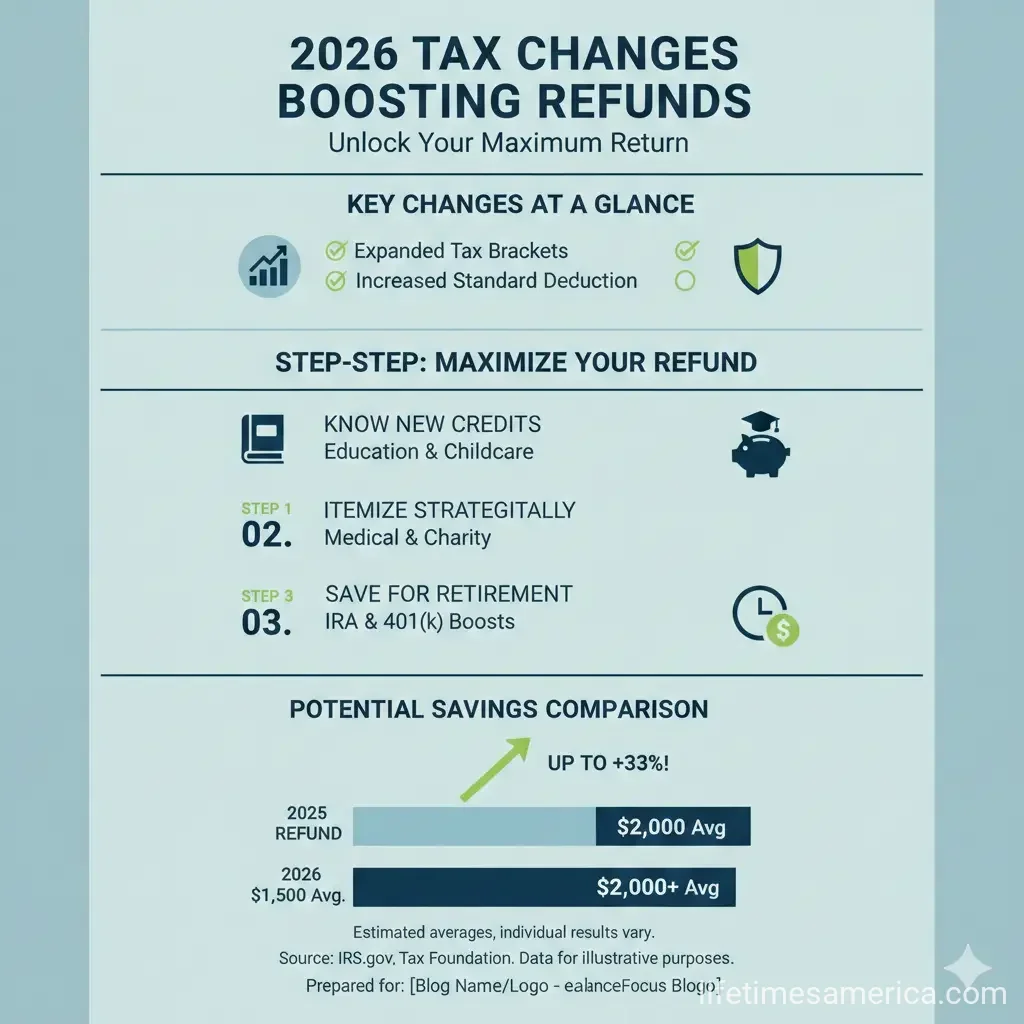
The OBBB introduced tax cuts driving higher refunds for tens of millions. Two main categories stand out: broad policies benefiting many with smaller savings, and targeted cuts offering thousands for specific groups.
Key Updates from the One Big Beautiful Bill
- Increased Standard Deduction: This simplifies filing and reduces taxable income automatically for most. It eases the burden, especially with tools like the 2026 tax refund calculator.
- Higher Child Tax Credit (CTC): Expanded to help families, with planning tips like securing a Social Security number for newborns early.
- Raised SALT Cap: State and local tax deductions now cap at $40,000 (phasing down above $500,000 MAGI), up from $10,000—huge for high-tax state residents.
- New Deductions for Tips and Overtime: Deduct up to $25,000 on qualified tips (average $1,400 savings for 5 million units) and overtime's "half" pay (up to $25,000 single/$12,500 others, benefiting 17 million with $1,400 average cut).
- Higher Retirement Limits: Boosted contributions for 401(k)s, IRAs, and HSAs to cut taxable income.
These changes mean filers could see refunds averaging over $3,000, with a projected $1,000 bump. Use the IRS Tax Withholding Estimator at irs.gov to preview your situation.
Step-by-Step Strategies to Maximize Your Refund
Don't just file—optimize. Here's how to get more money back on your 2025 return due in 2026.
1. Review and Adjust Your Withholdings Now
Life changes like marriage, kids, or a new home alter your tax picture. Over-withholding means lending the IRS interest-free money. Update Form W-4 via your employer's payroll or the IRS tool to match your situation, freeing up cash flow year-round.
- Run scenarios with the IRS Withholding Estimator.
- Aim to break even: Avoid big payments or refunds over $3,000.
2. Maximize Retirement Contributions
Contribute to tax-advantaged accounts by the deadline (April 15, 2026, for IRAs). For 2025, IRA limits are $7,000 ($8,000 if 50+ and married filing jointly)—deductible to slash taxable income. New 2026 limits are even higher for 401(k)s and HSAs.
| Account | 2025 Limit | 2026 Increase |
|---|---|---|
| IRA | $7,000 ($8,000 50+) | Higher per OBBB |
| 401(k) | Varies by plan | Expanded limits |
| HSA | Check irs.gov | Increased |
Pro tip: If self-employed, consider a Solo 401(k) for bigger contributions.
3. Itemize Deductions if They Beat the Standard
Compare itemizing vs. standard deduction. New SALT rules make itemizing viable again:
- Mortgage interest
- Charitable donations
- Medical expenses over 7.5% AGI
- State/local taxes (up to $40,000)
- New: Tips, overtime, work expenses
For many, this yields bigger refunds than the standard deduction.
4. Claim Every Credit You're Eligible For
Credits reduce taxes dollar-for-dollar—better than deductions. Top ones:
- Child Tax Credit: Increased under OBBB; claim for kids under 17.
- Earned Income Tax Credit (EITC): For low/moderate income workers.
- Child and Dependent Care Credit: Up to $3,000 per child for care costs.
- Education Credits: American Opportunity (up to $2,500) or Lifetime Learning.
- Energy Credits: For home improvements like solar panels.
Check eligibility at irs.gov/credits.
5. Time Your Income and Deductions
Bunch deductions into 2025: Accelerate charitable gifts or delay bonuses to stay in lower brackets. Defer freelance pay if nearing a threshold. Use tax-loss harvesting in investments—offset gains with losses up to $3,000 ordinary income.
6. Organize Records and Use Tools
Track everything: Receipts, 1099s, W-2s. Apps like TurboTax integrate AI for optimization. Test Refund Advance for quick access (up to $4,000).
Smart Ways to Use Your Bigger Refund
63% of filers get refunds averaging $3,000+—plan ahead:
- 1/3 to high-interest debt (credit cards first)
- 1/3 to emergency fund (3-6 months expenses)
- 1/3 to goals: Retirement, home down payment, or investments
Tie it to credit-building for long-term gains.
Next Steps to Secure Your Larger Refund
Gather documents now, run projections with IRS tools or software, and file early. Consult a CPA for complex situations—it's often worth the fee. Remember, tax laws evolve; this isn't advice—verify with pros and irs.gov. Start planning for 2026 today to keep more money working for you.
Ready to boost your refund? Bookmark irs.gov, update your W-4, and contribute to retirement accounts before deadlines hit.
Frequently Asked Questions
Sources & References
-
1
2026 Tax Season Playbook: Maximize your Refund while Navigating the New Tax Bill — www.creditkarma.com
-
2
How to Pay Less Taxes in 2026: 3 Easy Strategies to Maximize Your Refund — www.eliteconsultingpc.com
- 3
-
4
2026 Tax Law Updates: How To Prepare and Optimize Your Taxes — www.taxfyle.com
-
5
What's Driving Higher Tax Refunds in 2026? — bipartisanpolicy.org
-
6
5 Year-End Tax-Planning Actions to Take Before 2026 — privatebank.jpmorgan.com
- 7
-
8
7 Big Changes for the 2026 Tax Season — www.aarp.org
Related Articles

How to Avoid the "Marriage Penalty" in the 2026 US Tax Code
Imagine tying the knot and then discovering your tax bill just skyrocketed—thousands of dollars higher than if you'd stayed single. That's the harsh reality of the marriage penalty in the US tax code,...
The Best "Side-Hustle" Tax Software for 2026 Filers
Running a side hustle in 2026 means juggling gigs like Uber driving, freelance graphic design, or selling handmade crafts on Etsy while keeping your day job. But come tax time, tracking those 1099-NEC...

How to Use "Tax-Loss Harvesting" to Offset Your 2026 Stock Gains
Imagine locking in hefty stock gains in 2026 only to watch a big chunk vanish to capital gains taxes. What if you could slash that tax bill without derailing your investment strategy? That's the power...

The Gig Economy Tax Guide: How to Deduct Your Car; Internet; and Office
If you're earning money through gig work—whether you're driving for a rideshare company, freelancing, delivering groceries, or running a side hustle—you're probably wondering how to keep more of what...