What Is a Tax Refund and How Is It Calculated?

Imagine opening your mailbox or checking your bank account to find thousands of dollars waiting—a well-deserved reward after a year of hard work. That's the thrill of a tax refund, but have you ever w...
The Lifetimes America editorial team curates, fact-checks, and updates guides on personal finance, property, health, immigration, legal, business, and lifestyle topics relevant to Lifetimes America readers. Articles are produced with AI assistance and reviewed by the editorial team before publication.
Imagine opening your mailbox or checking your bank account to find thousands of dollars waiting—a well-deserved reward after a year of hard work. That's the thrill of a tax refund, but have you ever wondered exactly what it is and how the IRS calculates it? In 2026, with new tax laws like the One Big Beautiful Bill (OBBB) shaking things up, understanding your refund is more important than ever for American families planning their finances.
This guide breaks down everything you need to know about tax refunds, from the basics to the latest 2026 changes, so you can maximize yours and avoid surprises come filing season.
What Is a Tax Refund?
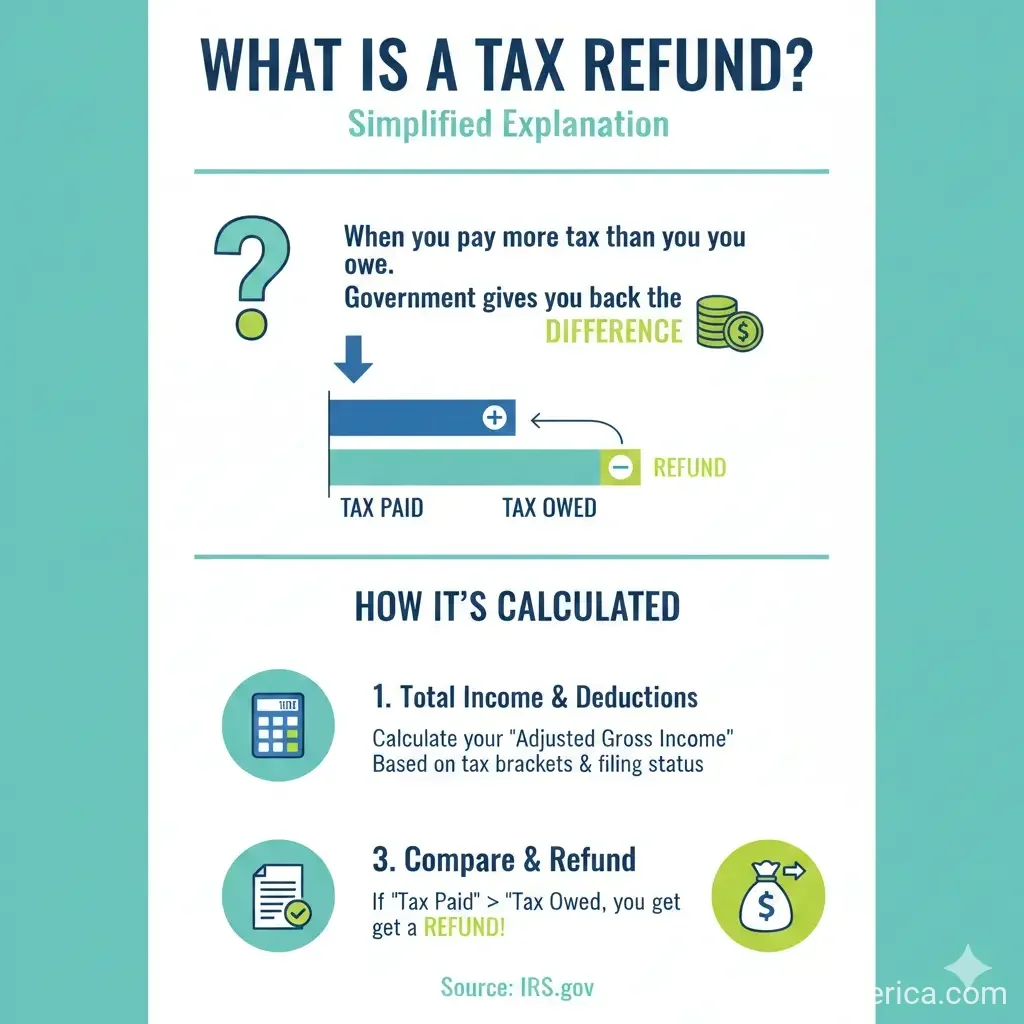
At its core, a tax refund is money the IRS sends back to you because you've overpaid your taxes throughout the year. This happens when the taxes withheld from your paycheck, plus any estimated payments you made, exceed your actual tax liability—the amount you truly owe based on your income, deductions, and credits.
On the flip side, if you've underpaid, you'll owe the difference. Refunds aren't free money; they're your own dollars held by the government interest-free. In 2026, projections show Americans could see record-high refunds totaling an extra $91 billion, thanks to permanent extensions of the 2017 Tax Cuts and Jobs Act (TCJA) provisions and OBBB enhancements like no tax on tips, overtime, or Social Security.
Why Do Most Americans Get Refunds?
Most U.S. workers get refunds because employers withhold taxes based on W-4 forms that often overestimate liability, especially for those with deductions or credits. Through early 2026 filing season, the average refund hit $2,290, driven by boosts in standard deductions and Child Tax Credits.
- Over-withholding from paychecks
- Quarterly estimated payments for self-employed folks
- Unexpected credits like the Earned Income Tax Credit (EITC)
Pro tip: Adjust your W-4 via IRS.gov to keep more in your paycheck and reduce refunds—or boost them strategically.
How Is a Tax Refund Calculated?
Calculating your refund follows a step-by-step process on your Form 1040. Start with your total income, subtract adjustments and deductions to find taxable income, apply tax rates, then subtract credits and payments. The formula boils down to: Refund = Total Payments - Tax Liability.
Step 1: Determine Your Adjusted Gross Income (AGI)
Your AGI is your total income minus "above-the-line" adjustments like student loan interest or IRA contributions. For 2026, every $25 reduction in taxable income can lower your taxes by about $5, potentially adding $100 to a $1,000 refund with just $500 in deductible contributions.
Step 2: Choose Deductions—Standard or Itemized
Subtract either the standard deduction or itemized deductions from AGI to get taxable income. For 2026, the standard deduction rises to $32,200 for married filing jointly—a $1,500 boost per family from OBBB—making it larger for most. Itemize if your qualifying expenses (mortgage interest, state taxes, charity) exceed this.
| Filing Status | 2026 Standard Deduction |
|---|---|
| Single | $16,100 |
| Married Filing Jointly | $32,200 |
| Head of Household | $24,150 |
Note: Add-ons for age 65+ or blindness apply.
Step 3: Apply Tax Rates to Taxable Income
Your taxable income falls into brackets (10% to 37%). OBBB keeps TCJA rates low and permanent. Example: A married couple with $100,000 taxable income might owe around $12,000 before credits.
Step 4: Subtract Credits
Credits directly reduce your liability dollar-for-dollar—better than deductions. Key 2026 ones:
- Child Tax Credit (CTC): Up to $2,200 per child, with $5,120 refundable.
- EITC: Helps low-to-moderate income workers; claim it fully.
- No-tax provisions: Tips deduction up to $25,000 (saving up to $6,000 in 24% bracket), overtime, Social Security.
Step 5: Total Payments vs. Liability
Add withholdings (from W-2s), estimated payments, and refundable credits. If payments > liability, that's your refund. Use the IRS Tax Withholding Estimator for precision.
Example Calculation (2026, Married Jointly):
- Gross Income: $120,000
- AGI: $115,000 (after adjustments)
- Standard Deduction: -$32,200 → Taxable: $82,800
- Tax Liability: ~$9,500 (after brackets)
- Credits: $4,400 CTC → Adjusted Liability: $5,100
- Withholdings: $14,000 → Refund: $8,900
2026 Tax Law Changes Impacting Refunds
The OBBB delivers big wins: permanent TCJA extensions, standard deduction hikes, and new no-tax rules. But refunds might feel smaller for some because withholding tables now reflect cuts—your money comes biweekly, not in one lump sum. Total relief hits $191 billion, with $91 billion in bigger refunds.
Key Updates
- No paper checks via Form 8888; direct deposit is primary (or electronic alternatives).
- Senior bonus deduction: $6,000 extra (phases out at higher incomes).
- Enhanced employer childcare credit: Up to $600,000 for small businesses.
Practical Tips to Maximize Your 2026 Tax Refund
Don't leave money on the table. Here's actionable advice:
- Contribute to retirement: Max your 401(k) or IRA for deductions.
- Bunch deductions: Time charity or medical expenses to itemize.
- Track tips/overtime: New deductions could save thousands.
- Update W-4: But aim for a refund if you need the forced savings.
- File early: Get your money sooner; use Free File if AGI < $79,000.
- Consult a pro via IRS Directory of Preparers.
"Tax refunds are a big deal for a lot of American families. It covers home repairs, health care, or summer vacations." — Ways and Means Chairman Jason Smith
Next Steps for Your 2026 Taxes
Gather your docs now: W-2s, 1099s, receipts. Run numbers with IRS tools, consider free e-file options, and tweak your W-4. For complex situations, get advice from a CPA or enrolled agent—it's worth it to claim every credit. File by April 15, 2027, and turn your refund into real financial wins like debt payoff or emergency savings. You're in control—make 2026 your best refund year yet.
Disclaimer: Tax laws change; this isn't personalized advice. Consult a tax professional or IRS.gov for your situation.
Frequently Asked Questions
Sources & References
-
1
How to Get a Bigger Tax Refund in 2026 - Jackson Hewitt — www.jacksonhewitt.com
- 2
-
3
Big, Beautiful Success Story: 2026 Tax Refunds Projected to be Largest Ever — waysandmeans.house.gov
-
4
IRS releases tax inflation adjustments for tax year 2026 — www.irs.gov
-
5
The Truth About 2026 Tax Refunds and Withholding - YouTube — www.youtube.com
-
6
What's Driving Higher Tax Refunds in 2026? - Bipartisan Policy Center — bipartisanpolicy.org
Related Articles

How to Avoid the "Marriage Penalty" in the 2026 US Tax Code
Imagine tying the knot and then discovering your tax bill just skyrocketed—thousands of dollars higher than if you'd stayed single. That's the harsh reality of the marriage penalty in the US tax code,...

The Best "Side-Hustle" Tax Software for 2026 Filers
Running a side hustle in 2026 means juggling gigs like Uber driving, freelance graphic design, or selling handmade crafts on Etsy while keeping your day job. But come tax time, tracking those 1099-NEC...

How to Use "Tax-Loss Harvesting" to Offset Your 2026 Stock Gains
Imagine locking in hefty stock gains in 2026 only to watch a big chunk vanish to capital gains taxes. What if you could slash that tax bill without derailing your investment strategy? That's the power...

The Gig Economy Tax Guide: How to Deduct Your Car; Internet; and Office
If you're earning money through gig work—whether you're driving for a rideshare company, freelancing, delivering groceries, or running a side hustle—you're probably wondering how to keep more of what...