The Gig Economy Tax Guide: How to Deduct Your Car; Internet; and Office

If you're earning money through gig work—whether you're driving for a rideshare company, freelancing, delivering groceries, or running a side hustle—you're probably wondering how to keep more of what...
The Lifetimes America editorial team curates, fact-checks, and updates guides on personal finance, property, health, immigration, legal, business, and lifestyle topics relevant to Lifetimes America readers. Articles are produced with AI assistance and reviewed by the editorial team before publication.
If you're earning money through gig work—whether you're driving for a rideshare company, freelancing, delivering groceries, or running a side hustle—you're probably wondering how to keep more of what you earn. The good news? The IRS allows you to deduct legitimate business expenses, including your vehicle, internet, and home office. Understanding these deductions can significantly reduce your tax bill and help you maximize your income as a self-employed worker.
Understanding Gig Economy Taxes
The IRS defines the gig economy as people earning income by providing on-demand work, services, or goods on either a part-time or full-time basis. If you're participating in the gig economy, you need to know one critical fact: all gig economy income is taxable, regardless of whether it's part-time, temporary, or paid in cash.
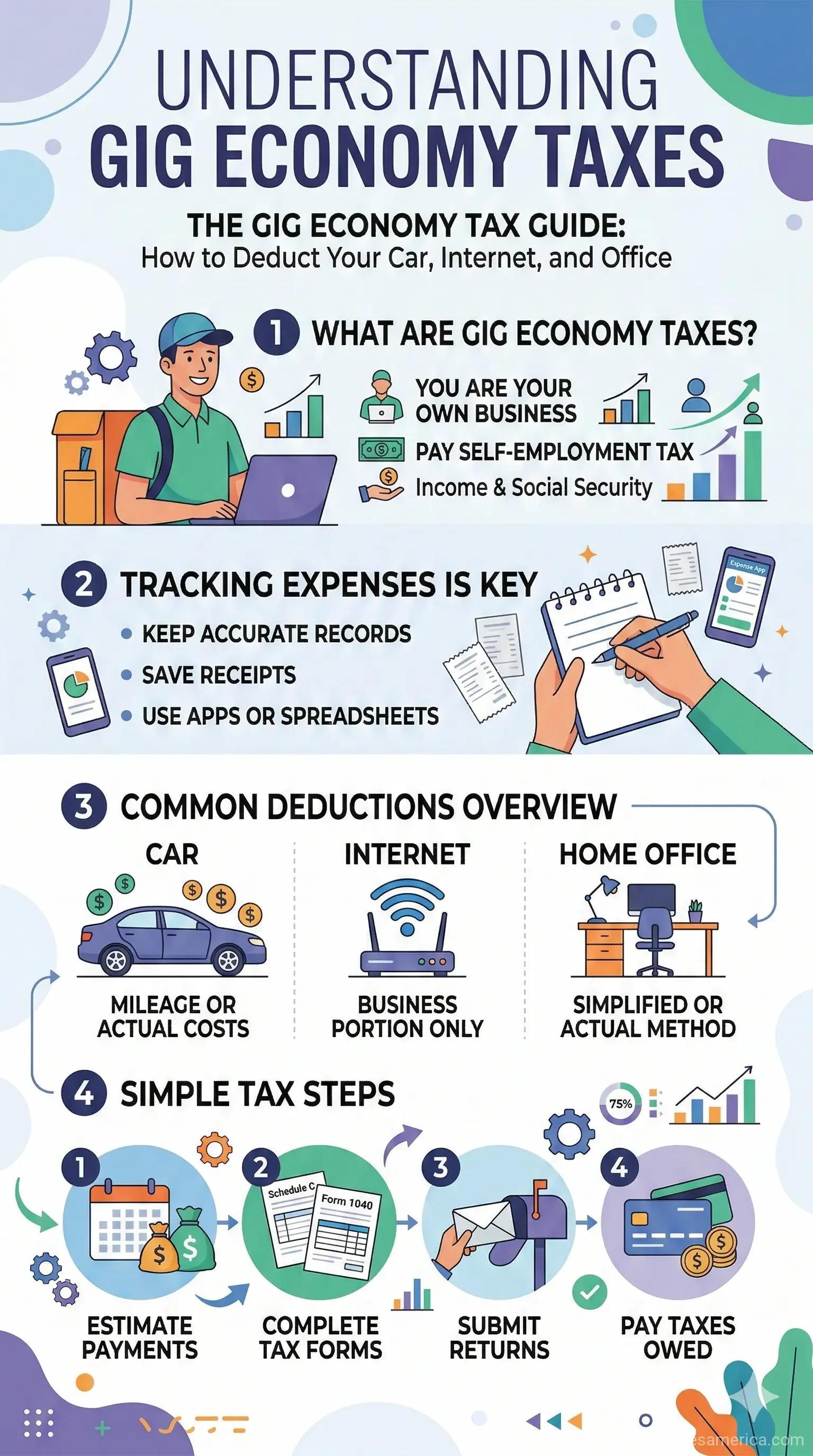
What makes gig work different from traditional employment is that you're classified as self-employed. This means you're responsible for paying both income taxes and self-employment taxes, which cover Social Security and Medicare contributions. For 2026, the self-employment tax rate is 15.3%—12.4% for Social Security and 2.9% for Medicare—and this applies to your net earnings.
Here's the silver lining: you can reduce your taxable income by claiming business deductions for ordinary and necessary expenses related to your work. Let's break down the three biggest deductions available to gig workers.
Vehicle and Mileage Deductions
If your gig work involves driving—whether you're delivering packages, driving for a rideshare service, or traveling to client meetings—you can deduct your vehicle expenses. This is one of the most valuable deductions available to gig workers.
How to Deduct Vehicle Expenses
You have two options for deducting vehicle expenses: the standard mileage rate or actual expenses.
Standard Mileage Rate: This is the simpler approach. You track the miles you drive for business purposes and multiply them by the IRS standard mileage rate. This method requires less documentation and is ideal if you don't want to track detailed expense records.
Actual Expense Method: You can deduct the actual costs of operating your vehicle, including gas, oil changes, maintenance, repairs, insurance, registration, and depreciation. This method requires more detailed record-keeping but can result in larger deductions if you have significant vehicle expenses.
Whichever method you choose, keep detailed records of your business mileage. Note the date, destination, purpose, and miles driven for each trip. This documentation is essential if the IRS ever audits your return.
What You Can't Deduct
Remember: you can only deduct miles driven for business purposes. Commuting to a regular job location doesn't count as business mileage. However, if you drive from one client location to another, that's deductible.
Home Office Deduction
Many gig workers operate from home, and the IRS allows you to deduct a portion of your home expenses if you use a dedicated space for your business.
Qualifying for the Home Office Deduction
To claim a home office deduction, your workspace must be used regularly and exclusively for business purposes. This means you can't claim a deduction for your kitchen table where you occasionally check emails. You need a dedicated office space—whether that's a spare bedroom, corner of your basement, or a dedicated desk in a room that serves other purposes.
Calculating Your Deduction
The IRS offers two methods for calculating your home office deduction:
- Simplified Method: Deduct $5 per square foot of dedicated office space (up to 300 square feet). This method requires minimal record-keeping and is ideal for smaller home offices.
- Regular Method: Calculate your home's total square footage, determine what percentage is used for business, and deduct that percentage of your home-related expenses, including mortgage interest (or rent), property taxes, utilities, insurance, and maintenance.
The regular method typically yields larger deductions if you have significant home expenses, but it requires more detailed documentation and record-keeping.
Internet and Office Equipment Deductions
If you use the internet and office equipment for your gig work, these expenses are deductible business expenses.
Internet and Utilities
If you use your home internet exclusively for business, you can deduct 100% of your internet bill. However, if you use it for personal purposes as well, you can only deduct the business percentage. For example, if you estimate 60% of your internet usage is for work, you can deduct 60% of your monthly bill.
Similarly, if you have a dedicated home office, you can deduct a portion of your utility bills (electricity, heating, water) based on the percentage of your home used for business.
Office Equipment and Supplies
Common deductible items include:
- Computer, laptop, or tablet used for business
- Printer, scanner, or copier
- Office furniture (desk, chair, filing cabinet)
- Software subscriptions and apps
- Office supplies (paper, pens, folders)
- Phone service (if used exclusively for business)
- Necessary tools and equipment related to your specific gig work
Keep receipts for all equipment purchases. For items that cost more than $2,500, you may need to depreciate them over several years rather than deducting the full amount in one year. Your tax software or a tax professional can help you navigate depreciation rules.
Other Deductible Business Expenses
Beyond your vehicle, home office, and internet, you can deduct other ordinary and necessary business expenses:
- Professional dues and subscriptions: Memberships in industry organizations or professional associations
- Education and training: Courses, certifications, or training related to your gig work
- Business insurance: Liability insurance or professional insurance relevant to your work
- Accounting and legal services: Fees paid to accountants or lawyers for business-related advice
- Marketing and advertising: Website hosting, business cards, or advertising costs
Reporting Your Income and Expenses
Form 1099-K and Other Income Reports
If you earn $600 or more from any side job during the tax year, the company that paid you is generally required to send you a Form 1099-NEC for nonemployee compensation or a Form 1099-K if you're paid through third-party payment platforms like PayPal. For the 2025 tax year, you should only receive a 1099-K if you received more than $20,000 in gross payments and conducted more than 200 transactions on a single platform.
Important: You must report all income earned from gig work on your tax return, even if you don't receive a 1099 form. The IRS expects you to report all income, including cash payments.
Schedule C: Profit or Loss From Business
When you file your taxes, you'll typically need to complete Schedule C (Form 1040), which reports your business income and expenses. This form calculates your net profit or loss, which is then transferred to your main tax return.
On Schedule C, you'll report:
- Your total business income
- Your business expenses and deductions
- Your net profit or loss
Quarterly Estimated Tax Payments
Here's something many new gig workers don't realize: you're likely required to pay taxes quarterly, not just annually. Because taxes aren't withheld from your gig income, you must make quarterly estimated tax payments to the IRS if you expect to owe $1,000 or more in taxes for the year.
For the 2026 tax year, the quarterly payment deadlines are:
- April 15, 2026 (for Q1)
- June 17, 2026 (for Q2)
- September 16, 2026 (for Q3)
- January 15, 2027 (for Q4)
To calculate your quarterly estimated taxes, use Form 1040-ES, which helps you determine how much to pay each quarter. If you don't pay your quarterly taxes on time, the IRS will assess penalties, which can significantly reduce your net income.
Record-Keeping Best Practices
The key to successfully claiming deductions is maintaining detailed records. Here's what you should track:
- Income records: Keep copies of all 1099 forms, invoices, and payment confirmations
- Mileage log: Document the date, destination, purpose, and miles for every business trip
- Expense receipts: Save receipts for all business expenses, including fuel, maintenance, equipment, and supplies
- Home office records: Keep documentation of your home's square footage and the percentage used for business
- Bank and credit card statements: These provide backup documentation for your expenses
Use a spreadsheet, accounting software, or a dedicated app to organize your records. The more organized you are throughout the year, the easier tax time becomes.
Next Steps: Maximize Your Deductions
Now that you understand the deductions available to gig workers, here's what you should do:
1. Set up a record-keeping system. Whether you use spreadsheets, accounting software, or an app, start tracking your income and expenses today. The more organized you are throughout the year, the easier tax time becomes.
2. Open a separate business bank account. This makes it easier to track business income and expenses and provides clear documentation for the IRS.
3. Calculate your quarterly estimated taxes. Don't wait until April to figure out what you owe. Use Form 1040-ES to calculate your quarterly payments and set aside money each month.
4. Consider working with a tax professional. A CPA or tax professional who specializes in self-employment can help you maximize your deductions, plan for quarterly payments, and ensure you're compliant with IRS requirements.
5. Review your deductions regularly. As your gig work evolves, your deductible expenses may change. Review your situation quarterly to ensure you're capturing all available deductions.
Gig work offers flexibility and independence, but it also comes with unique tax responsibilities. By understanding the deductions available to you—especially vehicle, home office, and internet expenses—you can significantly reduce your tax burden and keep more of what you earn. Start tracking your expenses today, make your quarterly estimated tax payments on time, and consider consulting with a tax professional to ensure you're maximizing every available deduction.
Frequently Asked Questions
Sources & References
-
1
Gig Economy Tax Center | Internal Revenue Service — www.irs.gov
-
2
2026 Remote Worker Tax Deductions and Credits — www.timetrex.com
-
3
Tax Considerations for Gig Economy Workers with Multiple Jobs — turbotax.intuit.com
-
4
Top 5 Tax Tips For Gig Economy Workers In 2026 — www.triplog.net
- 5
-
6
2026 Tax Filing and Form 1099-K — Know the New Rules This Tax Season — www.cpapracticeadvisor.com
-
7
A Guide to Gig Economy Tax Issues — www.njcpa.org
Related Articles

How to Avoid the "Marriage Penalty" in the 2026 US Tax Code
Imagine tying the knot and then discovering your tax bill just skyrocketed—thousands of dollars higher than if you'd stayed single. That's the harsh reality of the marriage penalty in the US tax code,...

The Best "Side-Hustle" Tax Software for 2026 Filers
Running a side hustle in 2026 means juggling gigs like Uber driving, freelance graphic design, or selling handmade crafts on Etsy while keeping your day job. But come tax time, tracking those 1099-NEC...

How to Use "Tax-Loss Harvesting" to Offset Your 2026 Stock Gains
Imagine locking in hefty stock gains in 2026 only to watch a big chunk vanish to capital gains taxes. What if you could slash that tax bill without derailing your investment strategy? That's the power...

How to File Your Taxes for Free: Best IRS Free File Options
Filing your taxes doesn't have to drain your wallet. The IRS Free File program lets you prepare and e-file your federal income tax return at absolutely no cost if you qualify—and you might be surprise...