What Is Self-Employment Tax and How Do You Pay It?

If you're working for yourself—whether you're a freelancer, independent contractor, or small business owner—you've probably heard the term "self-employment tax" and wondered what it really means. Unli...
The Lifetimes America editorial team curates, fact-checks, and updates guides on personal finance, property, health, immigration, legal, business, and lifestyle topics relevant to Lifetimes America readers. Articles are produced with AI assistance and reviewed by the editorial team before publication.
If you're working for yourself—whether you're a freelancer, independent contractor, or small business owner—you've probably heard the term "self-employment tax" and wondered what it really means. Unlike traditional employees who have taxes withheld from their paychecks, self-employed individuals are responsible for calculating and paying these taxes themselves. Understanding how self-employment tax works is crucial for managing your finances and avoiding surprises come tax season.
What Is Self-Employment Tax?
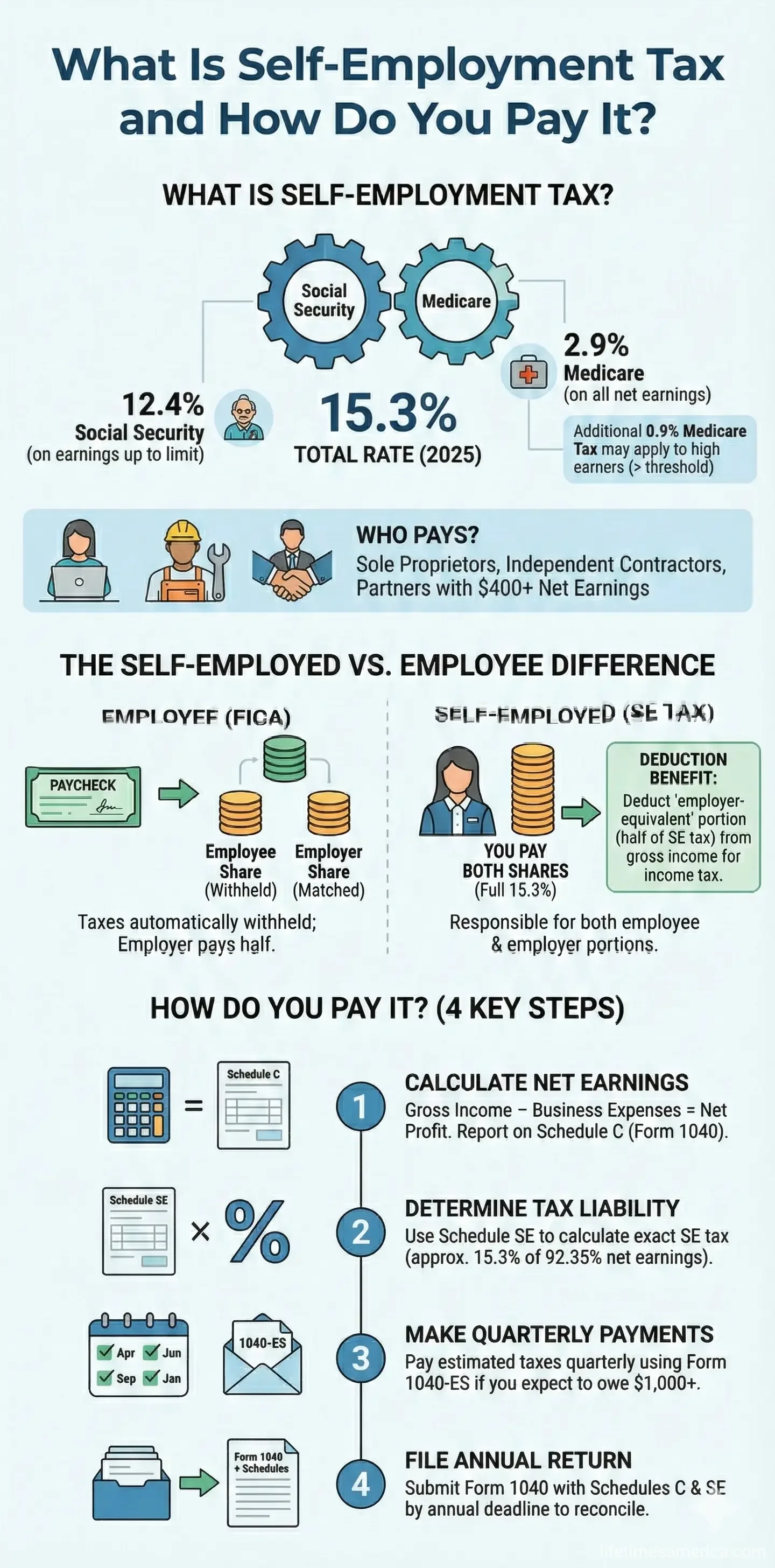
Self-employment tax is a federal tax consisting of Social Security and Medicare taxes that you pay as a self-employed person. It's essentially the self-employed version of the FICA (Federal Insurance Contributions Act) tax that employers and employees split when you work as a traditional employee.
Here's the key difference: when you're an employee, your employer withholds Social Security and Medicare taxes from your paycheck and contributes their own portion. When you're self-employed, you're responsible for paying both the employer and employee portions yourself. This means you're paying the combined amount directly to the IRS.
Self-employment income includes earnings from your business, freelance work, or independent contracting—basically any income from personal services where an employer-employee relationship doesn't exist. The IRS requires self-employment tax on this income if you're a U.S. citizen or resident with self-employment earnings.
Understanding Self-Employment Tax Rates for 2026
The Total Rate: 15.3%
The total self-employment tax rate is 15.3%, which breaks down into two components:
- Social Security tax: 12.4% (for old-age, survivors, and disability insurance)
- Medicare tax: 2.9% (for hospital insurance)
This 15.3% rate applies to 92.35% of your net self-employment earnings. That 92.35% figure represents an adjustment factor that accounts for the employer portion of the tax you're deducting.
2026 Wage Limits
For 2026, the Social Security portion of self-employment tax (12.4%) applies only to the first $184,500 of your combined wages and self-employment earnings. Once you exceed this threshold, you stop paying the Social Security tax portion for the year, though you continue paying Medicare tax on all earnings.
Medicare tax, on the other hand, has no earnings limit. You pay 2.9% on your entire net self-employment income.
Additional Medicare Tax
If your income exceeds certain thresholds based on your filing status, you'll owe an additional 0.9% Medicare tax:
- $200,000 for single filers or head of household
- $250,000 for married couples filing jointly
- $125,000 for married couples filing separately
How to Calculate Your Self-Employment Tax
Step-by-Step Calculation
Let's walk through a practical example to show how self-employment tax actually works. Say you run a catering business as a sole proprietor and your net profit for 2025 is $35,000.
Step 1: Apply the adjustment factor
Multiply your net self-employment income by 92.35%:
$35,000 × 0.9235 = $32,323
Step 2: Calculate your self-employment tax
Multiply the adjusted amount by the 15.3% self-employment tax rate:
$32,323 × 0.153 = $4,945
So your self-employment tax would be $4,945.
Step 3: Claim the deduction
Here's where it gets better: you can deduct half of your self-employment tax from your income. In this example, you'd deduct $2,473 ($4,945 × 0.50) from your adjusted gross income, which reduces the amount of income tax you owe.
Using Schedule SE
To officially calculate your self-employment tax, you'll use Schedule SE (Self-Employment Tax) with your Form 1040. If you're self-employed as a sole proprietor or independent contractor, you'll also use Schedule C to figure your net earnings from self-employment.
The IRS requires you to file Schedule SE if your net earnings from self-employment are $400 or more. Report the total from Schedule SE in the "Other Taxes" section of Form 1040.
Who Pays Self-Employment Tax?
Self-employment tax applies to virtually anyone who's self-employed, regardless of age. Even if you're already receiving Social Security or Medicare benefits, the self-employment tax rules still apply to your earnings.
This includes:
- Sole proprietors
- Independent contractors and freelancers
- Small business owners
- Partners in partnerships (on their share of partnership income)
- Members of LLCs classified as sole proprietorships or partnerships
If you have both W-2 wages and self-employment income, special rules apply. Your employer withholds Social Security and Medicare taxes on your wages first. If your total earnings exceed $184,500, you won't pay dual Social Security taxes on amounts over the limit.
Key Tax Deductions for Self-Employed People
The good news is that self-employment tax comes with important deductions that reduce your overall tax burden:
The Deductible Portion of Self-Employment Tax
As mentioned earlier, you can deduct half of your self-employment tax from your adjusted gross income. This is an "above-the-line" deduction, meaning you can claim it even if you take the standard deduction.
The Qualified Business Income (QBI) Deduction
Self-employed individuals may also qualify for the Qualified Business Income deduction, which allows you to deduct up to 20% of your qualified business income from your taxable income. This is a powerful deduction that can significantly lower your tax bill.
When and How to Pay Self-Employment Tax
Self-employment tax is due when you file your annual tax return (typically April 15). However, if you expect to owe $1,000 or more in self-employment tax, you should make quarterly estimated tax payments throughout the year to avoid penalties.
Quarterly estimated tax payments are due on:
- April 15 (for income through March 31)
- June 15 (for income through May 31)
- September 15 (for income through August 31)
- January 15 of the following year (for income through December 31)
You can make these payments online through the IRS website at irs.gov or mail Form 1040-ES with your payment.
Next Steps for Managing Your Self-Employment Taxes
Understanding self-employment tax is the first step toward managing your finances as a self-employed person. Here's what you should do:
- Track your income and expenses throughout the year using accounting software or a spreadsheet. This makes calculating your net earnings much easier at tax time.
- Set aside money for taxes each month. A good rule of thumb is to save 25-30% of your net profit for federal self-employment and income taxes (the exact percentage depends on your tax bracket).
- Make quarterly estimated tax payments if you expect to owe $1,000 or more to avoid underpayment penalties.
- Consult a tax professional about your specific situation. A CPA or tax advisor can help you maximize deductions, determine if an S-Corporation makes sense for your business, and ensure you're complying with all tax obligations.
- Visit irs.gov for official guidance on self-employment taxes, Schedule SE, and estimated tax payments.
Self-employment tax might seem complicated, but with proper planning and record-keeping, you can manage it effectively and avoid surprises when tax season arrives.
Frequently Asked Questions
Sources & References
-
1
2025 and 2026 Self-Employment Tax | Income Tax Unit — tax.un.org
-
2
Self-employment tax | Internal Revenue Service — www.irs.gov
-
3
A guide to self-employment tax for small business owners — tax.thomsonreuters.com
-
4
Self-employment tax (Social Security and Medicare taxes) — www.irs.gov
-
5
Self-Employment Taxes — turbotax.intuit.com
-
6
If You Are Self-Employed — www.ssa.gov
- 7
-
8
Self-employment tax: What it is and how to calculate it — www.fidelity.com
-
9
Self-Employment Tax — answerconnect.cch.com
Useful Tools
Related Articles

How to Avoid the "Marriage Penalty" in the 2026 US Tax Code
Imagine tying the knot and then discovering your tax bill just skyrocketed—thousands of dollars higher than if you'd stayed single. That's the harsh reality of the marriage penalty in the US tax code,...
The Best "Side-Hustle" Tax Software for 2026 Filers
Running a side hustle in 2026 means juggling gigs like Uber driving, freelance graphic design, or selling handmade crafts on Etsy while keeping your day job. But come tax time, tracking those 1099-NEC...

How to Use "Tax-Loss Harvesting" to Offset Your 2026 Stock Gains
Imagine locking in hefty stock gains in 2026 only to watch a big chunk vanish to capital gains taxes. What if you could slash that tax bill without derailing your investment strategy? That's the power...

The Gig Economy Tax Guide: How to Deduct Your Car; Internet; and Office
If you're earning money through gig work—whether you're driving for a rideshare company, freelancing, delivering groceries, or running a side hustle—you're probably wondering how to keep more of what...