What Is Social Security and How Do You Qualify?

Imagine clocking out after decades of hard work, only to wonder if your retirement check will cover the basics—or if you've even earned it. For millions of Americans, Social Security is the safety net...
The Lifetimes America editorial team curates, fact-checks, and updates guides on personal finance, property, health, immigration, legal, business, and lifestyle topics relevant to Lifetimes America readers. Articles are produced with AI assistance and reviewed by the editorial team before publication.
Imagine clocking out after decades of hard work, only to wonder if your retirement check will cover the basics—or if you've even earned it. For millions of Americans, Social Security is the safety net that turns that worry into reality, but qualifying isn't automatic. Here's everything you need to know about what Social Security is and how to qualify in 2026.
What Is Social Security?
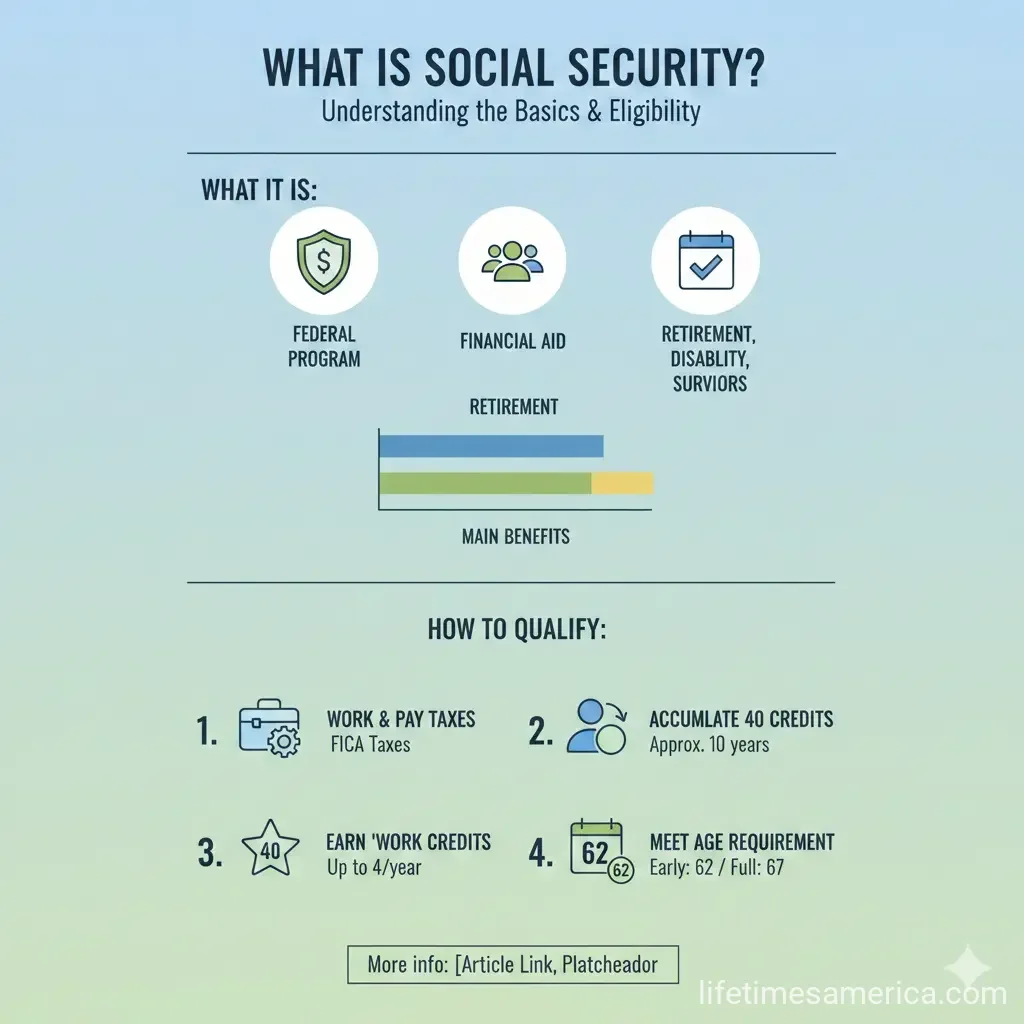
Social Security refers to the federal Old-Age, Survivors, and Disability Insurance (OASDI) program, administered by the Social Security Administration (SSA). Established by the Social Security Act of 1935, it provides retirement, disability, and survivor benefits to eligible workers and their families. It's funded primarily through payroll taxes under the Federal Insurance Contributions Act (FICA) for employees or the Self-Employed Contributions Act (SECA) for self-employed individuals.
In essence, while you work, you and your employer contribute 6.2% each of your wages (up to a cap) to the Social Security trust fund. In 2026, the maximum taxable earnings subject to this tax is $184,500, up from $176,100 in 2025. Earnings above this aren't taxed for Social Security, though Medicare taxes apply without a cap.
Key Programs Under Social Security
The SSA directly manages OASDI and Supplemental Security Income (SSI), but the broader Social Security Act includes related programs like Medicare, Medicaid, and Temporary Assistance for Needy Families (TANF). For retirement planning, focus on OASDI, which pays monthly benefits to retirees, disabled workers, and survivors.
- Retirement benefits: For workers reaching full retirement age (FRA).
- Disability benefits: For those unable to work due to severe disability.
- Survivors benefits: For spouses, children, or dependents of deceased workers.
- SSI: Needs-based payments for low-income elderly, blind, or disabled individuals.
In 2026, SSI federal benefit rates are $994 per month for individuals and $1,491 for couples, reflecting a 2.8% cost-of-living adjustment (COLA).
How Do You Qualify for Social Security?
Qualifying for Social Security retirement benefits requires earning at least 40 credits over your lifetime, roughly 10 years of work. You can earn up to four credits per year. In 2026, one credit requires $1,890 in covered earnings, so you'll need at least $7,560 annually for the maximum four credits.
Earning Credits: The Basics
Covered earnings come from jobs where FICA taxes are withheld or self-employment income under SECA. Not all work counts—some government jobs or non-U.S. work may not qualify unless covered by special agreements. Check your earnings record at ssa.gov/myaccount to ensure accuracy; discrepancies can reduce benefits.
Practical tip: If you're short on credits, recent work can help. Substantial earnings boost your record, especially the highest 35 years used for benefit calculations.
Full Retirement Age (FRA) in 2026
Your FRA—the age for full, unreduced benefits—depends on birth year. For those born in 1960 or later, FRA is now officially 67, completing the shift from 65. If you turn 62 in 2026, your FRA might be 66 years and 10 months or higher, depending on your exact birthdate.
| Birth Year | Full Retirement Age |
|---|---|
| 1959 | 66 years and 10 months |
| 1960 or later | 67 |
You can claim as early as 62, but benefits drop by up to 30% at that age. Delaying past FRA earns delayed retirement credits up to age 70, boosting payments by 8% per year.
Other Qualification Rules
- Disability: Must prove inability to engage in substantial gainful activity (SGA). In 2026, SGA is $1,690/month for non-blind workers and $2,830 for blind.
- Survivors: Spouses or children of deceased workers with enough credits.
- Recent Changes: The 2025 Social Security Fairness Act eliminated the Windfall Elimination Provision (WEP) and Government Pension Offset (GPO), benefiting public workers and others with non-covered pensions.
2026 Social Security Changes You Need to Know
Each year brings updates. The 2026 COLA is 2.8%, increasing average benefits modestly. Key limits also rise:
- Taxable wage base: $184,500.
- Earnings test (under FRA): $24,480/year ($2,040/month) before $1 reduction per $2 over; at FRA in 2026, $65,160 before $1 per $3 over.
- Trial Work Period for disability: $1,210/month counts as a trial month.
Higher earners pay more: Up to $521 extra in employee taxes on the increased cap, matched by employers.
Impact of COLA and Trust Fund Outlook
The 2.8% COLA applies to all benefits starting January 2026, but it may not fully offset inflation in high-cost states like California or Hawaii. Long-term, the OASI trust fund could deplete by 2033–2035 without reforms, paying only 77–83% of benefits. Plan accordingly with 401(k)s or IRAs.
Practical Steps to Maximize Your Benefits
- Create an SSA account: Review your earnings at ssa.gov.
- Work strategically: Aim for 35 high-earning years; replace low years with recent income.
- Time your claim: Use SSA calculators to model early vs. delayed claiming.
- Coordinate with spouses: Survivor benefits can be 100% of the deceased's amount.
- Appeal errors: If denied, request reconsideration within 60 days.
For self-employed Americans, report all net earnings for SECA taxes to build credits. Immigrants or non-citizens may qualify via totalization agreements with certain countries.
Plan Ahead for a Secure Retirement
Social Security is a cornerstone, but not your only pillar—combine it with personal savings for peace of mind. Visit ssa.gov today to check your statement, run projections, and apply if eligible. Start small: Log in now and verify your record. Your future self will thank you.
Frequently Asked Questions
Sources & References
-
1
Social Security (United States) — Wikipedia — en.wikipedia.org
-
2
7 Big Changes to Social Security in 2026 — AOL — www.aol.com
-
3
Six Changes Coming to Social Security in 2026 — Kiplinger — www.kiplinger.com
-
4
What's New in 2026? The Red Book — SSA.gov — www.ssa.gov
-
5
SSI Federal Payment Amounts for 2026 — SSA.gov — www.ssa.gov
-
6
Social Security in 2026: How Far Will Your Benefits Really Go? — Bankers Life — www.bankerslife.com
- 7
-
8
Social Security Benefit Amounts — SSA.gov — www.ssa.gov
- 9
Related Articles

The Best States for "Tax-Free" Retirement Income in 2026
Imagine waking up in your dream retirement spot, sipping coffee on a sunny porch, knowing your hard-earned Social Security checks, pensions, and 401(k) withdrawals won't get hit with state income taxe...

How to Use your 401(k) to Buy Your First House: The Hidden Risks
Picture this: You've scrimped and saved for years, eyeing that perfect starter home in your neighborhood. But the down payment feels like an insurmountable hurdle. In a pinch, your 401(k) balance star...

The Hidden Fees of 401(k) Plans: How to Save $100k over 30 Years
Imagine discovering that tiny, unnoticed fees in your 401(k) are quietly siphoning away enough money to buy a vacation home or fund a comfortable retirement. Over 30 years, cutting just 1% in hidden f...

The Best "Self-Directed" IRA Platforms for Real Estate and Private Equity
Imagine unlocking the full potential of your retirement savings by investing in rental properties, private equity deals, or even startups—all tax-deferred or tax-free within a self-directed IRA. For A...