What Is a Tax Deduction vs a Tax Credit?

Ever stared at your tax return wondering why a $1,000 tax credit feels like a windfall while a $1,000 deduction barely moves the needle? You're not alone—millions of Americans mix up these two powerho...
The Lifetimes America editorial team curates, fact-checks, and updates guides on personal finance, property, health, immigration, legal, business, and lifestyle topics relevant to Lifetimes America readers. Articles are produced with AI assistance and reviewed by the editorial team before publication.
Ever stared at your tax return wondering why a $1,000 tax credit feels like a windfall while a $1,000 deduction barely moves the needle? You're not alone—millions of Americans mix up these two powerhouses every tax season. Understanding what is a tax deduction vs a tax credit can unlock real savings on your federal tax bill, especially as we head into the 2026 tax year with updated brackets and deductions.
In this guide, we'll break it down simply: how they work, real-world examples tailored to U.S. taxpayers, and tips to maximize both. Whether you're a single filer scraping by or a married couple with kids, knowing the difference helps you keep more of your hard-earned money. Let's dive in.
What Is a Tax Deduction?
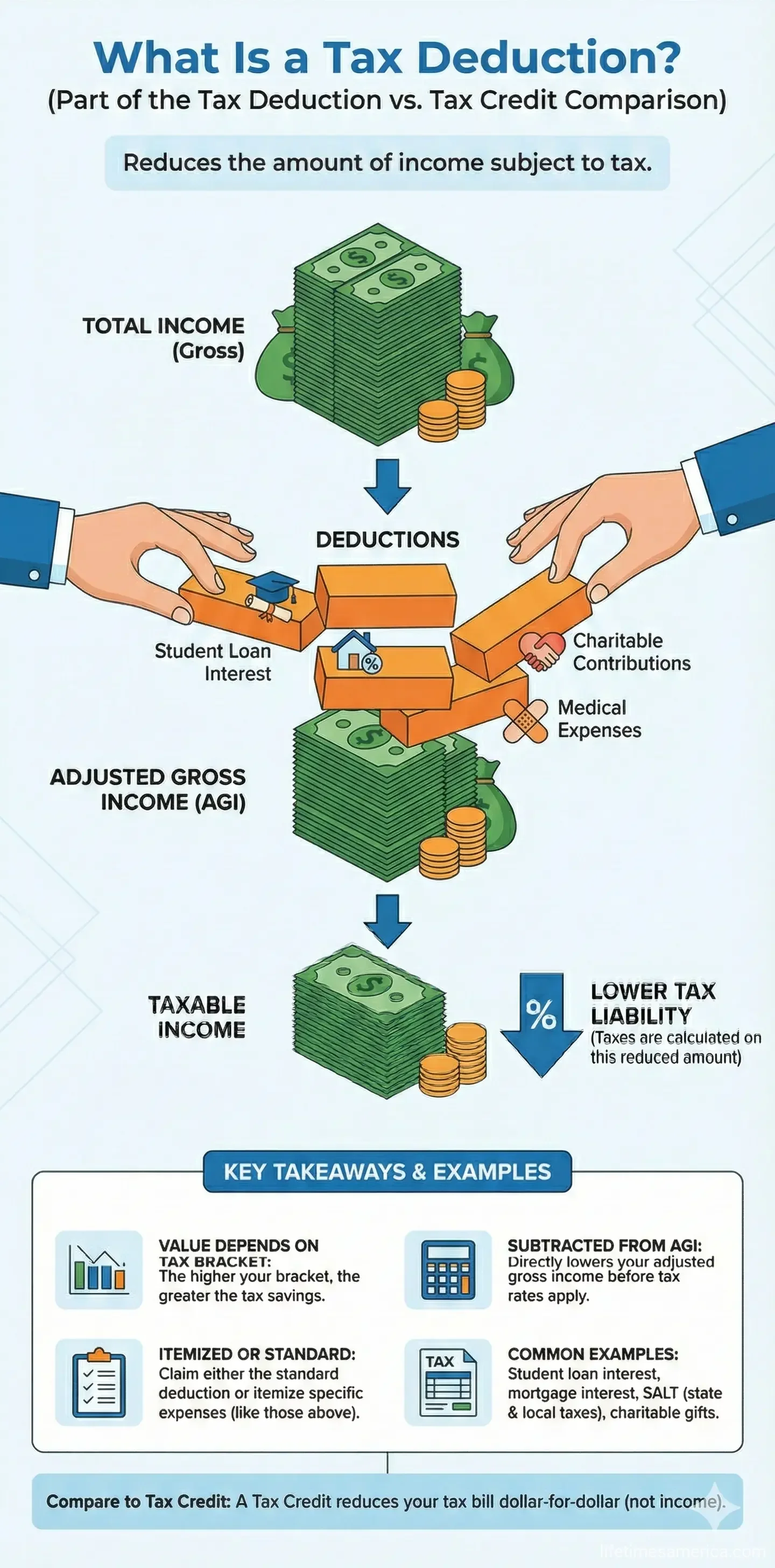
A tax deduction reduces your taxable income—the amount of your earnings that the IRS actually taxes. Instead of slashing your tax bill directly, it lowers the income base subject to your tax rate. For instance, if you earn $75,000 but claim $15,000 in deductions, you're taxed only on $60,000.
Deductions come in two flavors: the standard deduction (a flat amount based on filing status) or itemized deductions (a tally of eligible expenses like mortgage interest or charitable gifts). Most Americans—about 90%—take the standard deduction because it's simpler and often bigger than itemizing.
2026 Standard Deduction Amounts
The IRS adjusts these annually for inflation. For tax year 2026, here's what you can expect:
- Single or married filing separately: $16,200
- Head of household: $24,150
- Married filing jointly: $32,200
Note: These rise from 2025 levels ($15,750 single, $23,625 head of household, $31,500 joint). If your itemized expenses exceed these, list them on Schedule A of Form 1040.
How Much Does a Deduction Save You?
The savings? Your deduction amount multiplied by your marginal tax rate (your top bracket). Say you're single, earning $250,000 (35% bracket). A $2,000 deduction saves $700 (35% of $2,000). Drop to the 22% bracket? It's just $440.
Higher earners benefit more since deductions scale with your rate. But they can't drop taxable income below zero, and some face Alternative Minimum Tax (AMT) limits.
What Is a Tax Credit?
A tax credit is a direct knockout punch to your tax bill—dollar-for-dollar reduction in what you owe the IRS. Owe $2,000? A $1,000 credit drops it to $1,000. No math tricks involved.
Credits beat deductions hands-down for value. That same $1,000 credit saves the full $1,000, while a $1,000 deduction might save only $120-$370 depending on your bracket.
Refundable vs. Nonrefundable Credits
Not all credits are equal:
- Nonrefundable: Reduces your bill to zero max—no refund for extras. Example: Lifetime Learning Credit.
- Refundable: Zeroes your bill and sends a check for leftovers. Earned Income Tax Credit (EITC) is a prime example—if you owe $2,000 but qualify for $2,500 EITC, you get $500 back.
Eligibility often hinges on income, filing status, and specifics like kids or education. Always check IRS rules, as they evolve yearly.
Tax Deduction vs Tax Credit: Key Differences
Here's a side-by-side to make what is a tax deduction vs a tax credit crystal clear:
| Tax Deduction | Tax Credit | |
|---|---|---|
| Effect | Lowers taxable income | Lowers tax bill dollar-for-dollar |
| Value Example ($1,000) | Saves $120 (12% bracket) to $370 (37%) | Saves full $1,000 |
| Best For | Higher earners (scales with bracket) | Everyone, especially low/mid-income |
| Examples | Mortgage interest, charity | Child Tax Credit, EITC |
Bottom line: Credits win for raw savings, but you might qualify for both.
Common Tax Deductions for 2026
Maximize your return with these U.S.-specific staples:
- Mortgage interest: Up to $750,000 debt (post-2017 TCJA rules).
- State and local taxes (SALT): Capped at $10,000.
- Charitable contributions: Cash or goods to qualified nonprofits.
- Medical expenses: Over 7.5% of adjusted gross income (AGI).
- Student loan interest: Up to $2,500, phases out at higher incomes.
Pro tip: Use IRS Free File or tax software to compare standard vs. itemized—it's automatic.
Popular Tax Credits for Americans in 2026
These can supercharge refunds:
- Child Tax Credit: Up to $2,000 per kid under 17 (partially refundable).
- Earned Income Tax Credit (EITC): Huge for families; max $7,830 for three+ kids (refundable).
- American Opportunity Credit: Up to $2,500 for college tuition (partially refundable).
- Child and Dependent Care Credit: 20-35% of up to $3,000 childcare costs.
- EV Tax Credit: Up to $7,500 for qualifying electric vehicles.
Income limits apply—e.g., EITC phases out above $59,187 (single, one child). Visit IRS.gov for your eligibility.
Which Is Better: Deduction or Credit?
Credits almost always pack more punch—a $1,000 credit trumps any deduction. But deductions add up if you itemize big (think high mortgage + donations). Run the numbers: If you're in the 12% bracket, prioritize credits; 37% filers? Load up deductions too.
Actionable advice:
- Grab the standard deduction unless itemizing beats it by $1,000+.
- Hunt credits first—they're rarer and more potent.
- Use IRS withholding calculator to avoid surprises.
- File early for refundable credits.
Next Steps to Slash Your 2026 Taxes
Don't leave money on the table. Start by gathering W-2s, 1099s, and receipts now. Plug into free IRS tools like the Interactive Tax Assistant or Direct File pilot. If self-employed or complex (investments, business), grab a CPA—deduction errors cost $1B+ yearly in audits.
Track mid-year: Adjust W-4 withholding via IRS.gov. Donate smart, prep that IRA, or snag energy-efficient appliances for credits. You're in control—file by April 15, 2027, or extend to October.
Disclaimer: Tax laws shift; this isn't advice. Consult a tax pro or IRS.gov for your situation.
Frequently Asked Questions
Sources & References
-
1
Tax Credit vs. Tax Deduction: What's the Difference? - Experian — www.experian.com
-
2
Tax credit vs. deduction: What to know - Fidelity Investments — www.fidelity.com
-
3
What are tax credits and how do they differ from tax deductions? - Tax Policy Center — taxpolicycenter.org
- 4
- 5
-
6
What is a Tax Deduction? Basics and Tips to Know - Charles Schwab — www.schwab.com
-
7
Tax Deductions 2025-2026: What's New or Changed - TurboTax — turbotax.intuit.com
- 8
Useful Tools
Related Articles

How to Avoid the "Marriage Penalty" in the 2026 US Tax Code
Imagine tying the knot and then discovering your tax bill just skyrocketed—thousands of dollars higher than if you'd stayed single. That's the harsh reality of the marriage penalty in the US tax code,...

The Best "Side-Hustle" Tax Software for 2026 Filers
Running a side hustle in 2026 means juggling gigs like Uber driving, freelance graphic design, or selling handmade crafts on Etsy while keeping your day job. But come tax time, tracking those 1099-NEC...

How to Use "Tax-Loss Harvesting" to Offset Your 2026 Stock Gains
Imagine locking in hefty stock gains in 2026 only to watch a big chunk vanish to capital gains taxes. What if you could slash that tax bill without derailing your investment strategy? That's the power...

The Gig Economy Tax Guide: How to Deduct Your Car; Internet; and Office
If you're earning money through gig work—whether you're driving for a rideshare company, freelancing, delivering groceries, or running a side hustle—you're probably wondering how to keep more of what...