What Is the Stock Market and How Does It Work?

Imagine checking your phone one morning to see your retirement savings have grown overnight—or dipped—based on decisions made by millions of investors across America. That's the power of the stock mar...
The Lifetimes America editorial team curates, fact-checks, and updates guides on personal finance, property, health, immigration, legal, business, and lifestyle topics relevant to Lifetimes America readers. Articles are produced with AI assistance and reviewed by the editorial team before publication.
Imagine checking your phone one morning to see your retirement savings have grown overnight—or dipped—based on decisions made by millions of investors across America. That's the power of the stock market, a cornerstone of wealth-building for everyday Americans from coast to coast. Whether you're saving for a house, your kids' college, or a comfortable retirement, understanding how it works is your first step to making it work for you.
What Is the Stock Market?
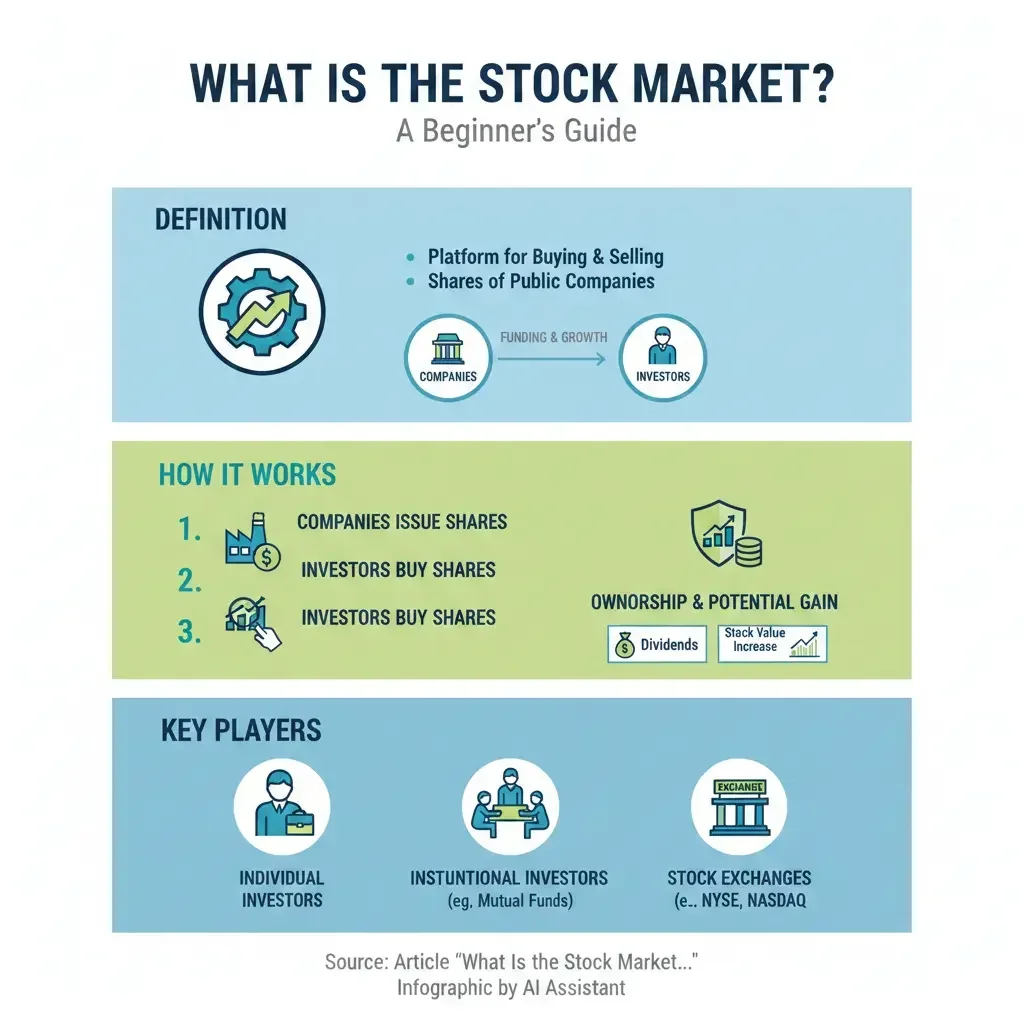
The stock market is the marketplace where shares of publicly traded companies are bought and sold, acting as a central hub—physical or digital—for investors, traders, and institutions to exchange ownership in businesses. It's not just a place to trade stocks; it's part of broader financial markets that include bonds, currencies, and commodities, helping companies raise capital while giving investors a shot at growing their wealth.
At its core, buying a stock means purchasing a small piece of ownership in a company. This gives you a claim on its assets and earnings, with prices fluctuating based on supply and demand, company performance, future expectations, and broader economic conditions. Unlike bonds or savings accounts, stocks offer potential for higher returns but come with greater risk—no two stocks are alike, making education essential for beginners.
Key Players in the U.S. Stock Market
- New York Stock Exchange (NYSE): The world's largest stock exchange, home to giants like Citigroup, Nike, and Walt Disney.
- Nasdaq: A tech-heavy exchange featuring companies such as Apple and Meta (formerly Facebook).
These exchanges operate as "secondary markets," where shares trade after a company's initial public offering (IPO)—the process of "going public" to sell shares and raise funds for growth, mergers, or acquisitions.
How Does the Stock Market Work?
When you place a buy or sell order through a broker or online platform, you're typically trading with another investor, not the company itself. Your order routes to an exchange like the NYSE, where electronic systems (and sometimes floor traders) match "bids" (what buyers will pay) with "asks" (what sellers want), executing the trade once they align.
Prices are set by market forces: strong earnings reports push prices up, while economic downturns or scandals pull them down. Institutional investors like mutual funds and pension funds drive much of the volume with large trades, while individual Americans add to the mix. In 2026, most trading is electronic, making it faster and more accessible than ever.
Understanding Stock Indexes
News headlines often say "the market is up," referring to major indexes that track groups of stocks:
- Dow Jones Industrial Average (DJIA): Follows 30 large U.S. companies, a snapshot of blue-chip stability.
- S&P 500: Tracks 500 leading U.S. firms, representing about 80% of the market's total value—widely seen as the best gauge of overall performance.
- Nasdaq Composite: Focuses on tech and growth stocks.
These indexes help investors benchmark their portfolios. Historically, the S&P 500 has averaged around 10% annual returns over long periods (including dividends), though years like 2008's -37% drop remind us of volatility.
Types of Stocks and Investments
Stocks vary by company size and style:
- Blue-Chip Stocks: Shares of large, established firms (large market cap) like those in the Dow—reliable with dividends.
- Growth Stocks: Often tech companies betting on rapid expansion, like Nasdaq listings.
Beyond individual stocks, beginners should consider:
| Investment Type | Description | Best For |
|---|---|---|
| Mutual Funds & Index Funds | Pools investor money to buy diversified stocks, often tracking an index like the S&P 500. | Hands-off diversification; lower risk than single stocks. |
| ETFs (Exchange-Traded Funds) | Like index funds but trade like stocks throughout the day. | Cost-effective, flexible trading for everyday investors. |
| Bonds | Loans to companies or governments, lower risk but modest returns. | Balancing a stock-heavy portfolio. |
Dividends—profit shares paid quarterly or annually—add income, especially from stable companies.
Why Invest in the Stock Market? U.S.-Specific Benefits
For Americans, the stock market is a proven path to retirement security. With 401(k)s and IRAs, you can invest pre-tax dollars, supercharging growth. In 2026, the IRS allows up to $23,500 in 401(k) contributions (plus $7,500 catch-up if 50+), with employer matches boosting your start. Tax-advantaged accounts like Roth IRAs let gains grow tax-free, ideal for long-term holding.
Over decades, stock investing beats inflation and builds wealth—think turning $10,000 into over $100,000 in 25 years at 10% average returns (before fees). It's democratic: platforms like Vanguard, Fidelity, or Robinhood let you start with $1 via fractional shares.
How to Get Started Investing in 2026
Ready to dive in? Follow these practical steps tailored for U.S. investors:
- Open a Brokerage Account: Choose FDIC/SIPC-insured brokers like Charles Schwab or E*TRADE. Link your bank for easy transfers.
- F fund Your Account: Start small—many have no minimums. Use direct deposit from your paycheck.
- Pick Investments: Beginners, opt for S&P 500 index funds or ETFs like VOO (Vanguard S&P 500 ETF) for instant diversification.
- Buy and Hold: Use dollar-cost averaging—invest fixed amounts regularly to smooth volatility.
- Monitor Taxes: Track capital gains; long-term holds (over 1 year) qualify for lower rates (0-20% in 2026).IRS.gov
Pro Tip: Enable automatic investing to build habits without timing the market.
Risks and How to Manage Them
Stocks can drop sharply—2022 saw the S&P 500 fall 20% amid inflation fears. Diversify across funds, avoid emotional selling, and keep 3-6 months' expenses in a high-yield savings account first. In the U.S., SIPC protects up to $500,000 per account if your broker fails, but not market losses.
Take the Next Step Toward Financial Freedom
The stock market isn't a get-rich-quick scheme—it's a marathon for building lasting wealth. Start by opening a brokerage account today, contribute to your 401(k) if available, and focus on low-cost index funds. With patience and discipline, you'll harness America's economic engine. Research thoroughly, invest consistently, and watch your future grow—your first trade could be the start of something big.
Frequently Asked Questions
Sources & References
-
1
Stock Market for Beginners: Basics & Tips for Investing - Britannica — www.britannica.com
-
2
Understanding the Stock Market: A Beginner's Guide — www.neamb.com
-
3
Stock Market for Beginners 2025/2026 – The Ultimate Investing Guide — www.youtube.com
-
4
Stock Market for Beginners 2026 Edition (Stock Market Basics) - Part 1 — www.youtube.com
-
5
Stock Market For Beginners 2026 | Step by Step Guide — www.youtube.com
-
6
How to start investing in the stock market in 2026 without panic? — www.finhabits.com
-
7
How to Invest in Stocks: 2026 Beginner's Guide - NerdWallet — www.nerdwallet.com
Related Articles

The Best "No-Fee" Brokerages for Fractional Shares in 2026
Imagine owning a slice of Amazon or Tesla without needing thousands of dollars upfront. That's the power of fractional shares, letting everyday Americans build diversified portfolios on any budget in...

The Best "Micro-Investing" Apps for Spare Change in 2026
Imagine turning your daily coffee run's spare change into a growing investment portfolio without lifting a finger. In 2026, micro-investing apps make it easier than ever for Americans to build wealth...
How to Hedge Against 2.8% Inflation: The Best Assets for 2026
Inflation at 2.8% might not grab headlines like the 9% peaks of a few years back, but it's still quietly eroding your purchasing power—think higher grocery bills, pricier gas, and rent that just keeps...

How to Use "Series I Bonds" as a 2026 Inflation Hedge
If you're worried about inflation eating away at your savings, Series I bonds offer a straightforward way to protect your purchasing power while earning a competitive return backed by the U.S. governm...