How to Catch Up on Retirement Savings in Your 40s and 50s

Feeling behind on retirement savings in your 40s or 50s? You're not alone—many Americans hit peak earning years while juggling family, mortgages, and unexpected expenses, but it's still possible to bu...
The Lifetimes America editorial team curates, fact-checks, and updates guides on personal finance, property, health, immigration, legal, business, and lifestyle topics relevant to Lifetimes America readers. Articles are produced with AI assistance and reviewed by the editorial team before publication.
Feeling behind on retirement savings in your 40s or 50s? You're not alone—many Americans hit peak earning years while juggling family, mortgages, and unexpected expenses, but it's still possible to build a solid nest egg with focused action.
With compound interest and catch-up contributions on your side, now's the time to ramp up. This guide breaks down practical steps tailored for U.S. workers, including 2026 IRS limits, to help you catch up effectively.
Assess Where You Stand: Retirement Savings Benchmarks
To catch up, first know your starting point. Financial experts recommend benchmarks based on your age and income, adjusted for lifestyle inflation.
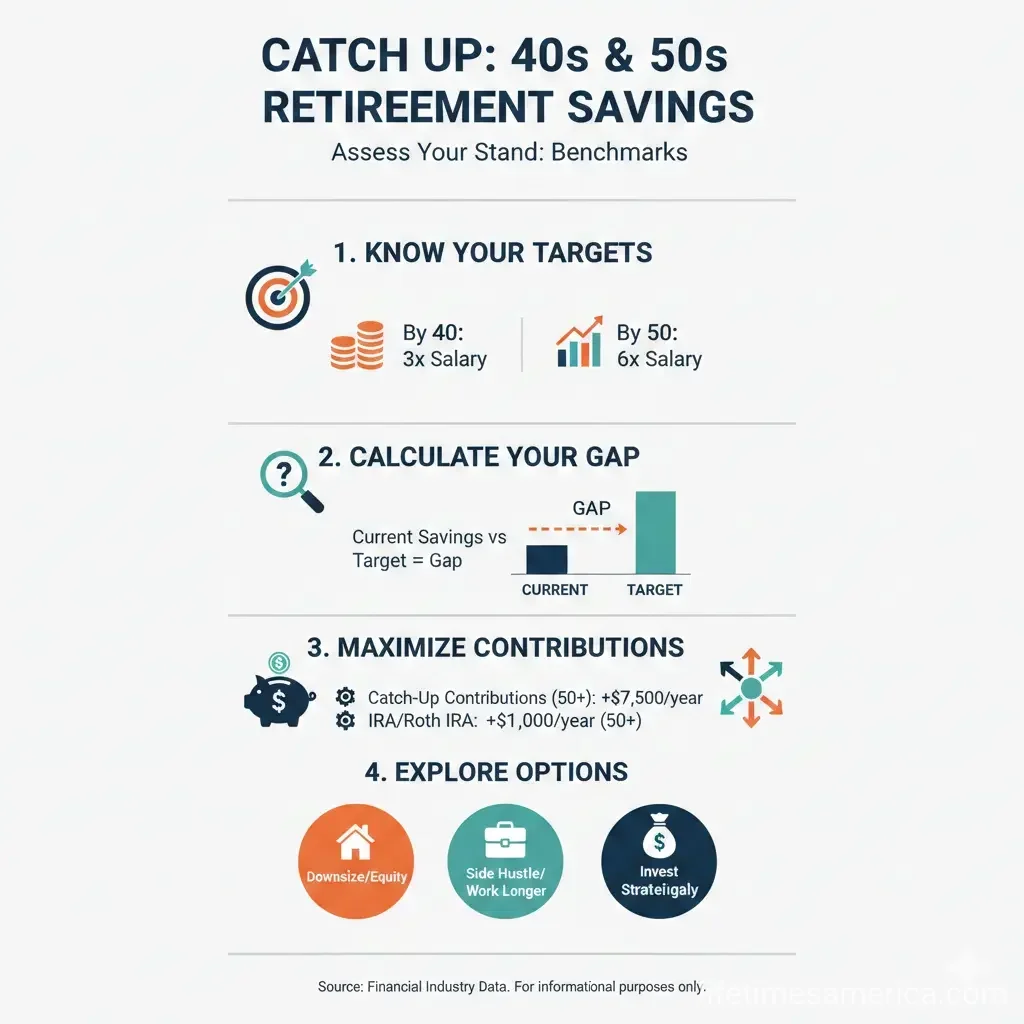
By age 45, aim for three times your current annual income saved. At 50, target five times your income, rising to seven times by 55. For example, if you earn $70,000 at 40, shoot for $210,000 saved; at 50 earning $100,000, aim for $500,000.
These goals leverage compound growth. A 40-year-old needs to save about $10,000 yearly at 9% returns to hit $1 million by 67—tough but doable with discipline.
Calculate Your Personal Benchmark
- Multiply your annual salary by the age-based multiplier (e.g., 4-5x at 50).
- Use free tools from IRS.gov or Fidelity's retirement calculator to project growth.
- Factor in Social Security estimates from ssa.gov—average benefits are around $1,900 monthly in 2026, but don't rely on them alone.
If you're short, don't panic. Small tweaks now yield big results later thanks to time and market returns.
Maximize Employer-Sponsored Plans Like 401(k)s
Your 401(k) is a powerhouse for catching up, especially with employer matches acting as free money.
Capture the Full Employer Match
Contribute at least enough to get every dollar of your employer's match—often 4-6% of salary. If you leave it on the table, you're missing instant returns. In your 40s, aim for 15-20% of income total savings; bump to 20%+ in your 50s.
Leverage 2026 Catch-Up Contributions
Turning 50? Supercharge with catch-up limits. For 2026, standard 401(k) contributions cap at $24,000 (up from $23,500 in 2025), but those 50-59 or 64+ get an extra $8,000, totaling $32,000. Workers 60-63 may qualify for even higher under SECURE 2.0 enhancements.
Plans like 403(b)s or 457(b)s follow similar rules. Automate 1-2% annual increases—your paycheck adjusts gradually, but savings soar.
"Bank raises and bonuses by increasing your contribution rate—this saves faster without pinching your budget."
Boost Savings with IRAs
IRAs offer flexibility beyond workplace plans. Everyone with earned income qualifies.
Traditional vs. Roth IRA: Which Fits?
Traditional IRAs provide upfront tax deductions; Roths grow tax-free for qualified withdrawals. 2026 limits: $7,500 under 50, $8,500 for 50+ (including $1,000 catch-up). Income limits apply for Roth deductibility—check irs.gov.
- No 401(k)? Start here.
- Have a 401(k)? Use IRA for extra savings.
- High earner? Consider Roth conversions for tax-free future income.
Roll Over Old 401(k)s
Consolidate forgotten 401(k)s from past jobs into an IRA. This cuts fees, simplifies tracking, and unlocks better investments. Avoid cashing out—taxes and penalties kill growth.
Tackle Debt and Cut Expenses
High-interest debt like credit cards (averaging 20%+ APR) sabotages savings. Pay off balances first—consider 0% balance transfers.
Trim lifestyle: Reduce dining out, subscriptions, or that extra car. Redirect savings to retirement. If you've saved 10% consistently, tweak habits; otherwise, push harder.
Practical Budget Hacks
- Track spending with apps like Mint or YNAB.
- Build a 3-6 month emergency fund in a high-yield savings account (5%+ rates in 2026).
- "Right-size" housing—downsize if kids leave home to free cash.
Optimize Your Investment Mix
In your 40s, prioritize growth: 80-100% stocks for long-term potential, riding out volatility. Shift in 50s to 80% stocks/20% bonds to cut risk without killing returns.
Rebalance annually. Low-cost index funds or target-date funds auto-adjust. Avoid timing the market—dollar-cost average via automations.
Extra Strategies for 2026
- Taxable Accounts: No limits, penalty-free access (earnings taxable).
- Side Hustles: Gig work or rentals funnel extra to retirement.
- Health Savings Accounts (HSAs): Triple tax-advantaged; 2026 family limit ~$8,500 + catch-up.
- RMD Planning: Starts at 73 (75 in 2033)—strategize now.
Common Mistakes to Avoid
- Borrowing from 401(k)—repayment risks and lost growth.
- Ignoring inflation (3% erodes purchasing power).
- Over-relying on home equity—it's not liquid.
Next Steps to Catch Up Today
Review your 401(k) statement, calculate benchmarks, and increase contributions by 1% this month. Consult a fiduciary advisor via napfa.org or use free IRS VITA tools. Track progress quarterly—you've got this!
Frequently Asked Questions
Sources & References
-
1
Saving for Retirement When You're in Your 40s — duncangrp.com
-
2
Saving for Retirement at 40 or 50 - American Century Investments — www.americancentury.com
-
3
Retirement Benchmarks by Age: Strategies to Save — www.soundcu.com
-
4
Retirement savings by age: What to do with your portfolio — www.troweprice.com
-
5
6 Retirement Habits to Build in 2026 | PensionBee (US) — www.pensionbee.com
-
6
7 Smart Money Moves for 2026 Retirement Planning — www.fidelity.com
-
7
9 Ways Your Retirement Planning Will Change in 2026 - AARP — www.aarp.org
-
8
Retirement Savings Approaches by Decade — www.ccfcu.org
-
9
9 Best Retirement Plans In 2025 — www.bankrate.com
- 10
Useful Tools
Related Articles

The Best States for "Tax-Free" Retirement Income in 2026
Imagine waking up in your dream retirement spot, sipping coffee on a sunny porch, knowing your hard-earned Social Security checks, pensions, and 401(k) withdrawals won't get hit with state income taxe...

How to Use your 401(k) to Buy Your First House: The Hidden Risks
Picture this: You've scrimped and saved for years, eyeing that perfect starter home in your neighborhood. But the down payment feels like an insurmountable hurdle. In a pinch, your 401(k) balance star...

The Hidden Fees of 401(k) Plans: How to Save $100k over 30 Years
Imagine discovering that tiny, unnoticed fees in your 401(k) are quietly siphoning away enough money to buy a vacation home or fund a comfortable retirement. Over 30 years, cutting just 1% in hidden f...

The Best "Self-Directed" IRA Platforms for Real Estate and Private Equity
Imagine unlocking the full potential of your retirement savings by investing in rental properties, private equity deals, or even startups—all tax-deferred or tax-free within a self-directed IRA. For A...