What Is an Umbrella Insurance Policy and Who Needs It?

Imagine you're driving home one evening when a split-second distraction leads to a serious accident. Medical bills pile up, lawsuits follow, and suddenly you're facing millions in damages that your st...
The Lifetimes America editorial team curates, fact-checks, and updates guides on personal finance, property, health, immigration, legal, business, and lifestyle topics relevant to Lifetimes America readers. Articles are produced with AI assistance and reviewed by the editorial team before publication.
Imagine you're driving home one evening when a split-second distraction leads to a serious accident. Medical bills pile up, lawsuits follow, and suddenly you're facing millions in damages that your standard auto insurance can't touch. This nightmare scenario is why so many Americans are turning to umbrella insurance policies—an extra layer of protection that safeguards your hard-earned assets from life's unexpected turns.
In the United States, where personal injury lawsuits average over $50,000 and can skyrocket into the millions, understanding what an umbrella insurance policy is and who needs it is crucial for financial security. Whether you own a home, drive a car, or have a family, this guide breaks it down with practical advice tailored for everyday Americans.
What Is an Umbrella Insurance Policy?
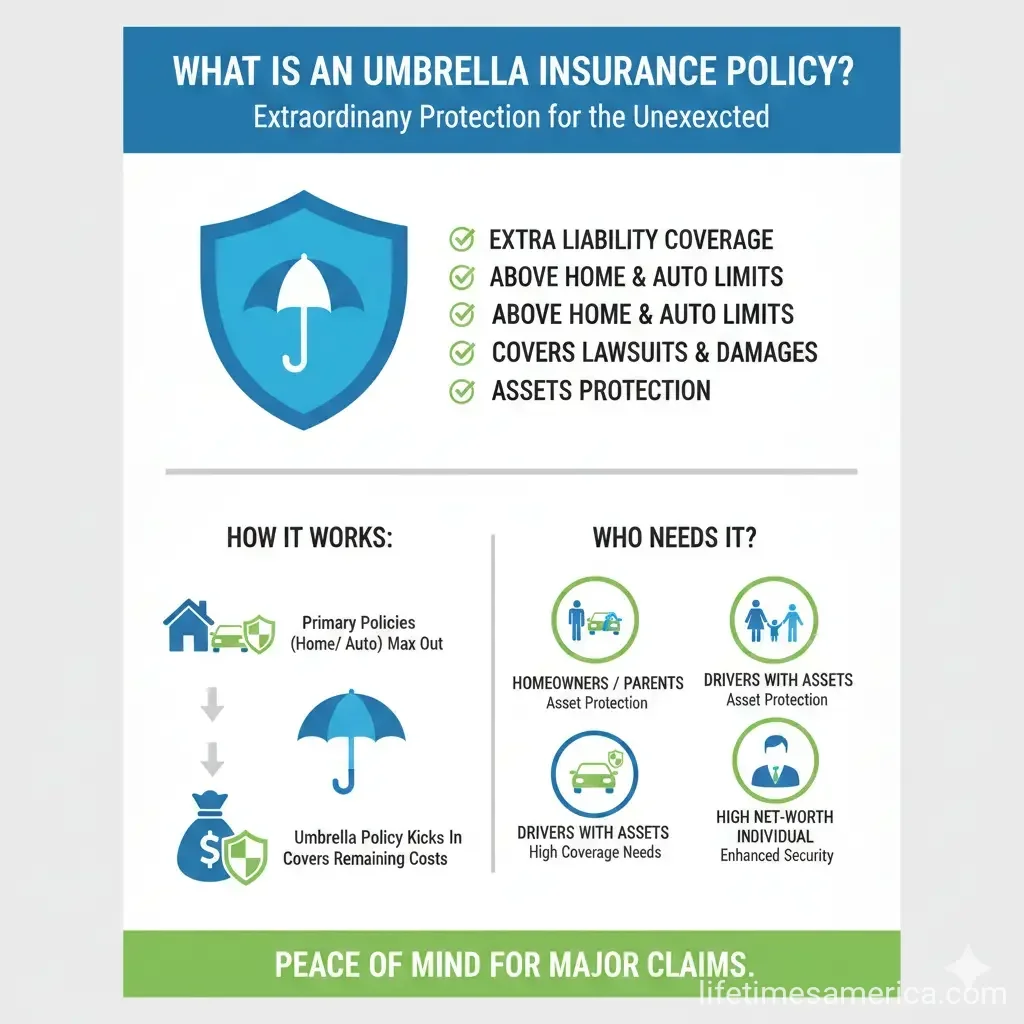
An umbrella insurance policy is extra liability coverage that kicks in after your primary policies—like homeowners, auto, or renters insurance—reach their limits. It acts as a safety net, providing broad protection against massive claims that could otherwise wipe out your savings, home, or retirement accounts.
How Does Umbrella Insurance Work?
Umbrella policies typically offer $1 million or more in coverage, starting only after your underlying policies are exhausted. For instance, if your auto policy has a $300,000 bodily injury limit but a crash results in $1.2 million in damages, your umbrella would cover the remaining $900,000 (minus any deductible).
Here's a real-world example: You're at fault in a multi-car pileup causing $4 million in injuries. Your primary auto policy pays the first $1 million, and your $5 million umbrella handles the rest—saving you from personal bankruptcy.
Key mechanics include:
- Excess Liability: Covers costs exceeding primary policy limits on home, auto, boat, or RV insurance.
- Broadened Coverage: Handles claims often excluded elsewhere, like libel, slander, false arrest, or liability from rental properties.
- Legal Defense: Pays attorney fees and court costs, even if the claim is baseless.
Most policies require minimum underlying limits, such as $300,000 on homeowners liability, to qualify.
What Does Umbrella Insurance Cover?
Umbrella policies focus on liability, protecting you if you're legally responsible for:
- Bodily Injury: Medical bills, lost wages, or pain and suffering for others hurt in accidents on your property or caused by you.
- Property Damage: Repairs to someone else's home, car, or belongings beyond your standard coverage.
- Personal Injury: Non-physical harms like defamation, invasion of privacy, or malicious prosecution.
- Worldwide Protection: Covers incidents anywhere in the world, as long as you reside in the U.S.
"Umbrella insurance provides coverage for injuries, property damage, certain lawsuits, and personal liability situations."
It usually extends to family members in your household, including children and even pets in some cases.
What Doesn't Umbrella Insurance Cover?
Umbrellas aren't all-inclusive. Common exclusions include:
- Intentional acts or criminal behavior.
- Business-related liabilities (consider commercial umbrellas for that).
- Your own injuries or property damage.
- Contractual liabilities or professional malpractice.
- Flood, earthquake, or other perils covered by specialized policies.
Always review policy details, as terms vary by insurer.
Who Needs Umbrella Insurance in the United States?
Not everyone needs an umbrella policy, but it's essential for those with assets to protect. In 2026, with rising litigation risks—from social media defamation to gig economy accidents—high-net-worth individuals and families face greater exposure.
Top Profiles for Umbrella Coverage
Consider an umbrella if you fit these common scenarios:
- Homeowners with Pools, Trampolines, or Dogs: These "attractive nuisances" invite lawsuits; a child injured at your home could lead to claims exceeding $500,000.
- Multiple Vehicles or High-Value Assets: Families with teens driving or owners of boats/RVs need extra layers.
- Rental Property Owners: Covers tenant injuries or damage not handled by standard landlord policies.
- High-Income Professionals: Doctors, lawyers, or executives with savings, 401(k)s, or homes at risk from judgments.
- Social Media Users or Public Figures: Protects against libel/slander claims in our litigious culture.
- Parents of Young Drivers: Teen accidents often result in massive payouts.
If your net worth exceeds your primary liability limits, an umbrella is a smart buy. For example, with $500,000 in assets but only $250,000 in coverage, you're vulnerable.
How Much Does Umbrella Insurance Cost in 2026?
Good news: Umbrellas are affordable. A $1 million policy averages $150–$300 annually, often less than $25 monthly—far cheaper than a single lawsuit defense.
Factors affecting premiums:
| Factor | Impact on Cost |
|---|---|
| Higher Limits (e.g., $2M+) | Increases premium by 50–100% |
| Clean Driving Record | Lowers cost |
| High-Risk Features (pool, dog breed) | Raises rates 20–50% |
| Bundling with Primary Policies | Saves 10–20% |
Shop via agents or online quotes from GEICO, Allstate, or American Family for the best 2026 rates.
Steps to Get Umbrella Insurance
- Review Current Policies: Ensure underlying limits meet requirements (e.g., $300,000 homeowners liability).
- Assess Your Risks: Calculate net worth vs. coverage gaps using free online tools.
- Get Quotes: Compare at least three insurers; mention bundling for discounts.
- Buy and Maintain: Update as assets grow; notify your agent of life changes like buying a boat.
For official guidance, check state insurance departments via NAIC.org or usa.gov insurance resources.
Protect Your Future Today
Umbrella insurance offers peace of mind at a fraction of potential losses. Take action now: Inventory your assets, review policies, and get quotes. Contact your agent or visit insurers like GEICO or Allstate online. In 2026's unpredictable world, don't leave your American dream exposed—secure that extra layer today.
Frequently Asked Questions
Sources & References
-
1
What is “Umbrella Insurance” and What Does it Cover? - OneDigital — www.onedigital.com
-
2
Umbrella Insurance - How it Works & What it Covers - GEICO — www.geico.com
-
3
Umbrella Insurance: What It Is & What It Covers | Allstate — www.allstate.com
- 4
- 5
-
6
Umbrella Insurance: Coverage & How It Works (2026 Guide) - NerdWallet — www.nerdwallet.com
-
7
What's an Umbrella Policy? - NAIC — content.naic.org
-
8
Why umbrella coverage is essential in 2026 - VIU by HUB — www.viubyhub.com
-
9
What is an Umbrella Insurance Policy? - Novatae — novatae.com
-
10
What is Umbrella Insurance? | Atlas Insurance Brokers — www.atlasinsurancerochester.com
Related Articles

The Best "Business Insurance" for E-commerce Sellers in 2026
Running an e-commerce business in 2026 means thriving amid booming online sales, but it also exposes you to unique risks like data breaches, product defects, and shipping mishaps. The best business in...

How to Use "Universal Life" Insurance for Executive Bonus Plans
Imagine rewarding your top executive with a benefit that protects their family, builds retirement wealth, and costs your business next to nothing after taxes. That's the power of using universal life...

How to Use "Infinite Banking" to Buy Your Next Car
Tired of watching your hard-earned money disappear when you buy a car? There's a financial strategy that's gaining traction among savvy Americans who want to keep more money in their own pockets. It's...

How to Use "Life Settlements" to Sell Your Life Insurance for Cash
Imagine holding a life insurance policy that's become more burden than benefit—premiums eating into your retirement savings, or changed family needs making the death benefit unnecessary. A life settle...