How to Dispute an Error on Your Credit Report

Finding an error on your credit report can feel stressful, but you have more power than you might think. Whether it's a collections account you don't recognize, an incorrect balance, or a debt that sh...
The Lifetimes America editorial team curates, fact-checks, and updates guides on personal finance, property, health, immigration, legal, business, and lifestyle topics relevant to Lifetimes America readers. Articles are produced with AI assistance and reviewed by the editorial team before publication.
Finding an error on your credit report can feel stressful, but you have more power than you might think. Whether it's a collections account you don't recognize, an incorrect balance, or a debt that should've aged off, you can dispute inaccurate information for free. The good news? The process is straightforward, and federal law is on your side. Here's everything you need to know to get errors removed and protect your credit score.
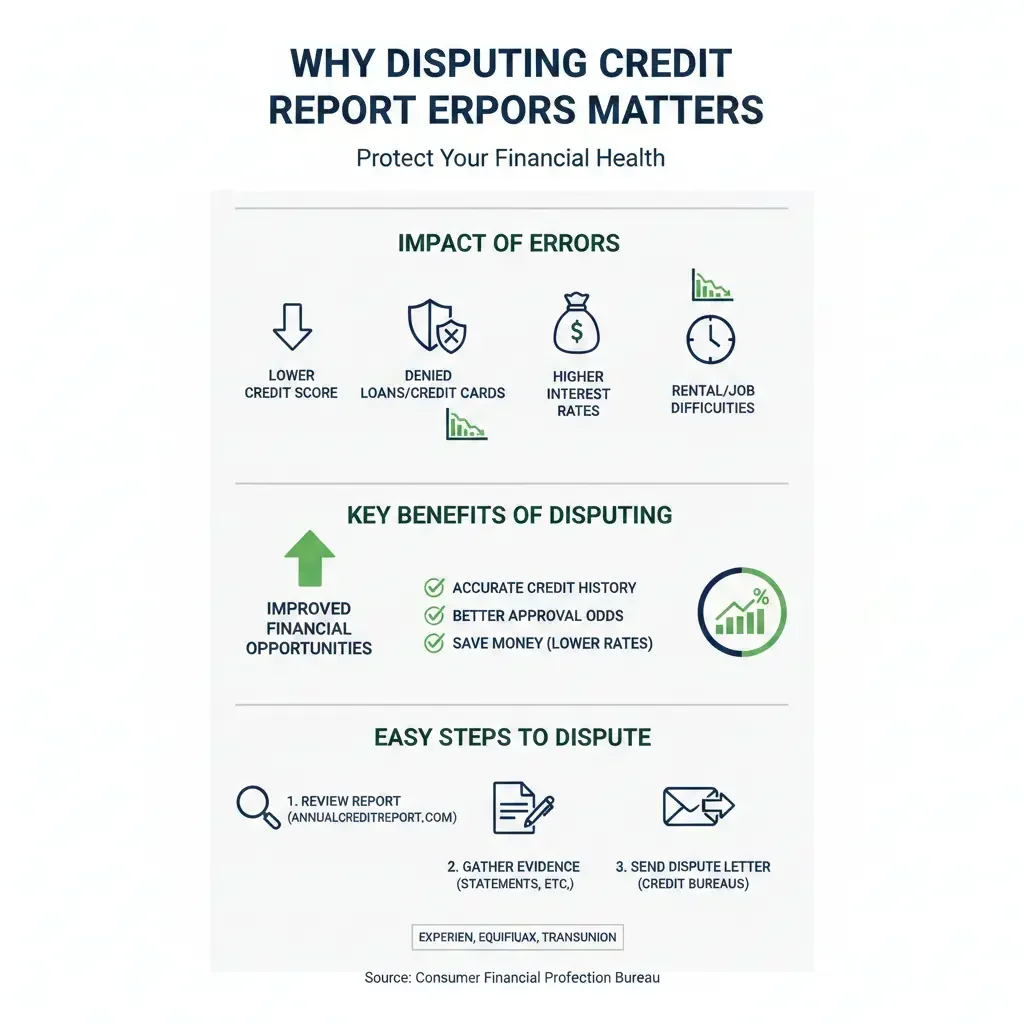
Why Disputing Credit Report Errors Matters
Your credit report directly impacts your financial life. Lenders use it to decide whether to approve you for loans, credit cards, and mortgages—and what interest rates they'll offer you. Even one error can tank your credit score and cost you thousands in higher interest payments. That's why the Fair Credit Reporting Act gives you the right to dispute inaccurate or incomplete information at no cost.
Common errors worth disputing include:
- Collections accounts you don't recognize
- Incorrect account numbers or balances
- Wrong payment dates or account status
- Debts that should have aged off (typically after 7 years)
- Duplicate accounts listed multiple times
- Accounts belonging to someone else due to identity theft
Step 1: Get Your Credit Reports and Spot the Errors
You can't dispute what you don't know about. Start by pulling your free credit reports from all three major bureaus—Equifax, Experian, and TransUnion. You're entitled to one free report from each bureau every 12 months through AnnualCreditReport.com, the official source authorized by the Federal Trade Commission.
Review each report carefully and look for:
- Collections accounts you don't recognize
- Incorrect account numbers or account information
- Wrong balances or dates
- Errors tied to credit inquiries or court judgments
- Debts that should have aged off your report
Write down the specific errors and keep copies of your reports. If you pulled them online, save the credit report confirmation number—you'll need this when you file your dispute.
Step 2: Decide Who to Dispute With
You have two options for disputing errors, and you can do both:
Option A: Dispute With the Credit Bureau
This is usually your first move. Contact the credit reporting agency that has the error on their report. You can dispute with Equifax, Experian, TransUnion, or all three if the error appears on multiple reports.
Option B: Dispute With the Creditor or Data Furnisher
You can also dispute directly with the company that reported the inaccurate information to the credit bureau—your bank, credit card company, collection agency, or lender. This can be effective because if the creditor confirms the information is wrong, they must notify the credit bureau to update or delete it.
Step 3: File Your Dispute
You can submit your dispute in three ways:
- Online through the credit bureau's dispute center
- By mail using a dispute letter
- By phone (though written disputes are recommended)
Submitting Your Dispute Online
Most credit bureaus offer online dispute portals on their websites. This is the fastest method. You'll typically need to provide:
- Your full name and address
- Email address
- A copy of a government-issued ID (driver's license or state ID)
- A copy of a utility bill, bank statement, or insurance statement
- The specific account and error you're disputing
Disputing by Mail (Recommended for a Paper Trail)
Writing a formal dispute letter creates documentation that protects you. Here's what to include:
- Your complete name, address, and phone number
- Credit report confirmation number (if available)
- Each error you want fixed, including the account number
- A clear explanation of why you're disputing the information
- A request that the information be removed or corrected
- A copy of the portion of your credit report with the disputed items circled or highlighted
- Copies (not originals) of supporting documents that prove the error
Always use certified mail with return receipt requested. Keep the confirmation code and copies of everything you send. This creates a paper trail that protects you if you need to escalate the dispute.
Step 4: Understand What Happens Next
Once you file your dispute, the credit reporting agency has 30 days to investigate (up to 45 days in certain circumstances). During this time, they contact the creditor or debt collector to verify the information.
Here's what the credit bureau will do:
- Review all information you provided about your dispute
- Contact the business reporting the disputed information
- Instruct them to investigate and verify the accuracy
- Collect their response and any changes they're making
- Notify you of the results in writing
If the creditor can't verify the information within the timeframe, it must be removed from your report.
Possible Outcomes
- The collections account is deleted — The error is removed entirely
- The information is corrected — The balance, date, or other details are fixed
- The account is verified and remains — The creditor confirmed the information is accurate
If the account remains without proper verification of debt, you may have grounds for further action, including consulting with a consumer attorney.
Recent Changes to the Dispute Process (2026)
The Consumer Financial Protection Bureau (CFPB) recently updated credit report dispute procedures to strengthen consumer protections. The changes ensure that disputes receive substantive review rather than being dismissed on procedural grounds. This means:
- Credit bureaus must provide clearer acknowledgment of disputed facts
- Companies must give more detailed responses instead of generic explanations
- Disputes involving repeated inaccuracies receive more careful review
- The focus is on meaningful investigation, not just processing complaints
From your perspective, the dispute process remains the same—you still provide documentation and clear explanations. But the updated rules make it less likely your dispute will be dismissed without real review.
Tips for Success
- Be specific. Don't just say "this is wrong." Explain exactly what's inaccurate and why.
- Include supporting documents. Send copies of bank statements, payment records, letters from creditors, or any evidence supporting your claim.
- Dispute all three bureaus if needed. An error on one bureau might appear on others. Dispute with each one that has the mistake.
- Keep records. Save copies of your dispute letter, supporting documents, and any responses you receive.
- Follow up. If you don't hear back within 30-45 days, contact the credit bureau to check on your dispute status.
- Request a statement. If a dispute doesn't resolve the issue, you can ask for a brief statement to be added to your credit report explaining your side.
What to Do If Your Dispute Is Rejected
If the credit bureau decides your dispute is "frivolous" or "irrelevant," they must notify you within five business days and explain why. This typically happens if you don't provide enough information for them to investigate.
If this happens:
- Provide additional evidence or documents to support your dispute
- Resubmit with a clearer explanation of the error
- Dispute directly with the creditor instead
- Consider consulting a consumer attorney if the error is significant
Frequently Asked Questions
Sources & References
-
1
AnnualCreditReport.com — www.annualcreditreport.com
-
2
FTC Dispute Guide — consumer.ftc.gov
-
3
Consumer Financial Protection Bureau (CFPB) — www.consumerfinance.gov
-
4
Equifax Dispute — www.equifax.com
-
5
Experian Dispute — www.experian.com
-
6
Fair Credit Attorneys — How to Dispute Collections on Your Credit Report: 2026 Guide — faircreditattorneys.com
-
7
Federal Trade Commission — Disputing Errors on Your Credit Reports — consumer.ftc.gov
-
8
AnnualCreditReport.com — Filing a Dispute — www.annualcreditreport.com
-
9
Consumer Financial Protection Bureau — How do I dispute an error on my credit report? — www.consumerfinance.gov
-
10
Consumer Data Industry Association (CDIA) — How to dispute an error — www.cdiaonline.org
-
11
Mortgage Processor — CFPB Revises Credit Report Dispute Process in Move to Strengthen Consumer Protections — www.mortgageprocessor.org
Related Articles
What Is a Credit Report and How Is It Different from a Credit Score?
Ever wondered why your loan application got approved with a great rate—or denied outright? It often boils down to two key pieces of your financial puzzle: your credit report and credit score. While pe...

How to Build Credit from Scratch in the USA
Imagine landing your dream apartment in a bustling American city, only to hear "sorry, we need a credit score of at least 650." Or applying for that first car loan after college and getting denied bec...

How to Increase Your Credit Score by 100 Points in 6 Months
Imagine unlocking lower mortgage rates, snagging that dream car loan without sky-high interest, or even qualifying for a premium credit card—all because your credit score jumped 100 points in just six...

What Is a Good Credit Score in the USA?
Imagine landing your dream home or snagging that low-interest auto loan, only to watch it slip away because of one number on your credit report. That number—your credit score—holds more power over you...