What Are Index Funds and Why Do Experts Recommend Them?

Imagine building wealth without picking individual stocks, dodging high fees, or timing the market. That's the promise of index funds—a straightforward strategy that's captured the attention of everyd...
The Lifetimes America editorial team curates, fact-checks, and updates guides on personal finance, property, health, immigration, legal, business, and lifestyle topics relevant to Lifetimes America readers. Articles are produced with AI assistance and reviewed by the editorial team before publication.
Imagine building wealth without picking individual stocks, dodging high fees, or timing the market. That's the promise of index funds—a straightforward strategy that's captured the attention of everyday Americans and Wall Street pros alike. In 2026, with retirement accounts like 401(k)s and IRAs relying more on these low-cost powerhouses, understanding index funds could be your smartest financial move yet.
What Are Index Funds?
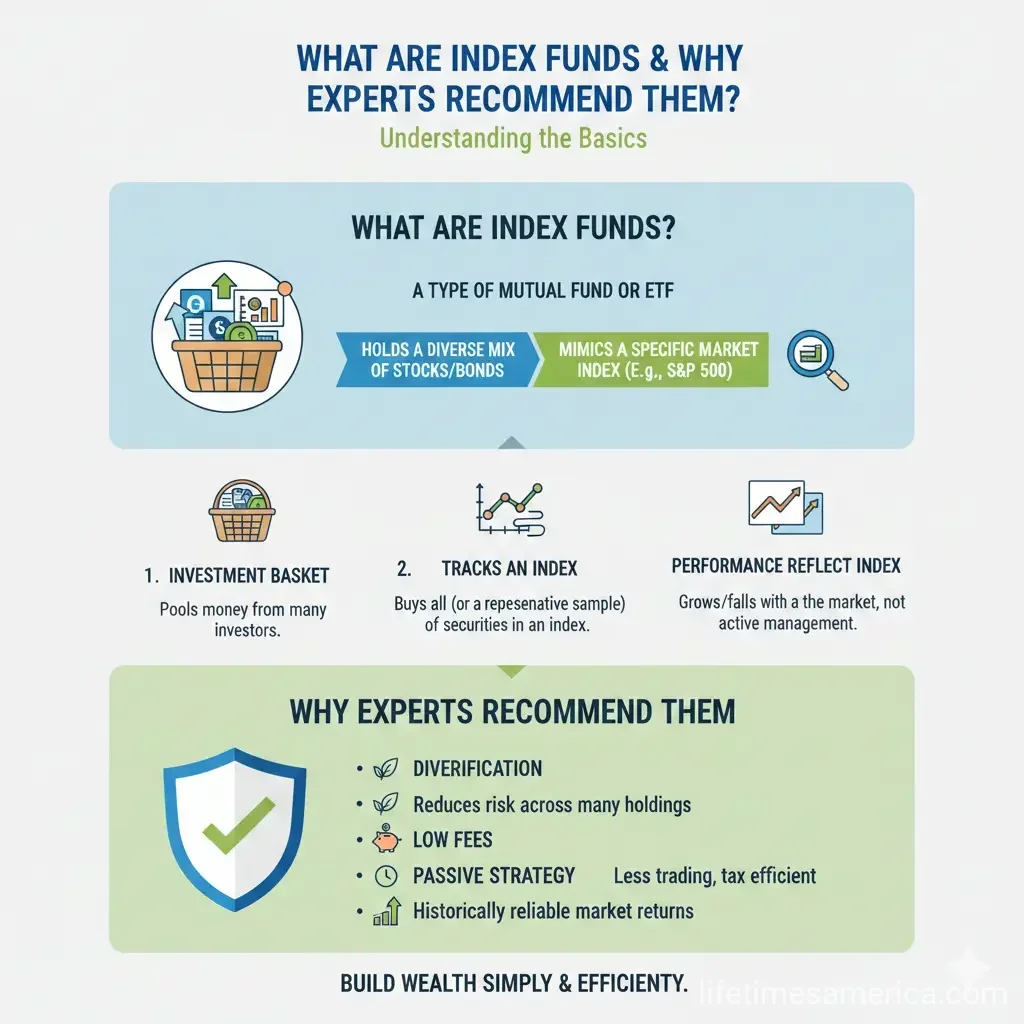
Index funds are investment vehicles, typically mutual funds or exchange-traded funds (ETFs), designed to replicate the performance of a specific market index, such as the S&P 500 or Dow Jones Industrial Average. Instead of a fund manager hand-picking stocks to beat the market, the fund simply buys all—or a representative sample of—the securities in that index, mirroring its composition and weighting.
For Americans, this means owning a slice of the U.S. economy with one purchase. An S&P 500 index fund, for example, gives you exposure to 500 of the largest U.S. companies like Apple, Microsoft, and Amazon, automatically diversified across tech, healthcare, finance, and more. You can't invest directly in an index, but index funds make it accessible through brokerage accounts, retirement plans, or apps like Vanguard or Fidelity.
How Do Index Funds Work?
Here's the simple mechanics: The fund manager tracks the index's rules. If the S&P 500 rises 7% in a year, the fund aims for roughly the same return, minus minimal fees. They come in two main forms:
- Index Mutual Funds: Bought or sold at the end of the trading day based on the net asset value (NAV). Ideal for long-term holders in 401(k)s.
- Index ETFs: Trade like stocks throughout the day on exchanges, offering flexibility and often lower minimums. Popular for taxable brokerage accounts.
This passive approach contrasts with actively managed funds, where managers trade frequently to outperform the market—a goal they rarely achieve long-term.
Why Do Experts Recommend Index Funds?
Financial heavyweights like Vanguard founder John Bogle and Warren Buffett endorse index funds for their proven track record. Buffett famously bet $1 million that an S&P 500 index fund would outperform a group of hedge funds over 10 years—and won handily. Experts recommend them because they deliver reliable results through four core strengths: low costs, diversification, tax efficiency, and performance predictability.
1. Lower Costs That Compound Over Time
Index funds shine with rock-bottom expense ratios—often under 0.10% annually—compared to 0.5-1% or more for active funds. In 2026, Vanguard's S&P 500 ETF (VOO) charges just 0.03%, meaning for every $10,000 invested, you pay only $3 yearly in fees. Over decades, this savings compounds massively. Saving 0.5% in fees could add hundreds of thousands to your retirement nest egg, per compounding calculations.
For U.S. investors maxing 401(k)s ($23,500 limit in 2026 for those under 50), low fees preserve more for growth.
2. Built-In Diversification Reduces Risk
One fund buys hundreds or thousands of stocks, bonds, or assets, spreading risk so one bad apple doesn't spoil your portfolio. An S&P 500 fund covers multiple sectors and industries; a total market fund adds mid- and small-caps for even broader U.S. exposure. This lowers volatility compared to individual stocks—think buffering against a tech crash or energy slump.
"By investing in an index fund, you essentially own a small piece of every investment within the index, which helps diversify risk and could lead to long-term growth."
3. Tax Efficiency for Taxable Accounts
Passive trading means fewer buys and sells, generating minimal capital gains distributions—key for non-retirement accounts. In higher tax brackets, this keeps more money compounding. Active funds' frequent trading often triggers taxable events, hiking your IRS bill. Pair with tax-advantaged accounts like Roth IRAs for optimal results.
4. Predictable Performance and Discipline
Index funds track the market closely, offering predictable returns near the benchmark—unlike active funds' wide performance swings. They foster discipline: set-it-and-forget-it investing avoids emotional trades chasing hot stocks. Data shows investors in active funds chase performance twice as reactively as index holders. For long-term goals like Medicare supplementation or college funds, this reliability wins.
Types of Index Funds for American Investors
Tailor index funds to your needs. Here's a breakdown:
| Type | Description | Best For |
|---|---|---|
| S&P 500 or Large-Cap | Tracks top 500 U.S. companies | Core U.S. equity exposure, retirement growth |
| Total Stock Market | Covers large-, mid-, small-cap U.S. stocks | Broad domestic diversification |
| International | Developed/emerging markets | Global balance, currency hedging |
| Bond Index | U.S. Treasuries, corporates | Income, stability in IRAs |
| Dividend or ESG | Consistent payers or ethical firms | Income or values-aligned investing |
Combine a few—like 60% U.S. stocks, 25% international, 15% bonds—for a balanced portfolio.
How to Get Started with Index Funds in the U.S.
It's easier than ever in 2026. Follow these actionable steps:
- Open an Account: Use brokerage like Vanguard, Fidelity, or Schwab—many offer commission-free ETF trades. For employer plans, check your 401(k) options.
- Choose Funds: Start with VTI (Vanguard Total Stock Market ETF) or SPY (S&P 500 ETF). Minimums are low—often $1 or none.
- Invest Regularly: Dollar-cost average: $500/month beats lump sums for most. Automate via 401(k) contributions or IRA auto-debits.
- Monitor Taxes: Use Roth IRAs for tax-free growth (2026 limit: $7,000 under 50). Track via IRS Form 1099.
- Rebalance Annually: Adjust to your target allocation, like 80/20 stocks/bonds if nearing retirement.
Pro Tip: Fidelity and Vanguard apps let you screen for ultra-low-fee funds matching your risk tolerance.
Pros and Cons of Index Funds
Pros:
- Low fees and easy access
- Instant diversification
- Tax-smart and hands-off
- Historical market-matching returns (S&P 500 averaged ~10% annually long-term)
Cons:
- No market-beating potential—delivers average returns
- Vulnerable in downturns (no downside protection)
- Some mutual funds have high minimums ($3,000+)
- Taxable distributions possible
Ready to Build Wealth with Index Funds?
Index funds offer Americans a proven path to financial security: low-cost, diversified, and expert-backed. Start small—open a Vanguard or Fidelity account today, pick an S&P 500 ETF, and automate contributions. Over 20-30 years, consistent investing could grow your savings exponentially. Consult a fiduciary advisor for personalized advice, and remember: time in the market beats timing the market. Your future self will thank you.
Frequently Asked Questions
Sources & References
-
1
What are index funds? Definition and examples - StoneX — www.stonex.com
-
2
What is an index fund? - Vanguard — investor.vanguard.com
-
3
Index Funds Are: How They Work And Why Investors Use Them - HeyGoTrade — www.heygotrade.com
-
4
What is an index fund and how does it work? - Fidelity Investments — www.fidelity.com
-
5
Four reasons to invest with index funds - Vanguard — www.nl.vanguard
-
6
The Best Index Funds and How to Start Investing - NerdWallet — www.nerdwallet.com
-
7
This ONE Index Fund Fixes Your Portfolio in 2026 - YouTube — www.youtube.com
-
8
What Are Index Funds And How Do They Work? - iShares — www.ishares.com
-
9
The Benefits of Index Investing | Provident Financial Planning — providentfp.com
Related Articles

The Best "No-Fee" Brokerages for Fractional Shares in 2026
Imagine owning a slice of Amazon or Tesla without needing thousands of dollars upfront. That's the power of fractional shares, letting everyday Americans build diversified portfolios on any budget in...

The Best "Micro-Investing" Apps for Spare Change in 2026
Imagine turning your daily coffee run's spare change into a growing investment portfolio without lifting a finger. In 2026, micro-investing apps make it easier than ever for Americans to build wealth...
How to Hedge Against 2.8% Inflation: The Best Assets for 2026
Inflation at 2.8% might not grab headlines like the 9% peaks of a few years back, but it's still quietly eroding your purchasing power—think higher grocery bills, pricier gas, and rent that just keeps...
How to Use "Series I Bonds" as a 2026 Inflation Hedge
If you're worried about inflation eating away at your savings, Series I bonds offer a straightforward way to protect your purchasing power while earning a competitive return backed by the U.S. governm...