How to Build Business Credit from Scratch

Imagine launching your dream business only to hit a wall when seeking loans or favorable supplier terms because you lack a business credit history. For American entrepreneurs starting from scratch, bu...
The Lifetimes America editorial team curates, fact-checks, and updates guides on personal finance, property, health, immigration, legal, business, and lifestyle topics relevant to Lifetimes America readers. Articles are produced with AI assistance and reviewed by the editorial team before publication.
Imagine launching your dream business only to hit a wall when seeking loans or favorable supplier terms because you lack a business credit history. For American entrepreneurs starting from scratch, building business credit is the key to unlocking better financing options, lower interest rates, and stronger vendor relationships—without relying solely on your personal credit score.
Whether you're a sole proprietor forming your first LLC or scaling an existing venture, this guide walks you through a proven, step-by-step process tailored for U.S. businesses in 2026. You'll learn practical actions to establish your business credit profile quickly and effectively, drawing on resources from the IRS, SBA, and top credit bureaus.
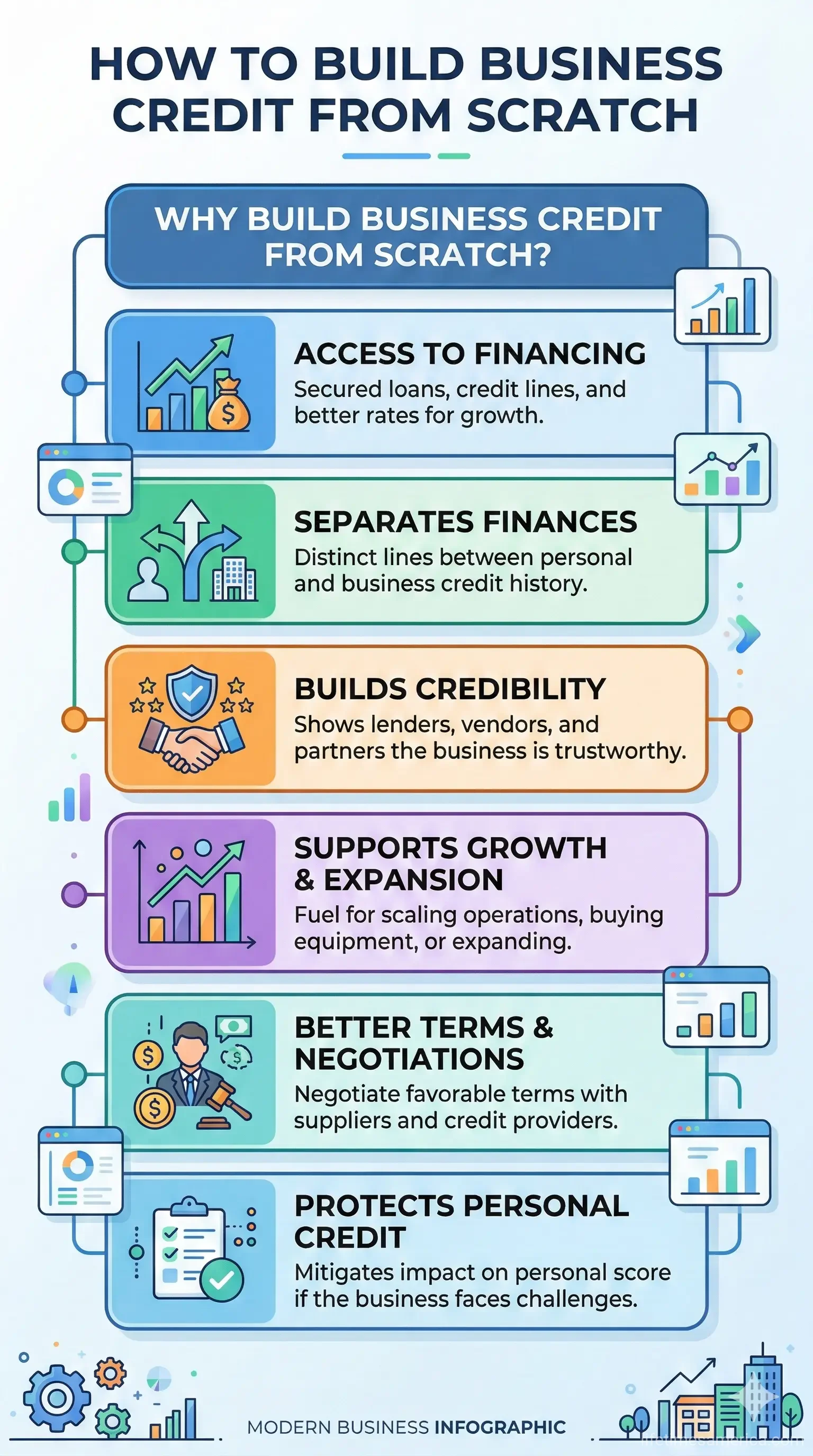
Why Build Business Credit from Scratch?
Business credit is a separate financial profile from your personal credit, tracked by major bureaus like Dun & Bradstreet (D&B), Experian Business, and Equifax Business. It reflects your company's payment history, credit utilization, and public records, influencing everything from loan approvals to insurance premiums.A strong business credit score can qualify you for higher credit limits and better terms, often with rates far below personal guarantees.
For new businesses, lenders frequently fall back on the owner's personal credit score via FICO or VantageScore, as noted by the Small Business Administration (SBA). But once established, business credit stands alone, protecting your personal assets and enabling growth. In 2026, with rising interest rates and tighter lending standards, a solid PAYDEX score (D&B's key metric, ranging 0-100) above 80 can mean the difference between approval and rejection.
Step 1: Incorporate Your Business and Separate Finances
The foundation of business credit starts with legitimacy. Register your business as an LLC, S-Corp, or C-Corp through your state's Secretary of State office—this creates a legal separation from personal finances, which many vendors and lenders require.
Get Your EIN from the IRS
Apply for a free Employer Identification Number (EIN) on irs.gov. This nine-digit number identifies your business for taxes, banking, and credit reporting, much like a Social Security number for individuals. Sole proprietors can use their SSN, but an EIN signals professionalism and aids separation.
- Action tip: Form your entity first if you're a sole prop—switching later may require new accounts.
- Expect processing in minutes online; print your confirmation immediately.
Open a Business Bank Account
Deposit startup funds into a dedicated business checking account at banks like Bank of America or Chase. Use it exclusively for business transactions to build a clean financial trail. This step is crucial for vendors verifying your legitimacy before extending net-30 terms.
Step 2: Obtain a D-U-N-S Number
Your D-U-N-S Number from Dun & Bradstreet is the business equivalent of a credit header—it's free and essential for visibility to the three major bureaus. Apply at dnb.com; it arrives in 1-2 business days (up to 30 for manual reviews).
Pro tip: Update your business info annually to keep your profile accurate, boosting your PAYDEX score faster.
Step 3: Start with Vendor Tradelines (Net-30 Accounts)
Net-30 accounts from suppliers let you buy now and pay in 30 days, reporting payments to bureaus if they participate. Aim for 3-5 initially; not all report, so choose wisely.
Top Starter Vendors for 2026
- Uline, Grainger, and Quill: Office and industrial supplies; easy approval for new businesses.
- Home Depot Pro or Lowe's Business: Net-30 for purchases over $100; reports to D&B.
- Staples Business Advantage: Common first tradeline with quick setup.
Make small purchases (under 30% of limit), pay early or on time. Payments report in 30-60 days, kickstarting your score.
Step 4: Apply for Business Credit Cards
Once you have 1-2 tradelines, apply for starter business cards from your bank or issuers like Capital One Spark or American Express Blue Business. Keep utilization below 30% and pay in full monthly.
Caution: New businesses may need a personal guarantee initially, but consistent use builds the business file independently.
Step 5: Monitor and Expand Your Credit Profile
Check reports monthly via Nav.com (free basic access) or D&B CreditSignal. Track your PAYDEX (80+ target), Delinquency score, and failure score.
- Add more tradelines after 3 months.
- Seek small loans from SBA lenders or online platforms like Kabbage once scores appear (45-90 days).
- Dispute errors via bureau portals.
Realistic Timeline for 2026
| Timeline | Milestone |
|---|---|
| Days 1-7 | Foundation: EIN, D-U-N-S, bank account |
| Days 8-30 | 3-5 net-30 accounts open; first payments |
| Months 2-3 | Scores appear (PAYDEX 80+ possible) |
| 6+ Months | $10K+ credit capacity; loans unlocked |
Common Pitfalls to Avoid
- Mixing personal and business expenses—dilutes your profile.
- Ignoring non-reporting vendors—wastes time.
- Missing payments—hurts scores more than personal credit.
- Over-applying for credit—triggers inquiries.
Fix personal credit first if below 680 FICO, as it impacts early approvals. Use CFPB tools at consumerfinance.gov.
Next Steps to Build Your Business Credit Today
Start with your EIN and D-U-N-S this week—both free and fast. Track progress in a dedicated folder, and aim for three net-30 accounts by month-end. Consistent, on-time payments are your superpower. With discipline, you'll access better terms from the IRS-backed SBA loans to vendor discounts, fueling your American dream business.
Resources: SBA's business credit guide at sba.gov and IRS EIN portal.
Frequently Asked Questions
Sources & References
-
1
How to Build Business Credit in 30 Days [Complete Action Plan] — www.startmybusiness.us
- 2
- 3
-
4
How to Establish and Build Business Credit - Chamber of Commerce — www.uschamber.com
-
5
How to Get and Build Business Credit - NerdWallet — www.nerdwallet.com
-
6
What is Business Credit and How do I Build It? - Bank of America — business.bankofamerica.com
- 7
Related Articles

How to Use a "Qualified Small Business Stock" (QSBS) to Pay Zero Tax
If you're an investor, entrepreneur, or employee at a startup, you've probably heard the phrase "tax-free gains" and thought it sounded too good to be true. But there's actually a legitimate way to po...
How to Claim the "Employee Retention Credit" (ERC) in 2026: Is it Still Possible?
Imagine discovering tens of thousands of dollars in your business's pocket—funds you earned by keeping employees on payroll during the toughest days of the COVID-19 crisis. That's the promise of the E...

The Best "Virtual" Business Addresses for US LLCs in 2026
Starting a limited liability company (LLC) in 2026 means navigating smart choices for privacy, professionalism, and compliance. One key decision is picking the right business address—especially if you...

How to Transition from W-2 to Self-Employed: A Financial Checklist
Making the leap from a steady W-2 paycheck to self-employment is exciting—and terrifying. You're trading the security of regular income and employer benefits for freedom and control over your work. Bu...