What Is an SBA Loan and How Do You Qualify?

Starting or growing a small business in America often means needing capital, but traditional bank loans can feel out of reach with their strict requirements. That's where SBA loans come in—they're gov...
The Lifetimes America editorial team curates, fact-checks, and updates guides on personal finance, property, health, immigration, legal, business, and lifestyle topics relevant to Lifetimes America readers. Articles are produced with AI assistance and reviewed by the editorial team before publication.
Starting or growing a small business in America often means needing capital, but traditional bank loans can feel out of reach with their strict requirements. That's where SBA loans come in—they're government-backed options designed to make financing more accessible for entrepreneurs like you, helping fuel dreams from coffee shops in Seattle to tech startups in Austin.
Backed by the U.S. Small Business Administration (SBA), these loans reduce risk for lenders, offering better terms like lower down payments and longer repayment periods. In this guide, we'll break down what an SBA loan is, the main types available in 2026, and how you qualify—with practical steps to boost your chances.
What Is an SBA Loan?
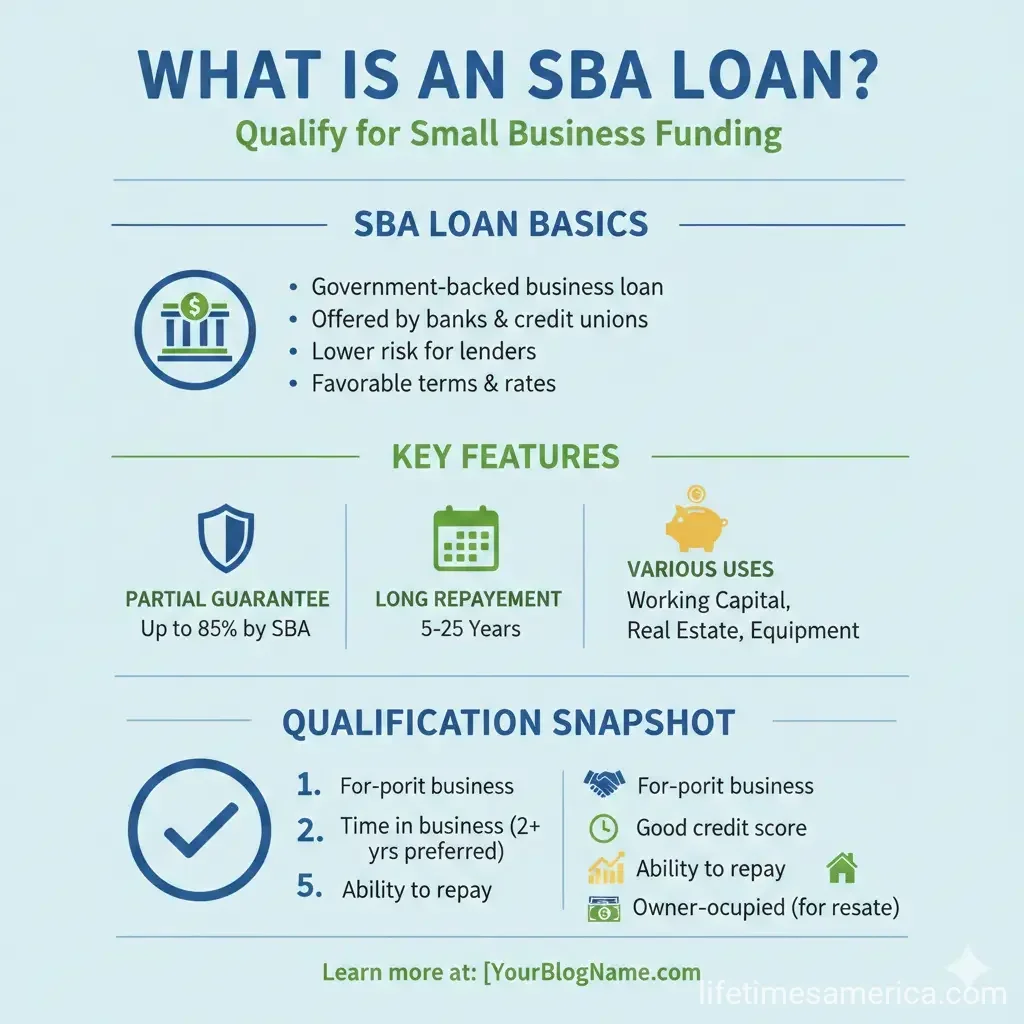
An SBA loan is not direct funding from the government; instead, the SBA guarantees a portion of loans issued by approved lenders, typically covering 50% to 85% of the amount. This backing lets lenders offer more favorable terms to small businesses that might not qualify elsewhere.
Created to support American small businesses, SBA loans help with everything from working capital to real estate purchases. Unlike conventional loans, they feature:
- Longer repayment terms—up to 10 years for working capital or equipment, and 25 years for real estate.
- Lower down payments, often just 10% for major purchases like businesses or property.
- No prepayment penalties on terms under 15 years.
- Maximum amounts up to $5 million for the popular 7(a) program.
In 2026, these programs remain vital amid economic shifts, with updates like new underwriting for 7(a) Small Loans effective March 1.
Main Types of SBA Loans
The SBA offers several programs tailored to different needs. Here's a quick overview:
| Loan Type | Max Amount | Best For | Key Features |
|---|---|---|---|
| 7(a) Loans | $5 million | General purpose: working capital, equipment, real estate | Most flexible; guaranty up to 85%; terms up to 25 years |
| 504 Loans | $5.5 million | Fixed assets like real estate, equipment | 10% down payment; involves Certified Development Companies (CDCs) |
| Microloans | $50,000 | Startups, very small businesses | Average $14,000; shorter terms |
| Express Loans | $500,000 | Quick funding needs | Streamlined approval; 50% guaranty |
The 7(a) loan is the flagship program, used for acquiring real estate, refinancing debt, buying equipment (including AI tools), or even business ownership changes.
Basic Eligibility for SBA Loans
To even be considered, your business must meet SBA's baseline rules. These apply across programs but vary slightly.
- Operate for profit in the U.S. or its territories—your business must be legally registered and physically located here.
- Be "small" per SBA size standards: generally under 500 employees or $7.5 million average annual revenue for the past three years (varies by industry).
- Eligible industry: No speculative businesses (like real estate investment), illegal activities, nonprofits, or certain others.
- Clean record: Current on all federal/state/local taxes, no defaults on government debts, and no owners incarcerated, on probation, or indicted for felonies.
- Exhausted alternatives: Prove you can't get funding on reasonable terms from non-government sources.
Recent 2026 updates clarify citizenship/residency rules, making it easier for certain owned businesses—check the latest SOP 50 10 8 guidance.
How Do You Qualify? Key Requirements
Meeting basic eligibility gets you in the door, but lenders make the final call based on financials, credit, and more. Approval isn't guaranteed by the SBA—it's up to the lender's underwriting.
Business Financial Requirements
Lenders scrutinize your ability to repay while keeping operations running. Expect to provide:
- Historical or projected revenue and cash flow statements showing sufficient coverage for debt.
- For 7(a): Average net income under $5 million after taxes (past two years); tangible net worth under $15 million.
- For 504: Tangible net worth < $20 million; average net income < $6.5 million (past two years).
- Working capital: Assets minus liabilities must support operations.
A strong Debt Service Coverage Ratio (DSCR)—net income exceeding debt payments by at least 1.25x—is often key, though not universally mandated.
Credit and Character Checks
Personal and business credit matter big time:
- Business creditworthy with sound repayment ability; even bad credit startups may qualify if other factors shine.
- Personal credit score preferably above 680; no recent bankruptcies, foreclosures, or tax liens.
- "Good character": Track record of managing finances and business affairs.
- Owners with 20%+ equity must personally guarantee and provide financial statements.
Collateral and Down Payment
Collateral is required for loans over $25,000-$50,000, but SBA rules are more lenient than traditional loans—no full collateral needed up to certain amounts.
- 10% down for buying businesses, real estate, or equipment.
- Lenders accept flexible options thanks to the SBA guaranty.
At least two years in operation helps, but startups can qualify with strong plans.
Documentation You'll Need
Prepare these to speed things up:
- Business plan with loan purpose and projections.
- Financial statements (2-3 years of tax returns, P&L, balance sheets).
- Personal financial statements and credit reports for owners.
- Legal docs: Articles of incorporation, leases, collateral details.
- Proof of SBA size eligibility (use SBA's tool at sba.gov/size-standards).
Steps to Apply for an SBA Loan in 2026
- Check eligibility: Use SBA's lender match tool at sba.gov/lendermatch.
- Find a lender: Work with SBA-approved banks like Bank of America or local community lenders via Lendio.
- Gather docs: Follow the SBA checklist for your program.
- Submit application: Lender reviews; SBA approves guaranty if eligible.
- Close and fund: Expect 45-90 days; Express loans faster.
Pro tip: Build credit now—pay bills on time, reduce debt, and create solid projections.
Common Myths About SBA Loans
"SBA loans are free money." Nope—they're real loans with interest (prime + 2.25%-4.75% typically) and repayment.
"Perfect credit required." Not true; flexible standards help riskier borrowers.
Ready to Fuel Your Business Growth?
SBA loans level the playing field for American small businesses, offering capital on terms big banks rarely match. If you meet the basics—small size, U.S. operations, repayment ability—start by assessing your financials and connecting with an SBA lender today.
Next steps: Visit sba.gov/loans for checklists, use the Lender Match tool, and consult a local SBA district office. With preparation, you could secure funding to expand, hire, or innovate in 2026.
Frequently Asked Questions
Sources & References
-
1
SBA Loan Qualification Requirements - Eligibility — Lendio — www.lendio.com
-
2
SBA 7(a) Loans: Borrower Qualifications — sba7a.loans — www.sba7a.loans
-
3
SBA Loans Explained: Complete Small Business Guide (2026 Edition) — Peoples Bank — www.peoplesbankmtg.com
-
4
What is an SBA Loan and How do I Qualify? — Bank of America — business.bankofamerica.com
-
5
7(a) Loans — U.S. Small Business Administration — www.sba.gov
-
6
Loans — U.S. Small Business Administration — www.sba.gov
- 7
- 8
Useful Tools
Related Articles

How to Use a "Qualified Small Business Stock" (QSBS) to Pay Zero Tax
If you're an investor, entrepreneur, or employee at a startup, you've probably heard the phrase "tax-free gains" and thought it sounded too good to be true. But there's actually a legitimate way to po...
How to Claim the "Employee Retention Credit" (ERC) in 2026: Is it Still Possible?
Imagine discovering tens of thousands of dollars in your business's pocket—funds you earned by keeping employees on payroll during the toughest days of the COVID-19 crisis. That's the promise of the E...

The Best "Virtual" Business Addresses for US LLCs in 2026
Starting a limited liability company (LLC) in 2026 means navigating smart choices for privacy, professionalism, and compliance. One key decision is picking the right business address—especially if you...

How to Transition from W-2 to Self-Employed: A Financial Checklist
Making the leap from a steady W-2 paycheck to self-employment is exciting—and terrifying. You're trading the security of regular income and employer benefits for freedom and control over your work. Bu...