The Best Business Structures for Freelancers: LLC vs. S-Corp
As a freelancer in the U.S., you're juggling client projects, deadlines, and now the big decision: how to structure your business for maximum protection and tax savings. Choosing between an LLC and an...
The Lifetimes America editorial team curates, fact-checks, and updates guides on personal finance, property, health, immigration, legal, business, and lifestyle topics relevant to Lifetimes America readers. Articles are produced with AI assistance and reviewed by the editorial team before publication.
As a freelancer in the U.S., you're juggling client projects, deadlines, and now the big decision: how to structure your business for maximum protection and tax savings. Choosing between an LLC and an S-Corp can save you thousands in taxes while shielding your personal assets—especially in 2026 with self-employment tax rates holding steady at 15.3%.
Whether you're a graphic designer in California or a consultant in New York, the right structure impacts your liability, taxes, and growth potential. This guide breaks down **LLC vs. S-Corp for freelancers**, highlighting pros, cons, setup steps, and real-world tips tailored to American independents.
Understanding Business Structures for Freelancers
Freelancers often start as sole proprietors, but that leaves personal assets like your home or savings exposed to lawsuits or debts. LLCs and S-Corps offer limited liability protection, meaning your business is a separate legal entity responsible for its own obligations. Both use pass-through taxation, so profits flow to your personal tax return without double taxation—unlike C-Corps.
For freelancers earning over $50,000 annually, upgrading from sole proprietorship makes sense. In 2026, with IRS enforcement on payroll compliance tightening, formal structures reduce audit risks and unlock tax strategies.
Why Freelancers Need to Choose Wisely
- Tax Savings: S-Corps can slash self-employment taxes on distributions.
- Liability Shield: Protect your 401(k) or family home from business claims.
- Credibility: Clients prefer invoicing "YourName LLC" over a personal name.
- Scalability: Add partners or employees without headaches.
LLC: The Flexible Choice for Solo Freelancers
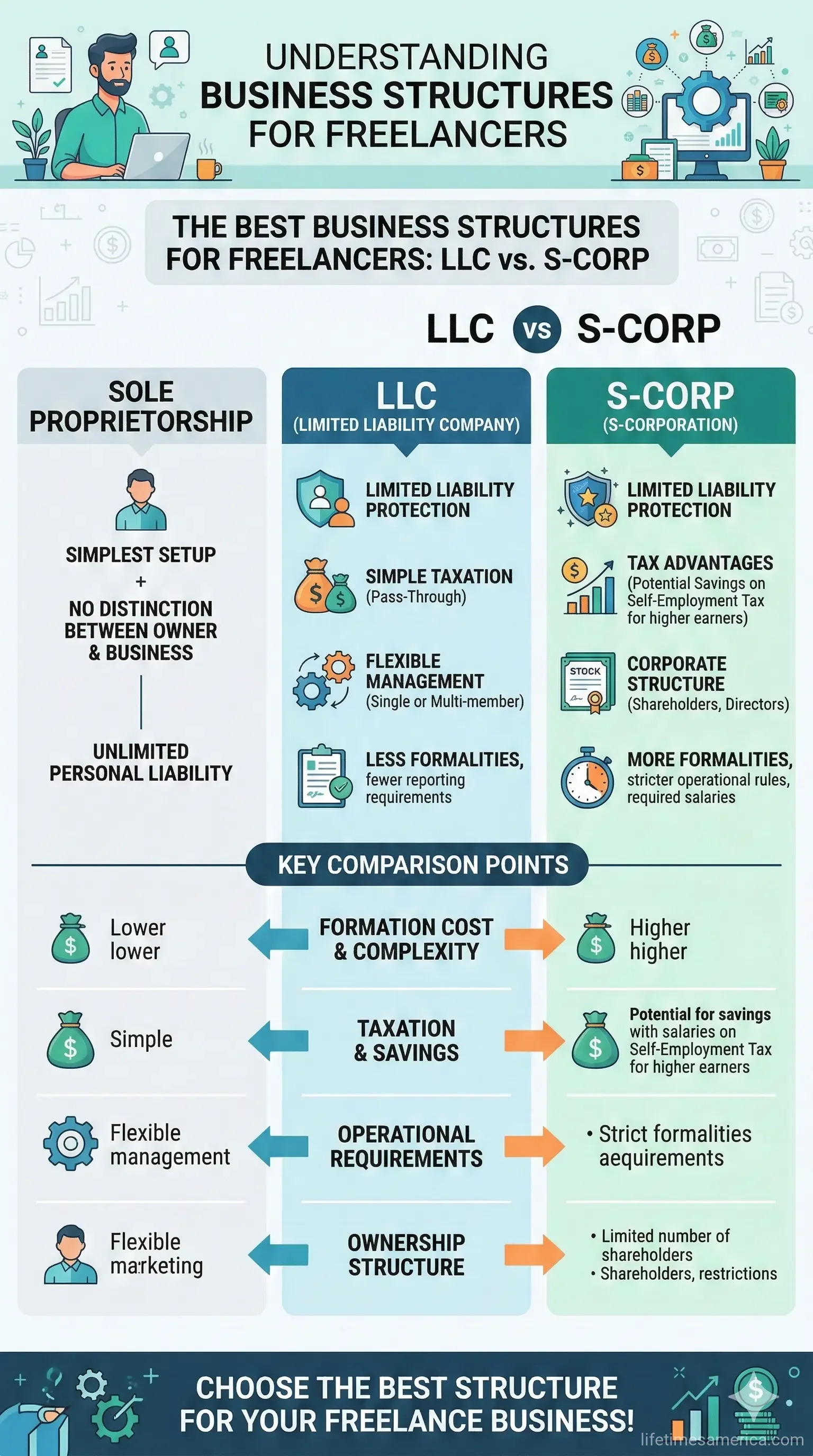
A Limited Liability Company (LLC) is ideal for freelancers wanting simplicity and flexibility. Formed at the state level, LLCs protect personal assets while allowing pass-through taxation by default. No board meetings or stock issuance required—just file articles of organization with your state's Secretary of State.
Pros of LLCs for Freelancers
- Easy Setup: Costs $50-$500 depending on your state; minimal paperwork.
- Flexible Ownership: Unlimited members, including non-U.S. citizens, corporations, or foreigners—no 100-shareholder cap.
- Management Freedom: Member-managed or manager-managed; customize via operating agreement.
- Profit Flexibility: Allocate profits based on contributions, not ownership percentage.
- Liability Protection: Personal assets safe from business debts.
Cons of LLCs
- Self-Employment Taxes: All profits hit with 15.3% (12.4% Social Security + 2.9% Medicare), even if not distributed.
- State Fees: Annual renewals and franchise taxes (e.g., California's $800 minimum).
- Less Tax Optimization: Fewer strategies for high earners.
Example: Freelance writer Sarah in Texas forms an LLC for $300. She reports all $80,000 income on Schedule C, paying ~$12,240 in self-employment taxes.
S-Corp: Tax-Smart for Profitable Freelancers
An S-Corporation is a tax election (via IRS Form 2553) for corporations or LLCs, capping shareholders at 100 U.S. citizens/residents. Freelancers love S-Corps for splitting income into salary (payroll-taxed) and distributions (tax-free for self-employment). This can save $10,000+ yearly on taxes in 2026.
Pros of S-Corps
- Tax Savings: Only "reasonable salary" (e.g., 40-60% of profits) faces 15.3% payroll taxes; distributions are exempt.
- Perpetual Existence: Business survives owner changes.
- Limited Liability: Protects directors, officers, and shareholders.
- Credibility Boost: Formal structure appeals to enterprise clients.
- Lower Audit Risk: Structured payroll and Form 1120-S filings.
Cons of S-Corps
- Strict Rules: U.S. citizens/residents only; max 100 shareholders; one stock class.
- More Formalities: Annual meetings, minutes, bylaws, board of directors.
- Payroll Hassle: Owners must take W-2 salary; setup costs $500+ for payroll services.
- IRS Scrutiny: "Reasonable salary" must pass IRS tests—too low risks reclassification.
Example: Consultant Mike earns $80,000. As S-Corp owner, he pays himself $50,000 salary ($7,650 payroll tax) and $30,000 distribution (no self-employment tax), saving ~$4,590 vs. LLC.
LLC vs. S-Corp: Side-by-Side Comparison
| Feature | LLC | S-Corp |
|---|---|---|
| Taxation | Pass-through; all profits self-employment taxed (15.3%) | Pass-through; salary payroll-taxed, distributions exempt |
| Ownership | Unlimited members; any nationality | ≤100 U.S. citizens/residents; no corps/LLCs |
| Management | Flexible (members/managers) | Board, officers, meetings |
| Setup Cost | $50-$500 + state fees | $100-$250 + Form 2553 (free) |
| Best For | Solo starters, flexible profits | Profitable freelancers ($50K+) |
How to Set Up as a Freelancer in 2026
Steps for LLC
- Choose a name and check availability via your state's business search.
- File Articles of Organization (e.g., $125 in New York).
- Draft an Operating Agreement (optional but smart).
- Get EIN from IRS.gov (free).
- Open a business bank account.
Steps for S-Corp
- Form a corporation or LLC first.
- File IRS Form 2553 within 75 days of formation—all shareholders sign.
- Set up payroll (use services like Gusto).
- Hold initial board meeting; adopt bylaws.
- File Form 1120-S annually; issue K-1s.
Pro Tip: LLCs can elect S-Corp status via Form 2553 without dissolving—perfect for freelancers scaling up. Consult irs.gov for 2026 deadlines.
Tax Implications and Savings Strategies
In 2026, freelancers face 15.3% self-employment tax on net earnings up to the Social Security wage base ($176,100 projected). S-Corps shine here: Pay a reasonable salary (IRS guidelines suggest industry norms, e.g., $60K for IT freelancers), distribute the rest tax-free for SE purposes.
Deductions like home office, mileage (67¢/mile), and equipment apply to both. Track via QuickBooks or Xero. For S-Corps, payroll taxes include employer FICA match—budget 7.65% extra.
"Switching to S-Corp can save $10,000+ in self-employment taxes for profitable freelancers."
Next Steps: Choose and Act Today
Assess your income: Under $50K? Stick with LLC for simplicity. Over? Elect S-Corp for savings. Use IRS withholding estimator at irs.gov and consult a CPA via AICPA directory. Form your entity at your state's site (e.g., sos.ca.gov), get an EIN, and open a business account at Chase or your bank.
Track 2026 changes via irs.gov/newsroom. Your structure isn't permanent—many freelancers start LLC, elect S-Corp later. Protect your hustle, minimize taxes, and focus on clients.
Frequently Asked Questions
Sources & References
-
1
S Corp and LLC: Differences, Advantages, and Disadvantages | CO — www.uschamber.com
- 2
- 3
- 4
-
5
Choosing the Right Business Structure in 2026 | LLC vs Corp Guide — boyerlawfirm.com
-
6
Compare S corporation vs LLC: Differences & benefits — www.wolterskluwer.com
-
7
S Corp or LLC - Which is Right for My Business? — www.barrettlaw.com
-
8
LLC vs. S-Corp in 2026: How to Save $10,000 in Self-Employment Tax — www.fynloapps.com
Related Articles

How to Use a "Qualified Small Business Stock" (QSBS) to Pay Zero Tax
If you're an investor, entrepreneur, or employee at a startup, you've probably heard the phrase "tax-free gains" and thought it sounded too good to be true. But there's actually a legitimate way to po...
How to Claim the "Employee Retention Credit" (ERC) in 2026: Is it Still Possible?
Imagine discovering tens of thousands of dollars in your business's pocket—funds you earned by keeping employees on payroll during the toughest days of the COVID-19 crisis. That's the promise of the E...

The Best "Virtual" Business Addresses for US LLCs in 2026
Starting a limited liability company (LLC) in 2026 means navigating smart choices for privacy, professionalism, and compliance. One key decision is picking the right business address—especially if you...

How to Transition from W-2 to Self-Employed: A Financial Checklist
Making the leap from a steady W-2 paycheck to self-employment is exciting—and terrifying. You're trading the security of regular income and employer benefits for freedom and control over your work. Bu...