How to File Your Taxes in the USA: A Beginner's Guide

Filing your taxes might feel overwhelming, especially if it's your first time, but millions of Americans do it successfully every year. With the right steps, tools, and resources, you'll navigate the...
The Lifetimes America editorial team curates, fact-checks, and updates guides on personal finance, property, health, immigration, legal, business, and lifestyle topics relevant to Lifetimes America readers. Articles are produced with AI assistance and reviewed by the editorial team before publication.
Filing your taxes might feel overwhelming, especially if it's your first time, but millions of Americans do it successfully every year. With the right steps, tools, and resources, you'll navigate the 2026 tax season confidently and even uncover refunds you might otherwise miss.
Understand Your Tax Filing Basics
Every U.S. taxpayer files a federal income tax return using IRS Form 1040 or its variations. You're generally required to file if your income exceeds certain thresholds, like the standard deduction amount—for 2025 income reported in 2026, that's $15,750 for single filers and $31,500 for married filing jointly. Even if you don't have to file, doing so could get you a refund if your employer withheld too much or if you qualify for credits like the Earned Income Tax Credit.
State taxes often follow a similar deadline, but check your state's revenue department for specifics. The federal deadline is April 15, 2026, with an automatic extension to October 15 if you file Form 4868 by April 15—though any taxes owed are still due April 15 to avoid penalties.
Who Must File in 2026?
- Single filers under 65 with gross income over $15,750 (or higher if dependent).
- Married filing jointly under 65 with combined income over $31,500.
- Self-employed individuals with net earnings of $400 or more.
- Anyone qualifying for refundable credits, regardless of income.
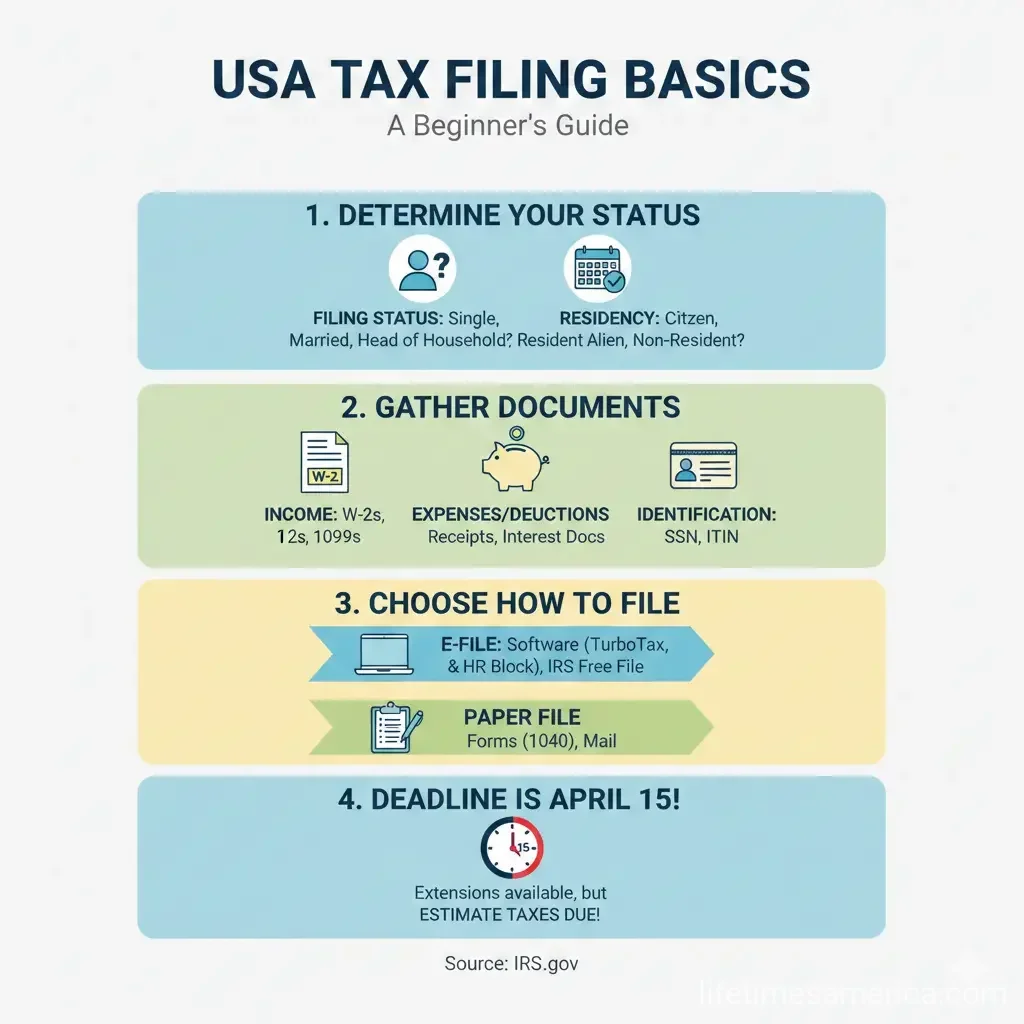
Gather Your Tax Documents Early
Start collecting paperwork now to avoid last-minute stress. Review last year's return for a checklist of what you'll need. Key documents include:
- W-2 from employers showing wages and withholdings.
- 1099 forms for freelance income, interest, dividends, or gig work (e.g., 1099-NEC for non-employee compensation).
- Schedule K-1 for partnerships or S-corporations.
- Records of deductions like mortgage interest (Form 1098), student loan interest (Form 1098-E), or medical expenses.
- Proof of child care costs for the Child and Dependent Care Credit.
- Prior year's adjusted gross income (AGI) for e-filing verification.
Pro tip: Create a dedicated folder or use apps like FreshBooks to track income and expenses throughout the year, especially if self-employed. Run a Profit and Loss report for cash-basis taxpayers (income taxed when received).
Choose Your Filing Method
You have three main options: DIY with software, paper filing, or hiring a pro. Electronic filing is fastest and IRS-preferred, with refunds in as little as 21 days.
Option 1: Free File for Simple Returns
If your adjusted gross income (AGI) is $89,000 or less, use IRS Free File for guided software from partners like TurboTax or H&R Block—at no cost for federal returns (some states free too). For higher incomes, try Free File Fillable Forms, but expect less hand-holding.
Option 2: Paid Tax Software
Programs like TurboTax walk you through step-by-step, importing W-2s and suggesting deductions. Great for beginners with rentals, investments, or self-employment. Costs range from $0 to hundreds, depending on complexity.
Option 3: Hire a Tax Professional
Ideal for complex situations like multiple states, business ownership, or audits. Search IRS.gov's directory of preparers with PTINs (Preparer Tax Identification Numbers). Expect $150–$400 for basic returns.
Option 4: Paper Filing (Last Resort)
Download forms from IRS.gov, mail to your regional IRS center, and use certified mail for proof. Slowest method—processing takes 6–8 weeks.
| Method | Best For | Cost | Refund Speed |
|---|---|---|---|
| IRS Free File | AGI ≤ $89,000, simple returns | Free federal (some states) | 21 days e-file |
| Tax Software | Moderate complexity | $0–$200+ | 21 days |
| Tax Pro | Complex situations | $150–$400+ | Varies |
| Paper | No internet/simple Form 1040 | Postage | 6–8 weeks |
Step-by-Step Guide to Filing Your 2026 Taxes
- Verify Identity: Have SSN/ITIN, prior AGI, and driver's license ready.
- Enter Personal Info: Name, address, filing status (single, married, head of household).
- Input Income: Add W-2s, 1099s. Software handles calculations.
- Claim Deductions/Credits: Standard deduction or itemize (e.g., SALT up to $10,000 cap). Check for Child Tax Credit or EV credits under recent laws.
- Review State Return: Most software includes it.
- E-File and Pay: Direct deposit for refunds; pay via IRS Direct Pay if owed.
- Track Status: Use IRS "Where's My Refund?" tool.
Watch for 2026 updates like the "One Big Beautiful Bill" changes affecting deductions and brackets.
Maximize Deductions and Credits
Beginners often miss easy wins:
- Standard Deduction: Simplest choice for most.
- Child Tax Credit: Up to $2,000 per qualifying child.
- Education Credits: American Opportunity Credit for college costs.
- Energy Credits: For home improvements like solar panels.
- Self-Employed: Deduct home office, mileage (70¢/mile in 2026 est.).
Use IRS Interactive Tax Assistant for eligibility.
Common Mistakes to Avoid
- Forgetting 1099 income from side gigs.
- Math errors—let software handle it.
- Missing deadlines, triggering 0.5% monthly failure-to-file penalty.
- Not itemizing if over standard deduction.
- E-filing without prior AGI.
Next Steps for a Smooth Tax Season
Don't wait—bookmark IRS.gov, download Free File now, and gather docs monthly. If complex, consult a CPA or use VITA (free help for low-income) via IRS.gov. Filing accurately saves money and stress. This guide covers beginners, but tax laws change; always verify with IRS tools or a professional for your situation.
Disclaimer: This is general info for 2026 tax year. Consult a tax advisor or IRS.gov for personalized advice.
Frequently Asked Questions
Sources & References
-
1
Get an Early Start on Tax Season 2026 | FreshBooks Blog — www.freshbooks.com
-
2
Tax filing 2026 | Ways to file taxes this year - Fidelity Investments — www.fidelity.com
-
3
How to file your federal income tax return - USAGov — www.usa.gov
-
4
How to File Step-by-Step by Katie St Ores CFP® ChFC® EA - Tax Pro — www.youtube.com
-
5
Guide to filing your taxes in 2026 - Consumerfinance.gov — www.consumerfinance.gov
-
6
How to File Taxes: A 2026 Tax Filing Guide - NerdWallet — www.nerdwallet.com
- 7
-
8
Your 2026 Tax Filing Guide: Key Tax Law Changes & Deadlines - Blog — blog.turbotax.intuit.com
- 9
Related Articles

How to Avoid the "Marriage Penalty" in the 2026 US Tax Code
Imagine tying the knot and then discovering your tax bill just skyrocketed—thousands of dollars higher than if you'd stayed single. That's the harsh reality of the marriage penalty in the US tax code,...

The Best "Side-Hustle" Tax Software for 2026 Filers
Running a side hustle in 2026 means juggling gigs like Uber driving, freelance graphic design, or selling handmade crafts on Etsy while keeping your day job. But come tax time, tracking those 1099-NEC...

How to Use "Tax-Loss Harvesting" to Offset Your 2026 Stock Gains
Imagine locking in hefty stock gains in 2026 only to watch a big chunk vanish to capital gains taxes. What if you could slash that tax bill without derailing your investment strategy? That's the power...

The Gig Economy Tax Guide: How to Deduct Your Car; Internet; and Office
If you're earning money through gig work—whether you're driving for a rideshare company, freelancing, delivering groceries, or running a side hustle—you're probably wondering how to keep more of what...