How to Build a Dividend Growth Portfolio for Passive Income

Building a dividend growth portfolio doesn't require complex strategies or constant monitoring—it's about selecting companies that consistently increase their payouts and letting time work in your fav...
The Lifetimes America editorial team curates, fact-checks, and updates guides on personal finance, property, health, immigration, legal, business, and lifestyle topics relevant to Lifetimes America readers. Articles are produced with AI assistance and reviewed by the editorial team before publication.
Building a dividend growth portfolio doesn't require complex strategies or constant monitoring—it's about selecting companies that consistently increase their payouts and letting time work in your favor. With strong dividend growth expected in 2026 and corporate balance sheets remaining healthy, now's an excellent time to establish a portfolio that generates reliable passive income while building long-term wealth.
Why Dividend Growth Matters for Your Portfolio
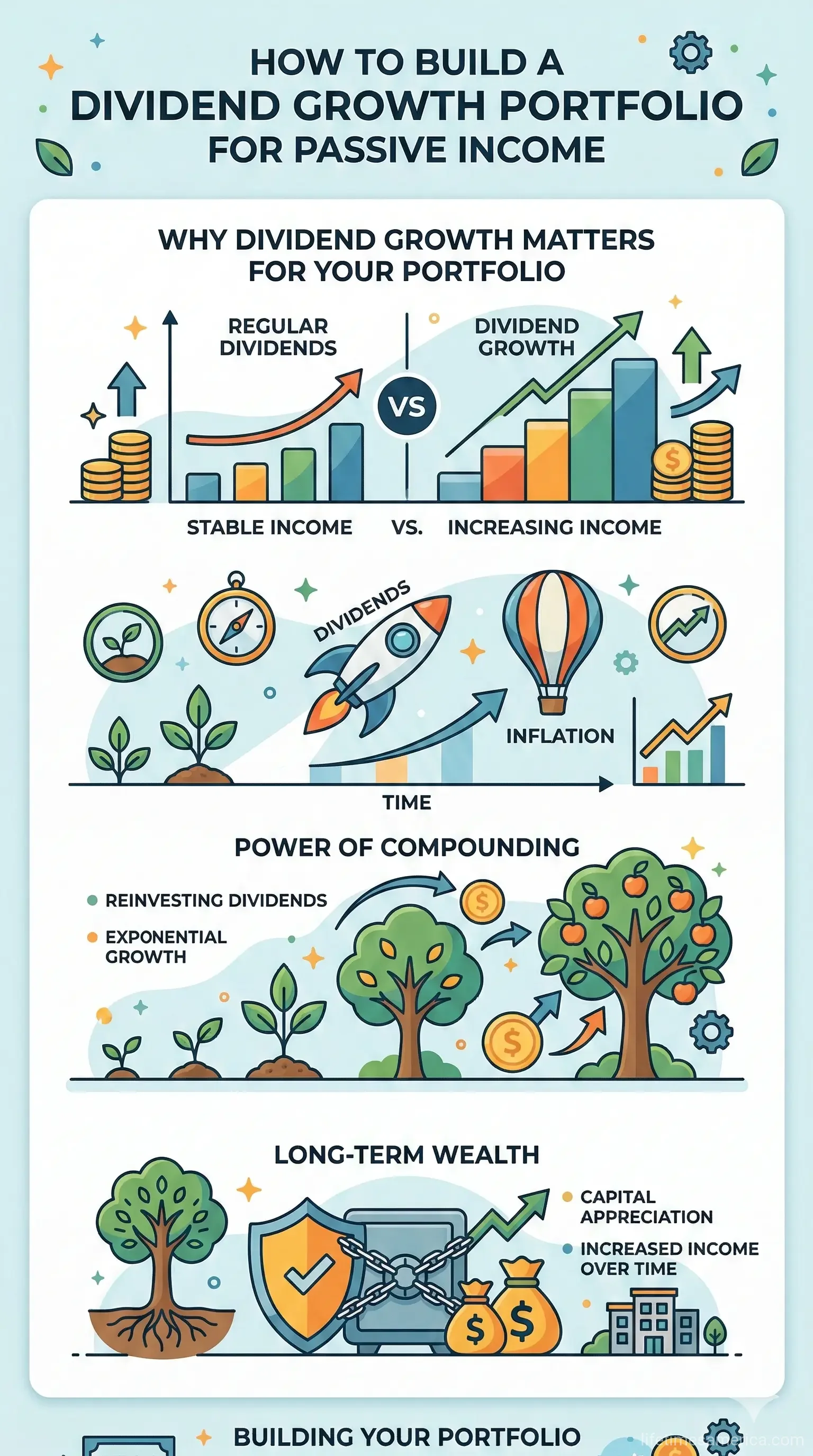
Dividend growth investing differs from simply chasing high yields. Instead of focusing on companies paying the largest current dividends, you're targeting businesses that regularly increase their payouts year after year. This approach offers compelling advantages for American investors seeking passive income.
Companies that grow or initiate dividends have historically generated higher annualized returns with lower volatility compared to other equity market segments. This means you're not just earning income—you're also building capital appreciation over time. The S&P 500 dividends per share grew by 4% in 2025, and consensus estimates expect 5% growth in 2026, demonstrating that corporate America remains committed to rewarding shareholders.
Beyond the numbers, dividend-paying stocks offer defensive characteristics that protect your portfolio during market downturns. These companies typically maintain more predictable earnings and conservative balance sheets, making them less volatile than non-dividend-paying stocks. When tech stocks stumble, dividend payers in utilities, healthcare, and industrials often hold steady—that's diversification in action.
Understanding Your Dividend Strategy
Before you buy a single share, you need to decide which dividend strategy aligns with your financial goals. There are two primary approaches, and choosing between them is the most critical decision you'll make.
Dividend Aristocrats vs. Growth Dividend Stocks
Dividend Aristocrats are companies with a history of consistently raising dividends for 25+ years. These are rock-solid, established businesses like Johnson & Johnson and Procter & Gamble. They offer stability and proven track records, making them ideal if you prioritize reliable income over growth.
Growing Dividend Stocks are younger companies increasing their dividends at higher rates, often 4% or more annually. These businesses offer greater growth potential but may carry slightly more volatility. If you're building a long-term portfolio and can tolerate some fluctuations, this strategy can deliver superior total returns.
The key trade-off: you can't easily have both high current yield and rapid capital growth. Decide whether you want steady income now or accelerated wealth building over time.
Which Sectors Are Positioned for Strong Growth?
Not all sectors offer equal dividend growth opportunities in 2026. Understanding where the strongest growth is expected helps you allocate your portfolio strategically.
Best positioned for strong dividend growth:
- Information Technology
- Financials
- Industrials
Modest single-digit growth expected:
- Consumer Staples
- Utilities
- Consumer Discretionary
This doesn't mean avoiding slower-growing sectors entirely. In fact, utilities and consumer staples provide stability and steady income that balances the growth potential from tech and financials. A diversified approach uses both.
Building Your Dividend Growth Portfolio
Step 1: Choose Between Individual Stocks or ETFs
You have two main paths: buying individual dividend stocks or investing through exchange-traded funds (ETFs). Most American investors benefit from ETFs because they provide instant diversification, lower fees, and professional management.
Popular dividend growth ETFs include:
- Vanguard Dividend Appreciation ETF (VIG) — focuses on large-blend companies with dividend growth history
- Schwab US Dividend Equity ETF (SCHD) — emphasizes quality dividend stocks with 3.51% yield
- iShares Core Dividend Growth ETF (DGRO) — convenient access to dividend-paying stocks
- Vanguard High Dividend Yield Index Fund (VYM) — targets higher-yielding large-cap stocks
If you're interested in international dividend opportunities, consider iShares International Dividend Growth ETF (IGRO) or Vanguard International Dividend Appreciation Index Fund (VIGI) to diversify beyond U.S. markets.
Step 2: Assess Your Risk Tolerance and Time Horizon
Your choice between high absolute yield or dividend growth should align with your risk profile and cash flow needs. Ask yourself:
- Do you need income right now, or can you reinvest dividends for 10+ years?
- Can you tolerate 20-30% portfolio swings during market downturns?
- Are you near retirement or still in your accumulation phase?
If you're 10+ years from retirement and don't need current income, prioritize dividend growth stocks. If you're retired or need regular cash flow, high-yield dividend stocks or covered call strategies may better suit your needs.
Step 3: Diversify Across Company Sizes and Sectors
Don't concentrate all your capital in mega-cap tech stocks. Consider diversifying into mid-cap and small-cap dividend stocks to boost total return potential. A balanced approach might look like:
- 60% large-cap dividend growth (VIG, SCHD)
- 25% mid-cap or small-cap value dividend stocks
- 15% international dividend stocks (IGRO, VIGI)
This allocation reduces concentration risk and ensures you're not overly dependent on any single sector or company size.
Step 4: Set Up Automatic Reinvestment
One of the most powerful wealth-building tools available to American investors is automatic dividend reinvestment. When your dividends are reinvested, you earn returns on those returns—compound growth in action.
Most brokerages offer Dividend Reinvestment Plans (DRIPs) at no cost. Enable this feature in your brokerage account, and you'll automatically purchase additional shares with your dividend payments, accelerating portfolio growth without additional effort.
Maximizing Your Tax Efficiency
Dividend income is taxable, but you can minimize the tax impact through smart account placement.
Tax-advantaged accounts for dividend investing:
- 401(k) plans — contributions reduce your current taxable income, and dividends grow tax-deferred
- Traditional IRAs — similar tax deferral benefits, with $7,000 annual contribution limits for those under 50
- Roth IRAs — dividends and capital gains grow completely tax-free if you follow withdrawal rules
- Taxable brokerage accounts — use qualified dividend treatment (taxed at lower capital gains rates) for dividends from U.S. corporations
If you're maximizing retirement accounts and still have capital to invest, qualified dividends in taxable accounts receive favorable tax treatment compared to ordinary income.
Monitoring and Rebalancing Your Portfolio
Dividend growth portfolios require less active management than growth-focused portfolios, but you shouldn't ignore them entirely. Review your holdings annually to ensure:
- Companies are still increasing dividends as expected
- Your asset allocation hasn't drifted too far from your target (e.g., stocks haven't grown to 80% of your portfolio)
- No dividend cuts or suspensions have occurred
- Your portfolio still aligns with your risk tolerance
Rebalancing annually—selling positions that have grown too large and buying those that have lagged—keeps your portfolio aligned with your strategy and forces you to "buy low, sell high."
The Path Forward in 2026
Corporate balance sheets remain healthy, the consumer continues to be resilient, and earnings growth is expected to accelerate further in 2026. These favorable conditions create an excellent environment for building a dividend growth portfolio. With strong S&P 500 dividend growth expected this year, companies are positioned to continue increasing their dividends over the long term.
The beauty of dividend growth investing is that it rewards patience. You're not trying to time the market or chase hot stocks. Instead, you're building a portfolio of quality companies that consistently reward shareholders with increasing dividends, providing both current income and long-term capital appreciation.
Getting Started Today
Building a dividend growth portfolio is one of the most straightforward paths to passive income and long-term wealth. You don't need to be a sophisticated investor or spend hours analyzing stocks. By choosing quality dividend growth ETFs, setting up automatic reinvestment, and staying the course through market cycles, you can build a portfolio that generates reliable income while your wealth compounds over decades.
The best time to plant a tree was 20 years ago. The second-best time is today. Open your brokerage account, fund your first investment, and let dividend growth work for you.
Frequently Asked Questions
Sources & References
- 1
-
2
Dividend Strategies 2026: Seeking Income & Diversification — iShares — www.ishares.com
-
3
5 Smart Ways to Diversify Your Portfolio in 2026 — Morningstar — www.morningstar.com
-
4
How to Build a Monster Dividend Portfolio (in 2026) — YouTube — www.youtube.com
-
5
13 High Dividend ETFs for 2026: Top Passive Income — Gotrade — www.heygotrade.com
- 6