How to Avoid "Probate" in Every US State: The Ultimate Checklist
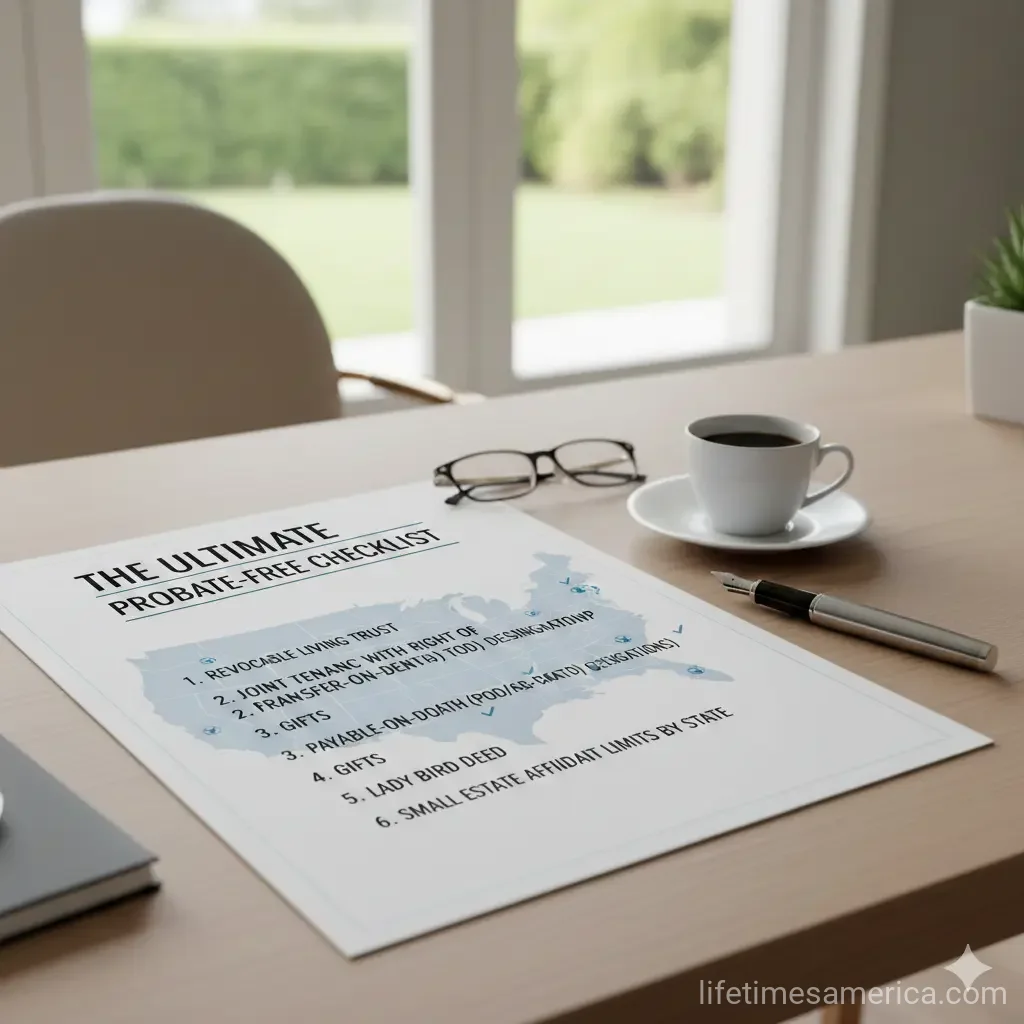
Imagine this: You've worked hard your whole life to build a legacy for your family, only to have it tied up in a lengthy, expensive court process after you're gone. Probate—the legal validation of you...
The Lifetimes America editorial team curates, fact-checks, and updates guides on personal finance, property, health, immigration, legal, business, and lifestyle topics relevant to Lifetimes America readers. Articles are produced with AI assistance and reviewed by the editorial team before publication.
Imagine this: You've worked hard your whole life to build a legacy for your family, only to have it tied up in a lengthy, expensive court process after you're gone. Probate—the legal validation of your will—can drag on for months or years, cost thousands in fees, and expose your private affairs to public scrutiny.Avoiding probate isn't just smart; it's essential for most Americans planning their estate. This ultimate checklist walks you through proven strategies that work in every US state, tailored to 2026 laws and practices.
Whether you live in California or Florida, Missouri or New York, these tools let assets pass directly to your loved ones without court interference. We'll cover revocable trusts, beneficiary designations, joint ownership, and state-specific tweaks, giving you a step-by-step plan to protect your estate.
Why Avoid Probate? The Real Costs and Delays
Probate serves a purpose—validating wills and distributing assets—but it's often a nightmare. In many states, it takes 6-18 months, with fees eating 3-7% of your estate's value.Court filings, attorney costs, and executor fees add up fast, and everything becomes public record. For out-of-state property, "ancillary" probates multiply the hassle and expense.
Take Missouri and Arkansas: Families face a six-month waiting period before accessing assets, freezing bank accounts and delaying home sales while bills pile up. In high-cost areas like California's probate can exceed $100,000 for mid-sized estates. Avoiding it keeps things private, fast, and affordable.
The Ultimate Checklist: 5 Proven Ways to Avoid Probate Nationwide
These methods work across all 50 states, though details vary. Start with an inventory of your assets—real estate, bank accounts, investments, vehicles—then apply the right tool. Consult an estate attorney to customize for your state.
1. Create a Revocable Living Trust
The gold standard for avoiding probate in every state. Transfer assets into the trust during your lifetime; you retain full control as trustee. Upon death, your successor trustee distributes everything privately—no court needed.
- Best for: Real estate, investments, businesses, and multi-state property.
- Steps:
- Draft the trust document (notarized, often with witnesses).
- Retitle assets: Deeds for homes, new account titles for banks/investments.
- Name successor trustee and beneficiaries.
- Pros: Handles incapacity planning; works nationwide.
- Cons: Upfront setup cost ($1,500-$3,000).
Revocable trusts shine for real estate—avoiding dual probates if you own property in multiple states.
2. Use Payable-on-Death (POD) and Transfer-on-Death (TOD) Designations
Simplest for liquid assets. Add a beneficiary to bank accounts (POD), brokerage accounts, vehicles, or even real estate (TOD deeds in 30+ states). Assets transfer automatically upon death.
- Best for: Bank accounts, CDs, stocks, cars.
- Steps: Contact your bank/broker/DMV; fill out a simple form—no lawyer needed.
- State note: TOD deeds valid in CA, MO, IL, and more; check your state's laws.
These are free and instant probate bypassers.
3. Joint Ownership with Right of Survivorship
Co-own assets with a spouse or family member; upon death, ownership passes automatically. Common forms: Joint tenancy or tenancy by the entirety (married couples only, in most states).
- Best for: Homes, bank accounts with spouses.
- Steps: Retitle deeds/accounts with "right of survivorship" language.
- Caveats: Risks if co-owner has creditors/divorce; not ideal for non-spouses.
- State variations: MO requires clear intent; tenancy by entirety in FL, IL.
4. Beneficiary Designations on Retirement and Insurance
IRAs, 401(k)s, life insurance already bypass probate—just update beneficiaries via your provider. Name primaries and contingents to avoid lapsed designations.
- Pro tip: Coordinate with your overall plan; these override wills.
5. Small Estate Affidavits and State Shortcuts
For modest estates, file an affidavit to skip full probate. Thresholds vary:
| State | Small Estate Limit (Personal Property) |
|---|---|
| California | $184,500 |
| Florida | $75,000 (summary admin) |
| Illinois | $100,000 |
| Missouri | $40,000 |
Use for leftovers after other tools.
State-Specific Strategies: Tailoring Your Plan
While core tools are universal, states tweak them. Here's how to avoid probate in key examples:
California
Revocable trusts for real estate; TOD deeds for homes; community property with survivorship for spouses. Small estates under $184,500 use affidavits.
Florida
Lady Bird deeds (enhanced life estate) keep control while auto-transferring homes. Summary admin for <$75,000; strong homestead rules.
Illinois
TOD for real estate; joint tenancy; small affidavits <$100,000.
Missouri
Joint tenancy/tenancy by entirety; trusts for multi-state assets; $40,000 small estates.
Delaware's evolving laws highlight why plans need updates. For all states, revocable trusts remain bulletproof.
Your Step-by-Step Actionable Checklist
- Inventory assets: List everything with values and locations.
- Prioritize: Trusts for real estate/investments; POD/TOD for accounts.
- Execute documents: Hire an attorney for trusts/deeds ($1,000-$5,000 total).
- Retitle everything: Banks, DMV, title companies—don't skip this!
- Review annually: Life changes (marriage, birth) require updates.
- Coordinate with will: A "pour-over" will catches stragglers.
DIY forms exist, but pros prevent errors that trigger probate.
FAQ: Common Questions About Avoiding Probate
Q1: Does a living trust protect against taxes?
A: No, revocable trusts don't shield from estate taxes, but they avoid probate delays.
Q2: Can I avoid probate for free?
A: Yes, with POD/TOD designations and joint ownership—no cost beyond paperwork.
Q3: What if I own property in multiple states?
A: Use a revocable trust to hold all titles, skipping ancillary probates.
Q4: Is joint ownership safe for non-spouses?
A: Risky—creditors or divorce can claim shares. Trusts are safer.
Q5: How much does a revocable trust cost in 2026?
A: $1,500-$3,000 for singles, $2,000-$5,000 for couples, depending on complexity.
Q6: Do all states allow TOD deeds?
A: About 30 do; others use trusts or affidavits.
Next Steps: Secure Your Legacy Today
Don't wait—probate avoidance starts now. Gather your documents, contact an estate planning attorney via the American Bar Association (americanbar.org), or use state bar referrals. Tools like trusts save your family time, money, and stress. Update your plan yearly, and sleep easy knowing your assets will flow smoothly to those you love.
Related Articles

The Best "Trustee" Services: Choosing Between a Person or a Bank
Imagine discovering that your carefully crafted trust has hit a snag because your chosen trustee lacks the expertise to handle investments or gets tangled in family disputes. This scenario plays out t...

How to Use a "Spendthrift Trust" to Protect a Family Member
Imagine leaving a substantial inheritance to your child, only to watch it vanish due to poor financial decisions, creditors, or a messy divorce. A spendthrift trust offers a powerful solution, shieldi...

How to Protect Your "Heirs" from a 2026 Inheritance Dispute
Imagine discovering that your life's work—your home, savings, and cherished family heirlooms—is tearing your loved ones apart in court, just when they need unity most. In 2026, with shifting tax laws...

The Best "Trust-Friendly" States for Middle-Class Families
Imagine safeguarding your family's hard-earned savings from creditors, lawsuits, and even future taxes—all while keeping more of your middle-class income in your pocket. For American families planning...