What Is a Tax Extension and How Do You File for One?

Imagine it's mid-April, and your tax documents are scattered like confetti after a party. You're staring at the calendar, heart racing as April 15 looms. Don't panic—a tax extension can be your lifeli...
The Lifetimes America editorial team curates, fact-checks, and updates guides on personal finance, property, health, immigration, legal, business, and lifestyle topics relevant to Lifetimes America readers. Articles are produced with AI assistance and reviewed by the editorial team before publication.
Imagine it's mid-April, and your tax documents are scattered like confetti after a party. You're staring at the calendar, heart racing as April 15 looms. Don't panic—a tax extension can be your lifeline, giving you breathing room without the immediate dread of late-filing penalties. Let's break down exactly what a tax extension is and how you can file one seamlessly for the 2026 tax year.
What Is a Tax Extension?
A **tax extension** is an official request to push back your federal income tax filing deadline from April 15 to October 15, providing an extra six months to submit your return. Formally known as IRS Form 4868, it's available to any U.S. taxpayer without needing to provide a reason—yes, it's automatic if filed correctly.
Here's the key caveat: This extension applies only to filing your return, not to paying any taxes you owe. If you expect to owe the IRS money, you must estimate and pay that amount by April 15 to avoid interest and penalties accruing daily. Underestimating your liability by more than 10% could lead to underpayment penalties, so aim to pay at least 90% of your total tax due.
Who Needs a Tax Extension?
- Individuals gathering complex documents, like investment records or self-employment income.
- Business owners, especially startups maximizing credits like the R&D Tax Credit on Form 6765.
- Those working with tax professionals who need more time for accuracy.
- Americans abroad who qualify for automatic extensions but want even more time.
Filing an extension reduces error risks, as rushing often leads to mistakes that trigger IRS scrutiny. It's not a red flag for audits either—many professionals recommend it for thorough preparation.
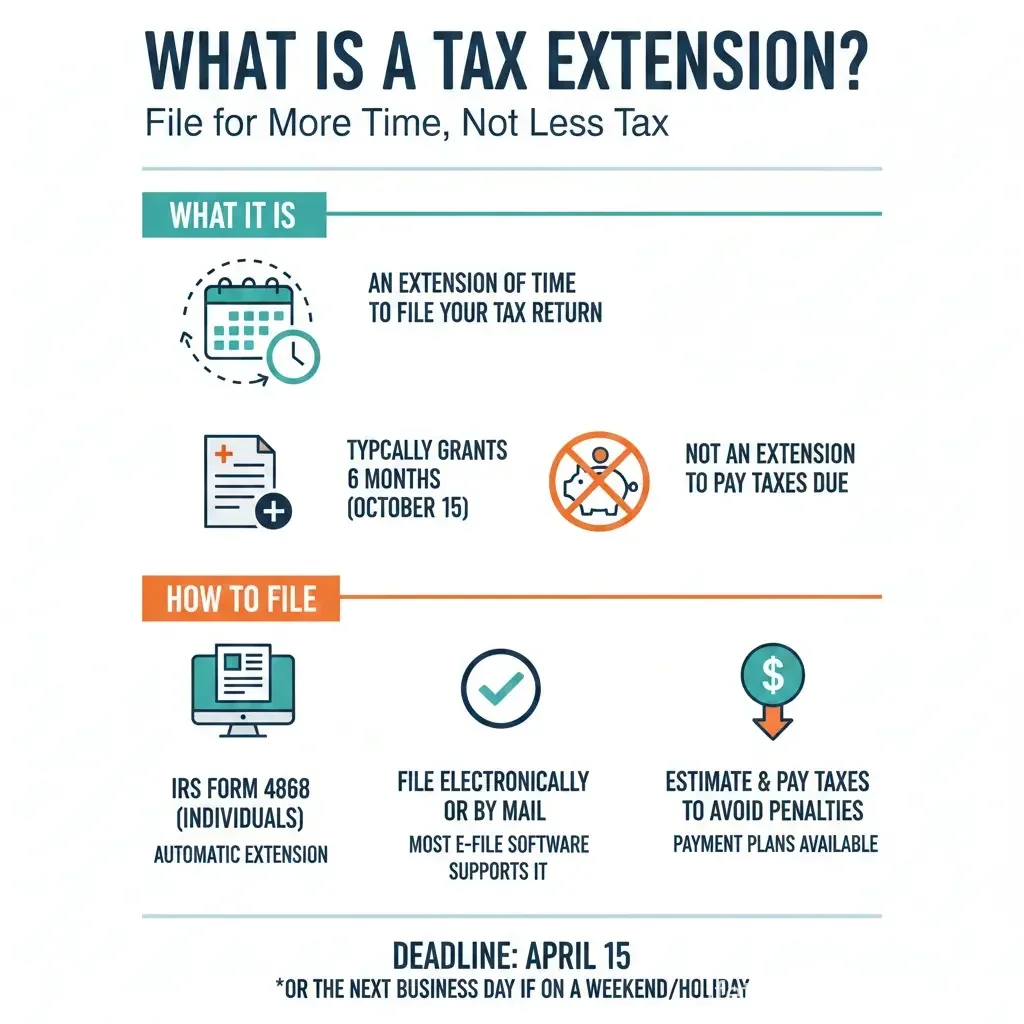
Key Deadlines for 2026 Tax Extensions
For the 2025 tax year (filed in 2026), the original federal deadline is April 15, 2026. Request your extension by that date, and you'll have until October 15, 2026, to file. If October 15 falls on a weekend or holiday, it shifts to the next business day.
Special Rules for Americans Abroad
U.S. citizens or residents living and working outside the country on April 15 get an automatic two-month extension to June 15, 2026, without filing Form 4868—just attach a statement to your return confirming your status. For more time, file Form 4868 by June 15 to extend to October 15. Remember, payment is still due April 15.
Business Extensions
Businesses use Form 7004. Partnerships, S-corps, and multi-member LLCs must file by March 16, 2026, for an extension to September 15. C-corps extend to October 15.
How Do You File for a Tax Extension? Step-by-Step Guide
Filing is free, straightforward, and can be done in minutes. No cost, no approval wait—it's automatic if timely. Here's how:
- Estimate Your Tax Liability: Review last year's return, W-2s, 1099s, and deductions. Pay at least 90% to avoid penalties.
- Choose Your Method: Pick from electronic, software, or mail options (detailed below).
- Submit by April 15, 2026: Include any payment with your request.
- Track Confirmation: E-filing provides instant approval; mailed forms need postmark proof.
Free and Easy Ways to File Form 4868
- IRS Free File: Use the IRS Free File tool starting January 2026 for electronic filing—no income limits for extensions.
- Tax Software: Platforms like TurboTax let you e-file directly; they often handle state extensions too.
- IRS Direct Pay: Pay your estimated balance online and select "extension" treatment—covers both payment and extension.
- Tax Professional: Your CPA can file on your behalf, ideal if you're outsourcing.
- Mail Form 4868: Download from IRS.gov, fill out, and mail with check by April 15 (postmark counts).
Pro tip: E-filing is fastest and provides immediate confirmation. If using software, check for built-in state extension links.
Handling State Tax Extensions
Most states automatically grant extensions if you file federal Form 4868, but rules vary—California, for example, requires no separate form, while others like New York do. Always check your state's revenue department website. TurboTax and similar tools often link directly to state forms.
Benefits and Risks of Filing a Tax Extension
Top Benefits
- More Time for Accuracy: Avoid rushed errors that could cost more in amendments or audits.
- Maximize Deductions: Startups can precisely calculate R&D credits, potentially saving thousands.
- Peace of Mind: No failure-to-file penalties (5% per month up to 25%) if you file by October 15.
- Free and Simple: No fees or explanations needed.
Potential Downsides and How to Mitigate Them
If you owe taxes and don't pay by April 15, expect 0.5% monthly failure-to-pay penalties plus interest (around 8% annually in recent years). Solution: Overestimate slightly and get a refund later. You can't file multiple extensions per year—one per return.
"Filing an extension alone isn’t generally viewed as a red flag, and shouldn’t increase the likelihood of a tax audit."
Practical Tips for a Smooth Extension Process
- Start early—gather forms now to estimate payments accurately.
- Use IRS withholding estimator tools or last year's return as a baseline.
- If self-employed, factor in quarterly estimates (next due June 16, 2026).
- Keep records: Save confirmation emails, payment receipts, and postmarks.
- Plan ahead for October—mark your calendar to avoid forgetting the final deadline.
For low-income filers, IRS Free File partners offer guided help. Reference IRS Publication 54 for expats or Pub. 17 for general guidance.
Frequently Asked Questions
Next Steps: Take Control of Your Taxes Today
Don't let tax season overwhelm you. Estimate your liability, choose your filing method, and submit Form 4868 well before April 15, 2026. This simple step buys you six months to file accurately while keeping penalties at bay. If your situation is complex—like business ownership or international income—consult a tax professional or use IRS resources at irs.gov. Remember, this isn't tax advice—always seek personalized guidance from a CPA or enrolled agent for your unique circumstances.
Ready to file? Head to IRS Free File in January 2026 or download Form 4868 now. You've got this—extend smart, file right, and reclaim your spring.
Sources & References
How and Where to File a Tax Extension in 2026 - NerdWallet — nerdwallet.com
IRS Tax Extension: The Ultimate Guide On What It Means To Extend - Range — range.com
2026 US Tax Calendar: Deadlines, Extensions & Penalties Explained - Glocalas — glocalas.com
Extensions | Internal Revenue Service — irs.gov
File an extension through IRS Free File | Internal Revenue Service — irs.gov
Free federal tax extension available in March - TurboTax — turbotax.intuit.com
Form 4868, Application for Automatic Extension of Time to File U.S. Individual Income Tax Return - IRS — irs.gov
Useful Tools
Related Articles

How to Avoid the "Marriage Penalty" in the 2026 US Tax Code
Imagine tying the knot and then discovering your tax bill just skyrocketed—thousands of dollars higher than if you'd stayed single. That's the harsh reality of the marriage penalty in the US tax code,...

The Best "Side-Hustle" Tax Software for 2026 Filers
Running a side hustle in 2026 means juggling gigs like Uber driving, freelance graphic design, or selling handmade crafts on Etsy while keeping your day job. But come tax time, tracking those 1099-NEC...

How to Use "Tax-Loss Harvesting" to Offset Your 2026 Stock Gains
Imagine locking in hefty stock gains in 2026 only to watch a big chunk vanish to capital gains taxes. What if you could slash that tax bill without derailing your investment strategy? That's the power...

The Gig Economy Tax Guide: How to Deduct Your Car; Internet; and Office
If you're earning money through gig work—whether you're driving for a rideshare company, freelancing, delivering groceries, or running a side hustle—you're probably wondering how to keep more of what...