The Best Passive Income Streams for 2026: A Practical Guide

Imagine waking up to money flowing into your bank account without clocking in a single hour of work. That's the power of passive income, and in 2026, with high interest rates and booming digital marke...
The Lifetimes America editorial team curates, fact-checks, and updates guides on personal finance, property, health, immigration, legal, business, and lifestyle topics relevant to Lifetimes America readers. Articles are produced with AI assistance and reviewed by the editorial team before publication.
Imagine waking up to money flowing into your bank account without clocking in a single hour of work. That's the power of passive income, and in 2026, with high interest rates and booming digital markets, Americans have more opportunities than ever to build wealth on autopilot. Whether you're saving for retirement, paying off debt, or just wanting financial freedom, these streams can help you get there.
This guide breaks down the best passive income streams for 2026, tailored for U.S. residents. We'll cover low-risk options like high-yield savings to higher-reward plays like real estate and digital products, with practical steps, earning potential, and tax tips from IRS guidelines. Let's dive in and start building your portfolio today.
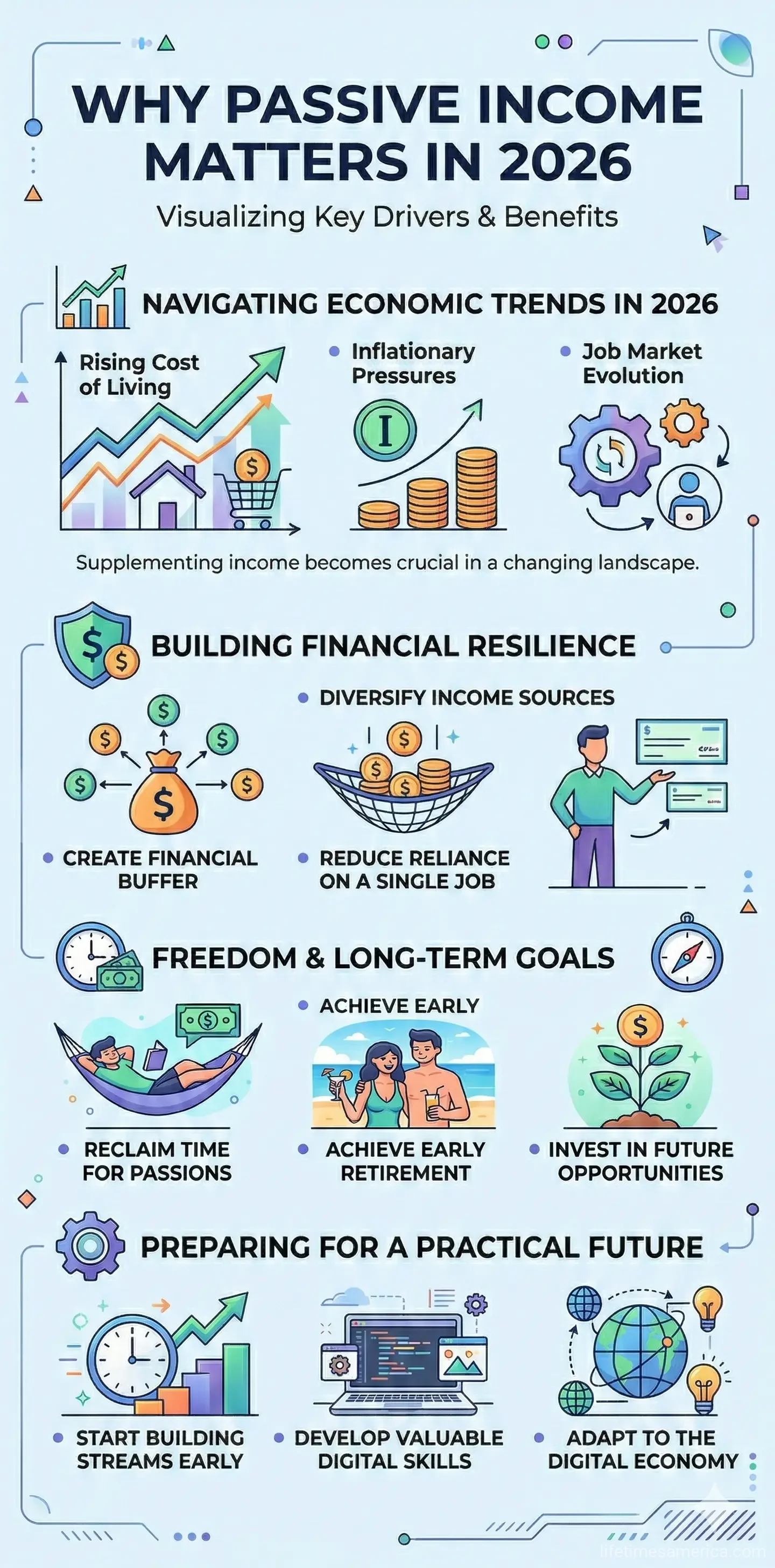
Why Passive Income Matters in 2026
In today's economy, traditional jobs often don't cut it with inflation hovering around 2.5% and living costs rising. Passive income lets you diversify earnings beyond your 9-to-5, funding everything from 401(k) contributions to family vacations. The beauty? Most streams require upfront effort but minimal ongoing work, freeing you to live life on your terms.
According to experts, the average American could aim for $500–$5,000 monthly from a mix of these streams, depending on investment size and risk tolerance. Start small, scale smart, and watch compound interest do the heavy lifting.
Top Low-Risk Passive Income Streams
If safety is your priority, stick to FDIC-insured options. These are perfect for emergency funds or conservative investors.
High-Yield Savings Accounts and CDs
With the Federal Reserve holding rates steady in 2026, high-yield savings accounts (HYSAs) and certificates of deposit (CDs) offer 4.5–5.5% APY—far better than the national average 0.45%. Park your cash at online banks like Ally or Marcus by Goldman Sachs for easy access and no fees.
- Startup cost: $0–$1,000
- Earning potential: $200–$1,000/year per $10,000 invested
- Action step: Compare rates on Bankrate.com and ladder CDs for liquidity.
Interest is taxable as ordinary income, so track it on Schedule B of your Form 1040. [IRS Interest Income Guide]
Money Market Accounts (MMAs)
MMAs blend savings and checking perks, yielding 4.2–5.0% in 2026 with check-writing access. Ideal for cash you might need soon, like home down payments. Credit unions like Navy Federal often beat big banks.
Bonds and Bond Funds
U.S. Treasury bonds and municipal bond funds provide steady interest with tax perks—munis are often state-tax-free. Expect 3.5–4.5% yields via Vanguard or Fidelity. Safer than stocks, they're great for diversifying your IRA.
Investment-Based Passive Income: Stocks and REITs
For growth with income, turn to the markets. These require brokerage accounts but offer liquidity.
Dividend Stocks and ETFs
Buy shares in stable companies like Procter & Gamble or ETFs like Vanguard Dividend Appreciation (VIG). Yields average 2–4%, paid quarterly. Warren Buffett swears by them for long-term compounding.
- Pros: Low entry ($100 via Robinhood), diversification
- Cons: Market volatility; qualified dividends taxed at 0–20%
- Tip: Use a Roth IRA to minimize taxes—contribute up to $7,000 in 2026 if under 50. [IRS IRA Limits]
Example: $50,000 in a 3% yield ETF nets $1,500/year, growing tax-deferred.
Real Estate Investment Trusts (REITs)
REITs let you own commercial real estate slices without landlord hassles. Popular ones like Vanguard Real Estate ETF (VNQ) yield 4–6% dividends. Trade like stocks on NYSE, perfect for 401(k)s.
In 2026, with office and retail rebounding, REITs shine. Minimum investment: $500.
Real Estate Rentals: Hands-Off Wealth Builders
Traditional and Short-Term Rentals
Buy a single-family home or condo in growing areas like Texas suburbs, rent via Zillow, or list on Airbnb for 20–50% higher returns ($500–$10,000/month). Use property managers (8–10% fee) for true passivity.
- Tax perks: Deduct depreciation, mortgage interest on Schedule E.
- 2026 update: New short-term rental regs in cities like NYC require permits—check local HOA rules.
- Financing: FHA loans for first-timers with 3.5% down.
Caveat: Upfront costs average $50,000+ after down payment.
Renting Out Space: Parking, Storage, or Rooms
No property? Rent your driveway via Neighbor ($100–$300/month) or spare room on Airbnb. Low effort, high locality demand in urban spots.
Digital Passive Income: Leverage Your Skills Online
The digital boom makes 2026 ideal for creators. Upfront work pays off forever.
Create and Sell Digital Products
Design printables, e-books, or courses on Etsy, Gumroad, or Teachable. A budgeting spreadsheet could earn $1,000/month passively. Tools like Canva make it beginner-friendly.
- Platforms: Udemy for courses (top earners: $10,000+/year)
- Taxes: Report as self-employment on Schedule C; deduct home office.
Affiliate Marketing and Content Creation
Build a blog, YouTube channel, or TikTok on niches like personal finance. Monetize via Amazon Associates (3–10% commissions) or sponsorships. Micro-influencers earn $500–$5,000/month once established.
Pro tip: Use AI tools like ChatGPT for content outlines to speed setup.
Peer-to-Peer Lending
Lend via Prosper or LendingClub at 5–7% returns. Automate reinvestments; $10,000 could yield $530/year. Risks include defaults—diversify loans.
Tax Tips and U.S. Regulations for Passive Income
All passive income is taxable, but smart structuring saves big. Use Roth accounts for investments; real estate qualifies for 1031 exchanges to defer capital gains. [IRS 1031 Exchanges] Track everything with QuickBooks Self-Employed.
Consult a CPA for Qualified Business Income (QBI) deduction—up to 20% off digital/stream income. [IRS QBI]
Next Steps to Launch Your Passive Income in 2026
Pick one stream matching your risk level and $1,000–$5,000 budget. Open a brokerage at Fidelity, list a room on Airbnb, or upload a digital product today. Track progress monthly, reinvest earnings, and consult a fee-only advisor via NAPFA.org. Your future self will thank you—start now for compound growth by 2027.
Frequently Asked Questions
Sources & References
-
1
20 Best Passive Income Ideas for 2026 - LLC Attorney — llcattorney.com
-
2
Best Passive Income Ideas 2026: Complete Guide — www.thelandgeek.com
-
3
5 Passive Income Ideas for 2026 - YouTube (Aldo James) — www.youtube.com
-
4
16 Passive Income Ideas to Try in 2026 - NerdWallet — www.nerdwallet.com
-
5
11 Passive Income Ideas to Increase Your Cash Flow in 2026 - Coursera — www.coursera.org
- 6
-
7
Passive Income Ideas 2026 - U.S. Bank — www.usbank.com
-
8
IRS Tax Topic 403: Interest Income — www.irs.gov
-
9
IRS Retirement Topics: IRA Contribution Limits — www.irs.gov
-
10
IRS Tax Topic 701: Like-Kind Exchanges (1031) — www.irs.gov
-
11
IRS Qualified Business Income Deduction — www.irs.gov
-
12
IRS Free File: Do Your Federal Taxes for Free — www.irs.gov
Related Articles

The 10 Best Side Hustles for 2026: Earn an Extra $2;000/Month
Imagine turning your evenings and weekends into a reliable path to financial freedom, adding an extra $2,000 to your monthly income without quitting your day job. In 2026, with rising costs and econom...

How to Start a Successful YouTube Channel for Extra Income
Imagine turning your smartphone into a money-making machine right from your living room in the heart of America. With millions of Americans seeking side hustles amid rising costs, starting a YouTube c...