How Much Should You Have in an Emergency Fund?

Most Americans aren't sure how much emergency savings they actually need, and that uncertainty often leads to inaction. The good news? You don't need to have the perfect amount to get started—even a s...
Most Americans aren't sure how much emergency savings they actually need, and that uncertainty often leads to inaction. The good news? You don't need to have the perfect amount to get started—even a small emergency fund can protect you from financial disaster. Here's what you need to know about building an emergency fund that works for your life in 2026.
The Standard Emergency Fund Rule
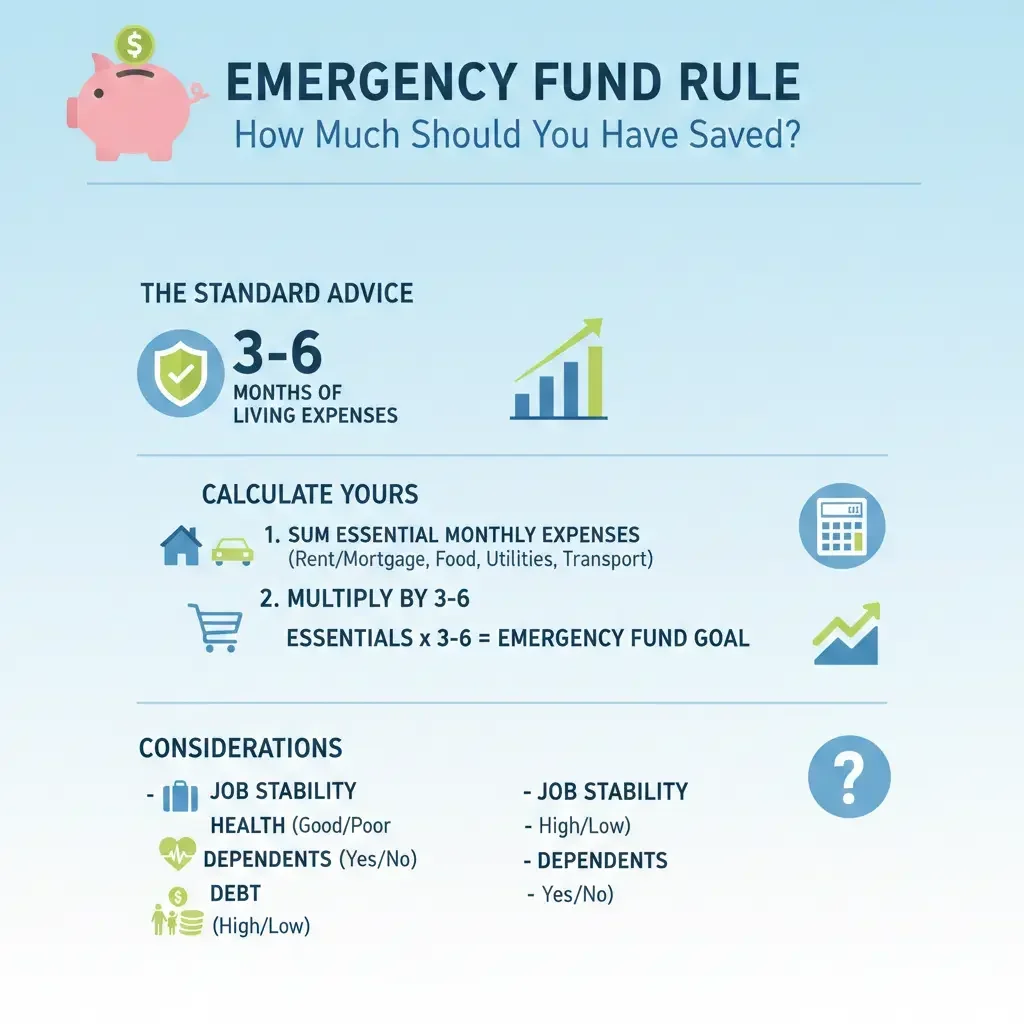
Financial experts have long recommended keeping three to six months of essential expenses in an easily accessible emergency fund[1]. However, this isn't a one-size-fits-all rule—it's more of a starting point that should reflect your specific situation.
Here's how to calculate your target: Start by identifying your bare-bones monthly expenses—the essentials you absolutely need to cover, such as:
- Rent or mortgage payments
- Utilities
- Groceries
- Insurance premiums
- Minimum debt payments
- Transportation costs
Notice what's not on that list: dining out, entertainment, subscriptions, or luxury purchases. Your emergency fund covers necessities, not your normal lifestyle.
For example, if your essential monthly expenses total $4,000, you'd aim for $12,000 (three months) to $24,000 (six months)[1]. That's a significant amount, which is why many Americans struggle to reach it.
How Much Emergency Fund Do You Really Need?
The amount that makes sense for you depends on several factors. Rather than a single target, think about emergency savings in "risk bands"[1]:
Three Months of Expenses
This amount may be sufficient if you:
- Have a stable, secure job
- Have dual household income
- Have minimal dependents
- Live in a low-cost area
Six Months of Expenses
This is a safer target if you:
- Work in a volatile industry
- Have variable income (freelance, commission-based, seasonal work)
- Support dependents or aging parents
- Have significant medical expenses
- Live in a high-cost area
Nine to Twelve Months of Expenses
This makes sense if you:
- Work in a field with long job searches (specialized professions)
- Have multiple dependents
- Are self-employed or own a business
- Have health conditions requiring ongoing care
The Reality Check: Where Americans Stand in 2026
Let's be honest about the current situation. According to a January 2026 Bankrate survey, only 47% of Americans have enough emergency savings to cover a $1,000 expense[2]. Even more concerning, the average emergency expense is almost $1,700[2].
The numbers get worse when you look at broader trends:
- More than 33% of Americans don't have an emergency fund at all[6]
- Of those who do have one, the median amount saved is just $500[6]
- 56% of Americans have more credit card debt than emergency savings[5]
- 58% of Americans say their emergency savings haven't increased in the past year[5]
If these statistics describe your situation, you're not alone—and you're not failing. Building an emergency fund while managing rising costs for housing, groceries, and insurance is genuinely difficult for many households.
Why Emergency Funds Matter More in 2026
Emergency funds aren't just for job loss anymore. Today's financial shocks include:
- Unexpected medical bills or health emergencies
- Major home or car repairs
- Temporary income loss or reduced hours
- Job transitions or career changes
- Family emergencies requiring travel
- Childcare disruptions
Without an emergency fund, you're likely to turn to credit cards. Consider this real scenario: A $2,000 emergency on a credit card with a 19.99% APR and $50 minimum monthly payment means you'll pay $3,321.85 total—over $1,300 in interest alone[6]. An emergency fund saves you money and stress.
Getting Started: A Practical Approach
If the idea of saving $12,000 to $24,000 feels impossible, here's the truth: you don't need to have the exact right amount before you start protecting yourself[1]. Even $1,000 to $2,500 can stop a short-term emergency from derailing your finances.
Step 1: Start with a Starter Emergency Fund
Begin with a $1,000 starter fund[8]. This covers many common surprises like minor car repairs or unexpected medical expenses. This first step is crucial because it creates the habit and removes the psychological barrier of "I haven't started yet."
Step 2: Automate Your Savings
Set up automatic transfers from your checking account to a dedicated savings account right after payday[6]. You won't miss money you never see in your checking account, and consistency matters more than the amount.
If you have a $400 monthly surplus between income and spending, consider putting $300 toward your emergency fund[6].
Step 3: Capture Windfalls
Don't wait for perfect circumstances. Use financial windfalls to accelerate your emergency fund:
- Tax refunds: If you're expecting a refund in 2026, use it to jump-start your savings[3]
- Bonus paychecks: In months where you receive three paychecks instead of two, save one of them[3]
- Tax refunds and recent legislation: Many people may be getting larger refunds due to recent tax legislation[3]
- Gifts or unexpected income: Bonuses, inheritance, or side gig earnings
Step 4: Build Gradually
You don't need to save $5,000 right away—that's not realistic for most people[3]. Even saving a couple hundred dollars over the rest of 2026 "infinitely decreases the likelihood that you would have to go into debt if you had some sort of unexpected expense"[3].
At just $2 per day, you'll save over $600 by the end of the year[4]. At $50 per day, you can build a $6,000 fund in four months[4].
Step 5: Choose the Right Account
Keep your emergency fund in a separate, easily accessible account—ideally a high-yield savings account. This keeps the money separate from your spending money and earns you interest while you're saving.
Special Considerations for Different Situations
Variable Income
If your income is irregular (freelance work, commission-based, seasonal jobs), automation and visibility matter more. Build flexibility into your target amount and contributions. You might aim for six months rather than three[2].
Living Paycheck to Paycheck
If you're living paycheck to paycheck, focus on saving extra income rather than trying to carve out money from your regular budget. This might mean directing tax refunds, bonuses, or side gig earnings entirely to your emergency fund until you reach your starter goal[6].
Households with Dependents
Single-income households with dependents should aim for six months of expenses rather than three, as you have less income flexibility[4].
FAQ: Emergency Fund Questions Answered
Can I start with just $100?
Absolutely. You can start with $1, and of course you can start with $100. The first $100 matters more than the first $10,000 because it creates the habit[2].
What if I can't reach three months of expenses?
Start with what you can. A $1,000 starter fund is a realistic first goal for most people and covers many common emergencies. Once you reach that, aim for one month of expenses, then two, then three[8].
Should I pay off debt or build emergency savings first?
Build at least a starter emergency fund ($1,000) first. This prevents you from going deeper into debt when an emergency happens. Then you can focus on debt payoff while maintaining your emergency fund.
Where should I keep my emergency fund?
Keep it in a separate, high-yield savings account that earns interest but allows quick access. Don't invest it in stocks or keep it in a CD with withdrawal penalties—you need quick access in an emergency.
What counts as an "emergency"?
True emergencies are unexpected expenses you can't avoid: medical bills, car repairs, job loss, home repairs, or family emergencies. Your emergency fund is not for planned expenses like vacations or holiday shopping.
What if my emergency fund isn't growing?
You're not alone—58% of Americans report that their emergency savings haven't increased in the past year[5]. Focus on consistency over perfection. Even small amounts add up over time, and capturing windfalls (tax refunds, bonuses) can accelerate your progress.
The Bottom Line
You don't need to be perfect to be prepared. Whether you're aiming for three months, six months, or starting with just $1,000, the most important step is beginning today. Your emergency fund creates slack in your financial system, giving you time and space to think instead of just reacting when unexpected expenses happen.
Start with a realistic goal based on your situation. Automate your savings. Capture windfalls. Build gradually. In 2026, with 58% of Americans saying that growing their emergency savings is a priority[5], you're not alone in recognizing this need. The difference between those who succeed and those who don't is action—and you can start today.
Sources & References
- I Asked ChatGPT How Much Emergency Cash I Really Need in 2026 — AOL
- How to Build an Emergency Fund in 2026: A Step-by-Step Guide — Origin
- Americans are struggling to save emergency funds — WTOP
- Yes, You Need An Emergency Fund. Here's How To Start In 2026 — HerMoney
- How Americans are prioritizing money goals in 2026: survey — LiveNow from FOX
- How to build an emergency fund for 2026 — Rocket Loans
- Your 2026 Financial Roadmap — iTHINK Financial
Related Articles

How to Invest Your First $1;000: A Beginner’s Guide to the S&P 500
Imagine turning your hard-earned $1,000 into a foundation for long-term wealth without needing a finance degree or Wall Street connections. For beginners in the United States, investing in the S&P 500...

How to Protect Your Savings from Inflation in 2026
Inflation doesn't have to erode your hard-earned savings. In 2026, with economic shifts like moderating shelter costs and persistent pressures on everyday expenses, Americans can take proactive steps...

The Best Ways to Invest in Gold and Precious Metals in 2026
Gold delivered one of its strongest performances in decades during 2025, rising approximately 70% and hitting over 50 all-time highs[6]. As we move into 2026, financial experts across major institutio...

The Best Online Brokerages for Day Trading in 2026
Day trading offers Americans the thrill of capturing quick market moves, but success hinges on choosing the right online brokerage with lightning-fast execution, low fees, and robust tools. In 2026, t...