How to Protect Your Identity Online: A 2026 Financial Security Guide
Imagine checking your bank account only to find thousands of dollars drained by a thief halfway across the world, all because they cloned your voice from a social media video. In 2026, identity theft...
The Lifetimes America editorial team curates, fact-checks, and updates guides on personal finance, property, health, immigration, legal, business, and lifestyle topics relevant to Lifetimes America readers. Articles are produced with AI assistance and reviewed by the editorial team before publication.
Imagine checking your bank account only to find thousands of dollars drained by a thief halfway across the world, all because they cloned your voice from a social media video. In 2026, identity theft isn't just a risk—it's a daily battle fueled by AI deepfakes and synthetic identities. With over 1.1 million Americans falling victim to identity fraud in 2025 alone, protecting your financial life online has never been more critical. This guide equips you with practical steps, U.S.-specific tools, and 2026 trends to safeguard your identity and secure your banking and accounts.
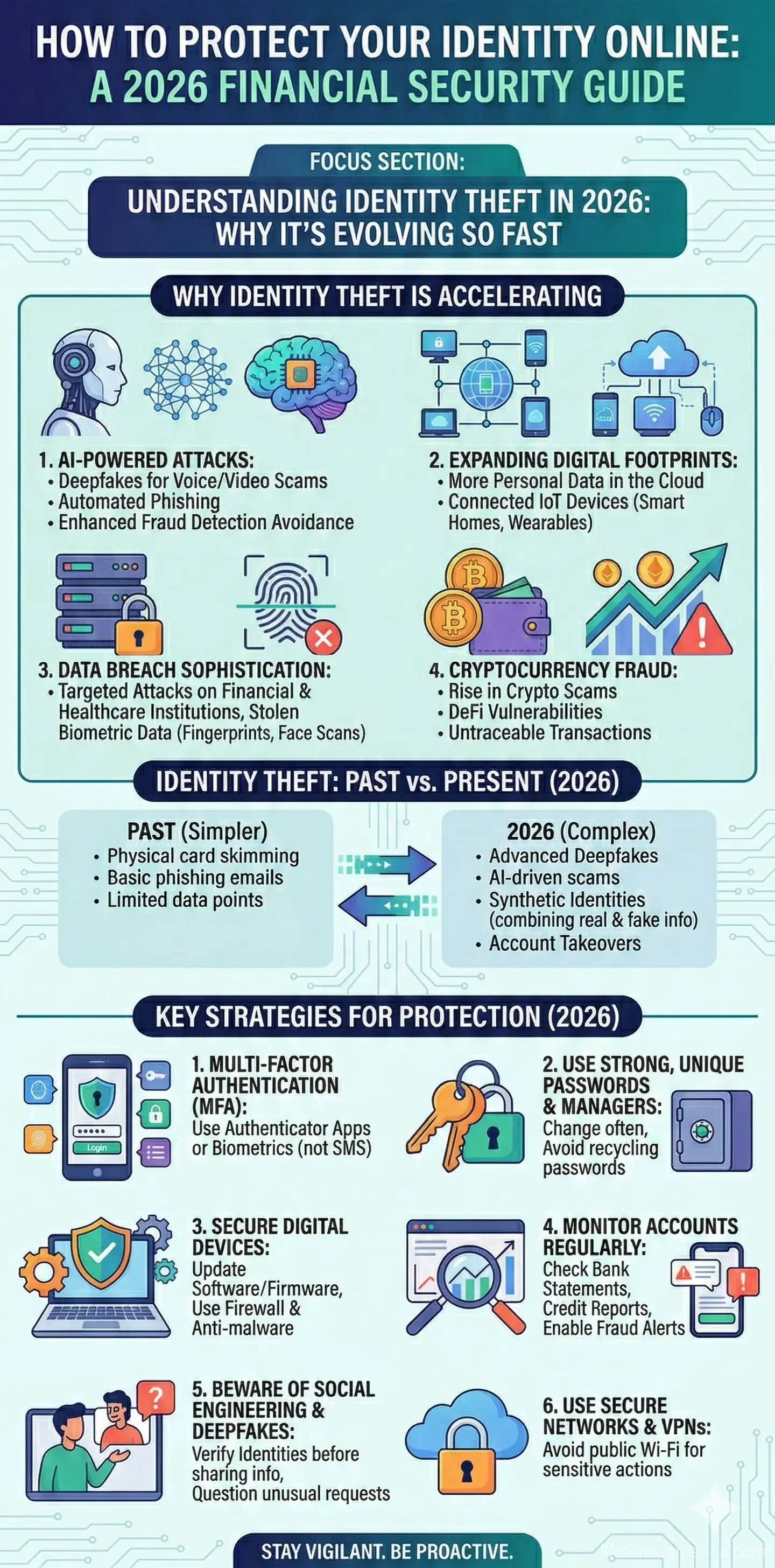
Understanding Identity Theft in 2026: Why It's Evolving So Fast
Identity theft occurs when criminals steal your personal information—like Social Security numbers, bank details, or biometrics—to commit fraud. In 2026, AI has supercharged these threats: deepfakes, voice cloning, and AI-driven phishing make attacks more convincing and harder to spot. Traditional defenses like passwords are obsolete against bots that solve CAPTCHAs better than humans.
The shift to cloud banking and remote work has blurred security perimeters, turning your smartphone into the new front line. Financial losses hit $12.5 billion in 2025, with synthetic identities—fake profiles blending real and fabricated data—now the fastest-growing fraud type. For Americans, this means higher premiums on cybersecurity insurance unless you adopt multifactor authentication (MFA) and continuous verification.
Key Threats Targeting U.S. Bank Accounts
- AI-Powered Social Engineering: Phishing emails and calls mimic your bank, using voice cloning from public videos.
- Deepfake Fraud: Video or audio fakes bypass video verification for account changes.
- Non-Human Identities: Hacked API keys or service accounts drain 401(k)s and IRAs silently.
- Dark Web Leaks: Stolen data from breaches sells for pennies, fueling account takeovers.
Federal laws like the FTC's Identity Theft Affidavit and FCRA give you rights to freeze credit for free at Equifax, Experian, and TransUnion. Act fast—report to IdentityTheft.gov within 24 hours of suspicion.
Step-by-Step: How to Protect Your Identity Online
Start with these actionable strategies tailored for 2026's threats. Focus on prevention to avoid the headache of restoration.
1. Enable Multifactor Authentication (MFA) Everywhere
MFA adds layers beyond passwords—think app approvals, biometrics, or hardware keys. In 2026, it's non-negotiable; many banks like Chase and Bank of America require it for high-risk logins. Opt for app-based (e.g., Google Authenticator) over SMS, as SIM-swapping scams plague U.S. carriers.
- Turn on MFA for banking apps, email, and IRS.gov accounts.
- Use FIDO2 hardware keys like YubiKey for passwordless logins—quantum-resistant and phishing-proof.
2. Adopt Zero Trust and Continuous Verification
Zero Trust means "never trust, always verify"—no automatic access, even from your device. Tools like Microsoft Entra ID monitor behavior in real-time, flagging odd logins from new locations. For personal use, enable this in your Google or Apple accounts.
Continuous Access Evaluation Protocol (CAEP) checks risks ongoing, revoking access if anomalies appear—like sudden logins from overseas. Banks are rolling this out post-2025 regulations.
3. Use Biometrics and Liveness Detection
Biometrics like Face ID or fingerprint scans differentiate you from AI bots. In 2026, passive liveness detection spots deepfakes by analyzing micro-movements or pulse. Apps from Wells Fargo and Capital One now use this for transactions over $1,000.
"Biometrics are the only scalable way to distinguish humans from AI in 2026."
4. Monitor Your Credit and Dark Web Exposure
Freeze your credit for free via AnnualCreditReport.com—weekly checks mandated by law. Services like Aura ($1M insurance, VPN, family plans) or LifeLock scan dark web and three bureaus. Identity Guard's AI spots synthetic IDs early.
| Service | Key Features | Best For |
|---|---|---|
| Aura | $1M insurance, VPN, family coverage | Families |
| LifeLock | Three-bureau monitoring, restoration | Individuals |
| Identity Guard | AI social media scans, old account detection | Social users |
5. Secure Your Devices and Data
Install VPNs (NordVPN via Aura) on public Wi-Fi—essential for mobile banking. Use password managers like LastPass with zero-knowledge encryption. Enable post-quantum encryption where available, as quantum risks loom.
- Update software weekly—patches block 95% of exploits.
- Use antivirus with identity theft alerts (e.g., Norton 360).
- Opt out of data brokers via services like Incogni.
6. Practical Daily Habits for Americans
- Shred mail with SSN; use USPS Informed Delivery.
- Avoid sharing biometrics publicly—lock down Facebook privacy.
- Report lost cards immediately; services like IdentityIQ assist.
- For taxes, use IRS IP PIN to block fraudulent filings.
Frequently Asked Questions
Sources & References
-
1
Identity Protection Is Your New Primary Defense: 5 Key Strategies — www.grassiadvisors.com
-
2
Top 12 Identity Verification Trends 2026 - Regula — regulaforensics.com
-
3
AI, Fraud, and Identity: The Biggest Biometrics Trends for 2026 — www.aware.com
-
4
Best Identity Theft Protection Services of 2026 - Security.org — www.security.org
-
5
Data Protection Strategies for 2026: Zero Trust and AI Security — hyperproof.io
-
6
What is Identity Security? 2026 Guide | Strata.io — www.strata.io
-
7
Why Identity Protection Will Define Cybersecurity in 2026 - rf IDEAS — www.rfideas.com
Related Articles
How to Handle "Identity Theft" in 2026: The First 24 Hours
Imagine checking your bank account on a quiet Saturday evening, only to discover unauthorized charges totaling thousands of dollars—or worse, spotting a new credit card opened in your name. In 2026, i...
The Best "Digital Banking" Apps for US Teens: A Parent's Guide
Imagine handing your teen a debit card that teaches them financial responsibility without the risk of overdrafts or debt. In 2026, digital banking apps make this possible, giving US parents powerful t...
The Best Online Banks with No Monthly Fees in 2026
Imagine ditching those pesky monthly bank fees that quietly eat into your budget every single month. In 2026, online banks make it easier than ever for Americans to enjoy truly free checking accounts...

How to Start an Emergency Fund from Scratch: $1 to $1;000
Picture this: Your car breaks down on the way to work, or an unexpected medical bill lands in your mailbox. Without a safety net, you're scrambling for credit cards or loans with sky-high interest rat...